


题目描述
给你一个正整数 n ,表示总共有 n 个城市,城市从 1 到 n 编号。给你一个二维数组 roads ,其中 roads[i] = [ai, bi, distancei] 表示城市 ai 和 bi 之间有一条 双向 道路,道路距离为 distancei 。城市构成的图不一定是连通的。
两个城市之间一条路径的 分数 定义为这条路径中道路的 最小 距离。
返回城市 1 和城市 n 之间的所有路径的 最小 分数。
注意:
- 一条路径指的是两个城市之间的道路序列。
- 一条路径可以 多次 包含同一条道路,你也可以沿着路径多次到达城市
1 和城市 n 。 - 测试数据保证城市
1 和城市n 之间 至少 有一条路径。
示例 1:
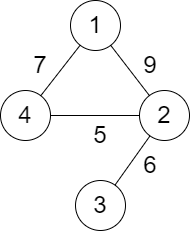
输入:n = 4, roads = [[1,2,9],[2,3,6],[2,4,5],[1,4,7]]
输出:5
解释:城市 1 到城市 4 的路径中,分数最小的一条为:1 -> 2 -> 4 。这条路径的分数是 min(9,5) = 5 。
不存在分数更小的路径。
示例 2:
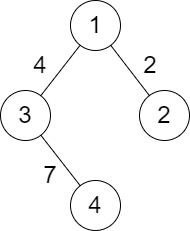
输入:n = 4, roads = [[1,2,2],[1,3,4],[3,4,7]]
输出:2
解释:城市 1 到城市 4 分数最小的路径是:1 -> 2 -> 1 -> 3 -> 4 。这条路径的分数是 min(2,2,4,7) = 2 。
提示:
2 <= n <= 1051 <= roads.length <= 105roads[i].length == 31 <= ai, bi <= nai != bi1 <= distancei <= 104- 不会有重复的边。
- 城市
1 和城市 n 之间至少有一条路径。
解法
方法一:DFS
根据题目描述,每条边可以经过多次,并且保证节点 \(1\) 和节点 \(n\) 在同一个连通块中。因此,题目实际上求的是节点 \(1\) 所在连通块中的最小边权。
我们首先根据 \(\textit{roads}\) 构建无向图 \(g\),然后从节点 \(1\) 开始 DFS。在遍历连通块的过程中,对每条经过的边用 \(\textit{ans} = \min(\textit{ans}, w)\) 更新答案。
时间复杂度 \(O(n + m)\),空间复杂度 \(O(n + m)\)。其中 \(n\) 和 \(m\) 分别是节点数和边数。
 1
 2
 3
 4
 5
 6
 7
 8
 9
10
11
12
13
14
15
16
17
18 | class Solution:
def minScore(self, n: int, roads: List[List[int]]) -> int:
def dfs(a: int):
vis[a] = True
nonlocal ans
for b, w in g[a]:
ans = min(ans, w)
if not vis[b]:
dfs(b)
g = [[] for _ in range(n + 1)]
for a, b, w in roads:
g[a].append((b, w))
g[b].append((a, w))
ans = inf
vis = [False] * (n + 1)
dfs(1)
return ans
|
 1
 2
 3
 4
 5
 6
 7
 8
 9
10
11
12
13
14
15
16
17
18
19
20
21
22
23
24
25
26
27
28
29
30
31
32
33 | class Solution {
private int ans;
private boolean[] vis;
private List<int[]>[] g;
public int minScore(int n, int[][] roads) {
g = new ArrayList[n + 1];
Arrays.setAll(g, k -> new ArrayList<>());
for (int[] e : roads) {
int a = e[0], b = e[1], w = e[2];
g[a].add(new int[]{b, w});
g[b].add(new int[]{a, w});
}
ans = Integer.MAX_VALUE;
vis = new boolean[n + 1];
dfs(1);
return ans;
}
private void dfs(int a) {
vis[a] = true;
for (int[] nb : g[a]) {
int b = nb[0], w = nb[1];
ans = Math.min(ans, w);
if (!vis[b]) {
dfs(b);
}
}
}
}
|
 1
 2
 3
 4
 5
 6
 7
 8
 9
10
11
12
13
14
15
16
17
18
19
20
21
22
23
24
25
26
27 | class Solution {
public:
int minScore(int n, vector<vector<int>>& roads) {
vector<vector<pair<int,int>>> g(n + 1);
for (auto &e : roads) {
int a = e[0], b = e[1], w = e[2];
g[a].push_back({b, w});
g[b].push_back({a, w});
}
vector<bool> vis(n + 1, false);
int ans = INT_MAX;
auto dfs = [&](this auto&& dfs, int a) -> void {
vis[a] = true;
for (auto &[b, w] : g[a]) {
ans = min(ans, w);
if (!vis[b]) {
dfs(b);
}
}
};
dfs(1);
return ans;
}
};
|
 1
 2
 3
 4
 5
 6
 7
 8
 9
10
11
12
13
14
15
16
17
18
19
20
21
22
23
24
25
26 | func minScore(n int, roads [][]int) int {
g := make([][][2]int, n+1)
for _, e := range roads {
a, b, w := e[0], e[1], e[2]
g[a] = append(g[a], [2]int{b, w})
g[b] = append(g[b], [2]int{a, w})
}
vis := make([]bool, n+1)
ans := int(1e9)
var dfs func(int)
dfs = func(a int) {
vis[a] = true
for _, nb := range g[a] {
b, w := nb[0], nb[1]
ans = min(ans, w)
if !vis[b] {
dfs(b)
}
}
}
dfs(1)
return ans
}
|
 1
 2
 3
 4
 5
 6
 7
 8
 9
10
11
12
13
14
15
16
17
18
19
20
21
22
23 | function minScore(n: number, roads: number[][]): number {
const g: [number, number][][] = Array.from({ length: n + 1 }, () => []);
for (const [a, b, w] of roads) {
g[a].push([b, w]);
g[b].push([a, w]);
}
const vis = new Array(n + 1).fill(false);
let ans = Infinity;
const dfs = (a: number): void => {
vis[a] = true;
for (const [b, w] of g[a]) {
ans = Math.min(ans, w);
if (!vis[b]) {
dfs(b);
}
}
};
dfs(1);
return ans;
}
|
 1
 2
 3
 4
 5
 6
 7
 8
 9
10
11
12
13
14
15
16
17
18
19
20
21
22
23
24
25
26
27
28
29
30
31
32
33
34
35
36 | impl Solution {
pub fn min_score(n: i32, roads: Vec<Vec<i32>>) -> i32 {
let n = n as usize;
let mut g: Vec<Vec<(usize, i32)>> = vec![vec![]; n + 1];
for e in roads {
let a = e[0] as usize;
let b = e[1] as usize;
let w = e[2];
g[a].push((b, w));
g[b].push((a, w));
}
let mut vis = vec![false; n + 1];
let mut ans = i32::MAX;
fn dfs(
a: usize,
g: &Vec<Vec<(usize, i32)>>,
vis: &mut Vec<bool>,
ans: &mut i32,
) {
vis[a] = true;
for &(b, w) in &g[a] {
*ans = (*ans).min(w);
if !vis[b] {
dfs(b, g, vis, ans);
}
}
}
dfs(1, &g, &mut vis, &mut ans);
ans
}
}
|
 1
 2
 3
 4
 5
 6
 7
 8
 9
10
11
12
13
14
15
16
17
18
19
20
21
22
23
24
25
26
27 | /**
* @param {number} n
* @param {number[][]} roads
* @return {number}
*/
var minScore = function (n, roads) {
const g = Array.from({ length: n + 1 }, () => []);
for (const [a, b, w] of roads) {
g[a].push([b, w]);
g[b].push([a, w]);
}
const vis = new Array(n + 1).fill(false);
let ans = Infinity;
const dfs = a => {
vis[a] = true;
for (const [b, w] of g[a]) {
ans = Math.min(ans, w);
if (!vis[b]) dfs(b);
}
};
dfs(1);
return ans;
};
|
方法二:BFS
我们也可以用 BFS 来求解。将节点 \(1\) 加入队列,逐层扩展与节点 \(1\) 连通的子图,每次访问边时用 \(\textit{ans} = \min(\textit{ans}, w)\) 更新答案。
时间复杂度 \(O(n + m)\),空间复杂度 \(O(n + m)\)。其中 \(n\) 和 \(m\) 分别是节点数和边数。
 1
 2
 3
 4
 5
 6
 7
 8
 9
10
11
12
13
14
15
16
17
18
19 | class Solution:
def minScore(self, n: int, roads: List[List[int]]) -> int:
g = [[] for _ in range(n + 1)]
for a, b, w in roads:
g[a].append((b, w))
g[b].append((a, w))
vis = [False] * (n + 1)
vis[1] = True
ans = inf
q = deque([1])
while q:
for _ in range(len(q)):
a = q.popleft()
for b, w in g[a]:
ans = min(ans, w)
if not vis[b]:
vis[b] = True
q.append(b)
return ans
|
 1
 2
 3
 4
 5
 6
 7
 8
 9
10
11
12
13
14
15
16
17
18
19
20
21
22
23
24
25
26
27
28
29
30
31
32
33 | class Solution {
public int minScore(int n, int[][] roads) {
List<int[]>[] g = new ArrayList[n + 1];
Arrays.setAll(g, k -> new ArrayList<>());
for (int[] e : roads) {
int a = e[0], b = e[1], w = e[2];
g[a].add(new int[] {b, w});
g[b].add(new int[] {a, w});
}
boolean[] vis = new boolean[n + 1];
Deque<Integer> q = new ArrayDeque<>();
q.offer(1);
vis[1] = true;
int ans = Integer.MAX_VALUE;
while (!q.isEmpty()) {
for (int k = q.size(); k > 0; --k) {
int a = q.pollFirst();
for (int[] nb : g[a]) {
int b = nb[0], w = nb[1];
ans = Math.min(ans, w);
if (!vis[b]) {
vis[b] = true;
q.offer(b);
}
}
}
}
return ans;
}
}
|
 1
 2
 3
 4
 5
 6
 7
 8
 9
10
11
12
13
14
15
16
17
18
19
20
21
22
23
24
25
26
27
28
29
30
31 | class Solution {
public:
int minScore(int n, vector<vector<int>>& roads) {
vector<vector<pair<int, int>>> g(n + 1);
for (auto& e : roads) {
int a = e[0], b = e[1], w = e[2];
g[a].push_back({b, w});
g[b].push_back({a, w});
}
vector<bool> vis(n + 1, false);
int ans = INT_MAX;
queue<int> q{{1}};
vis[1] = true;
while (!q.empty()) {
for (int k = q.size(); k; --k) {
int a = q.front();
q.pop();
for (auto [b, w] : g[a]) {
ans = min(ans, w);
if (!vis[b]) {
vis[b] = true;
q.push(b);
}
}
}
}
return ans;
}
};
|
 1
 2
 3
 4
 5
 6
 7
 8
 9
10
11
12
13
14
15
16
17
18
19
20
21
22
23
24
25
26
27
28
29 | func minScore(n int, roads [][]int) int {
g := make([][][2]int, n+1)
for _, e := range roads {
a, b, w := e[0], e[1], e[2]
g[a] = append(g[a], [2]int{b, w})
g[b] = append(g[b], [2]int{a, w})
}
vis := make([]bool, n+1)
ans := int(1e9)
q := []int{1}
vis[1] = true
for len(q) > 0 {
for k := len(q); k > 0; k-- {
a := q[0]
q = q[1:]
for _, nb := range g[a] {
b, w := nb[0], nb[1]
ans = min(ans, w)
if !vis[b] {
vis[b] = true
q = append(q, b)
}
}
}
}
return ans
}
|
 1
 2
 3
 4
 5
 6
 7
 8
 9
10
11
12
13
14
15
16
17
18
19
20
21
22
23
24
25
26
27 | function minScore(n: number, roads: number[][]): number {
const g: [number, number][][] = Array.from({ length: n + 1 }, () => []);
for (const [a, b, w] of roads) {
g[a].push([b, w]);
g[b].push([a, w]);
}
const vis = new Array(n + 1).fill(false);
let ans = Infinity;
let q: number[] = [1];
vis[1] = true;
while (q.length > 0) {
const nq: number[] = [];
for (const a of q) {
for (const [b, w] of g[a]) {
ans = Math.min(ans, w);
if (!vis[b]) {
vis[b] = true;
nq.push(b);
}
}
}
q = nq;
}
return ans;
}
|
 1
 2
 3
 4
 5
 6
 7
 8
 9
10
11
12
13
14
15
16
17
18
19
20
21
22
23
24
25
26
27
28
29
30
31
32
33
34
35
36 | use std::collections::VecDeque;
impl Solution {
pub fn min_score(n: i32, roads: Vec<Vec<i32>>) -> i32 {
let n = n as usize;
let mut g: Vec<Vec<(usize, i32)>> = vec![vec![]; n + 1];
for e in roads {
let a = e[0] as usize;
let b = e[1] as usize;
let w = e[2];
g[a].push((b, w));
g[b].push((a, w));
}
let mut vis = vec![false; n + 1];
let mut ans = i32::MAX;
let mut q = VecDeque::new();
q.push_back(1);
vis[1] = true;
while !q.is_empty() {
for _ in 0..q.len() {
let a = q.pop_front().unwrap();
for &(b, w) in &g[a] {
ans = ans.min(w);
if !vis[b] {
vis[b] = true;
q.push_back(b);
}
}
}
}
ans
}
}
|
 1
 2
 3
 4
 5
 6
 7
 8
 9
10
11
12
13
14
15
16
17
18
19
20
21
22
23
24
25
26
27
28
29
30
31
32
33 | /**
* @param {number} n
* @param {number[][]} roads
* @return {number}
*/
var minScore = function (n, roads) {
const g = Array.from({ length: n + 1 }, () => []);
for (const [a, b, w] of roads) {
g[a].push([b, w]);
g[b].push([a, w]);
}
const vis = new Array(n + 1).fill(false);
let ans = Infinity;
let q = [1];
vis[1] = true;
while (q.length > 0) {
const nq = [];
for (const a of q) {
for (const [b, w] of g[a]) {
ans = Math.min(ans, w);
if (!vis[b]) {
vis[b] = true;
nq.push(b);
}
}
}
q = nq;
}
return ans;
};
|