难度中等
题目描述
有 n 种单位,编号从 0 到 n - 1。
给定一个二维整数数组 conversions,长度为 n - 1,其中 conversions[i] = [sourceUniti, targetUniti, conversionFactori] ,表示一个 sourceUniti 类型的单位等于 conversionFactori 个 targetUniti 类型的单位。
同时给定一个长度为 q 的 2 维整数数组 queries,其中 queries[i] = [unitAi, unitBi]。
返回一个长度为 q 的数组 answer,其中 answer[i] 表示多少个 unitBi 类型的单位等于 1 个 unitAi 类型的单位,并且当 p 和 q 互质的时候可以表示为 p/q。以 pq-1 返回每个 answer[i] 对 109 + 7 取模 的值,其中 q-1 表示 q 模 109 + 7 的乘法逆元。
示例 1:
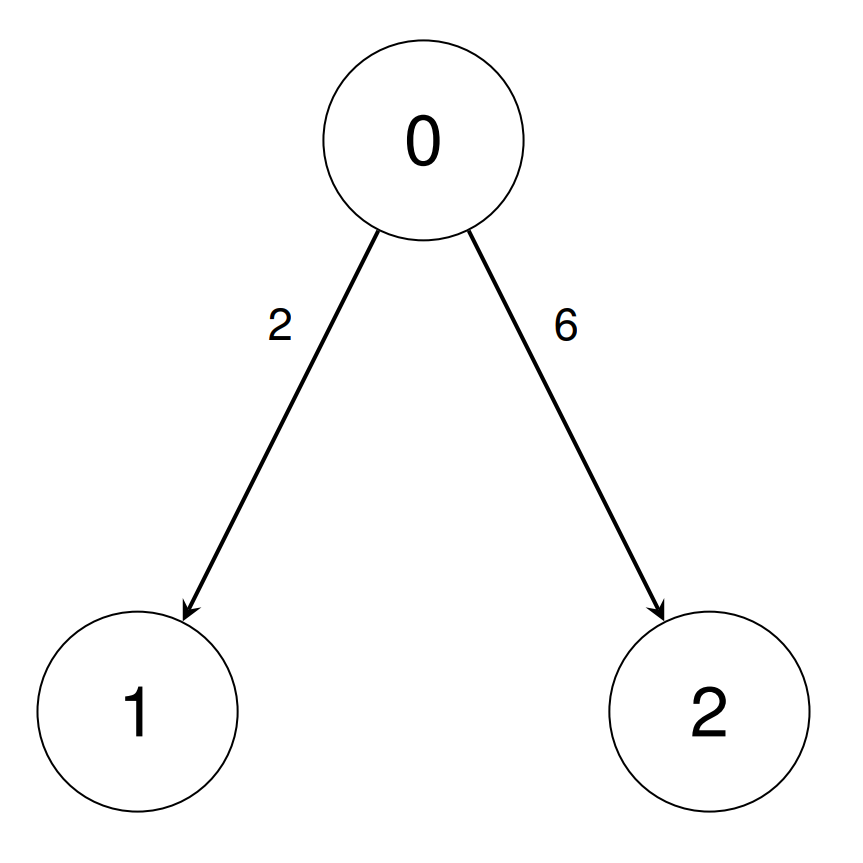
输入:conversions = [[0,1,2],[0,2,6]], queries = [[1,2],[1,0]]
输出:[3,500000004]
解释:
- 在第一次查询中,我们可以反向使用
conversions[0],然后使用 conversions[1] 将单位 1 转换为 3 个单位的类型 2。 - 在第二次查询中,我们可以反向使用
conversions[0] 将单位 1 转换为 1/2 个单位的类型 0。我们返回 500000004 因为它是 2 的乘法逆元。
示例 2:
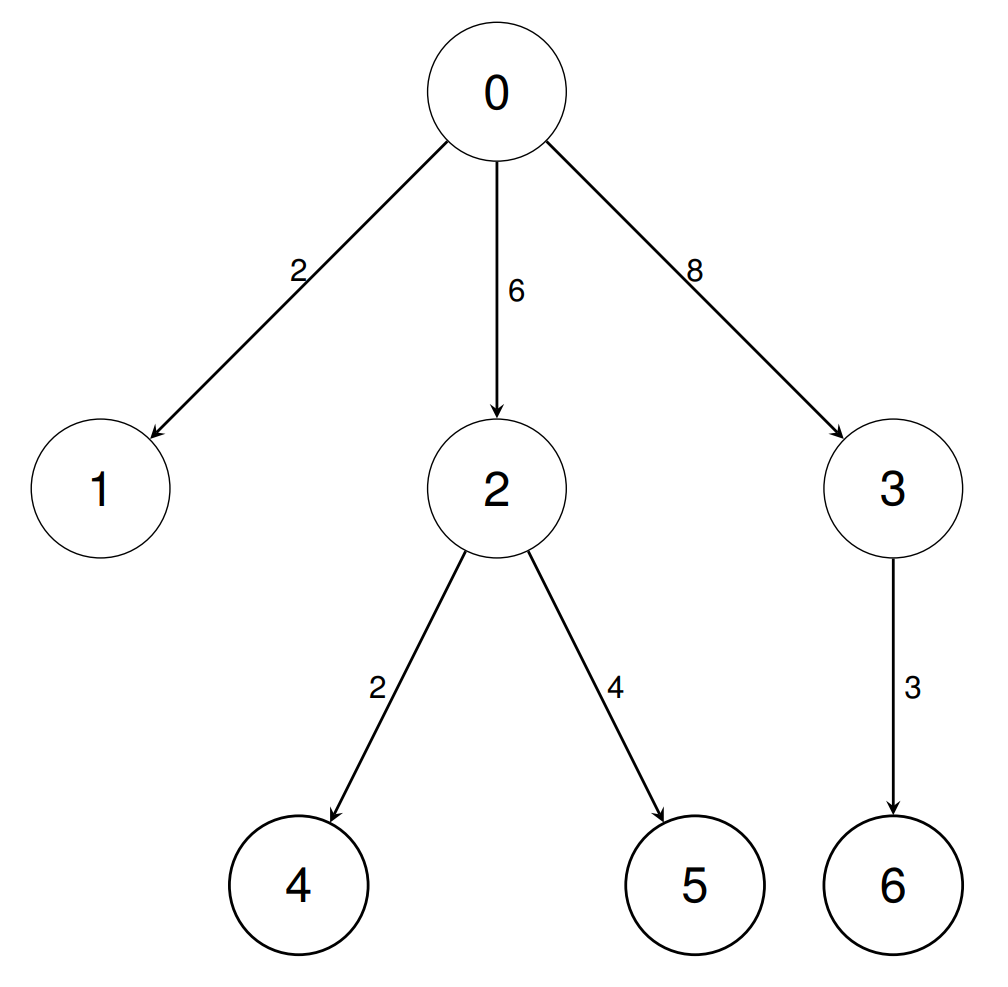
输入:conversions = [[0,1,2],[0,2,6],[0,3,8],[2,4,2],[2,5,4],[3,6,3]], queries = [[1,2],[0,4],[6,5],[4,6],[6,1]]
输出:[3,12,1,2,83333334]
解释:
- 在第一次查询中,我们可以反向使用
conversions[0],然后使用 conversions[1] 将单位 1 转换为 3 个单位的类型 2。 - 在第二次查询中,我们可以使用
conversions[1],然后使用 conversions[3] 将单位 0 转换为 12 个单位的类型 4。 - 在第三次查询中,我们可以使用
conversions[5],反向使用 conversions[2],conversions[1],然后使用 conversions[4] 将单位 6 转换为 1 个单位的类型 5。 - 在第四次查询中,我们可以反向使用
conversions[3],反向使用 conversions[1],conversions[2],然后使用 conversions[5] 将单位 4 转换为 2 个单位的类型 6。 - 在第五次查询中,我们可以反向使用
conversions[5],反向使用 conversions[2],然后使用 conversions[0] 将单位 6 转换为 1/12 个单位的类型 1。我们返回 83333334 因为它是 12 的乘法逆元。
提示:
2 <= n <= 105conversions.length == n - 10 <= sourceUniti, targetUniti < n1 <= conversionFactori <= 1091 <= q <= 105queries.length == q0 <= unitAi, unitBi < n- 保证 0 单位可以通过正向或反向转换的组合唯一地转换为任何其他单位。
解法
方法一:DFS + 模逆元
思考
转换树与上一题相同,已能求出 \(1\) 个单位 \(0\) 对应的 \(\textit{res}[i]\)。查询是任意两点之比,而非相对 \(0\)。
\(\textit{unitA}\) 到 \(\textit{unitB}\) 等于 \(\textit{res}[B] \cdot \textit{res}[A]^{-1}\)。模数为素数,用费马小定理 \(a^{MOD-2}\) 求逆。
由题意可知,转换关系构成一棵以 \(0\) 为根的有向树。从根节点 \(0\) 出发 DFS,维护 res[i] 表示 \(1\) 个单位 \(0\) 等于多少个单位 \(i\)。
对于查询 \((unitA, unitB)\),答案为 \(\frac{res[unitB]}{res[unitA]}\),对 \(10^9 + 7\) 取模即 res[unitB] * res[unitA]^(MOD - 2) % MOD,其中 MOD - 2 利用费马小定理求模逆。
时间复杂度 \(O(n + q \log MOD)\),空间复杂度 \(O(n)\)。其中 \(n\) 为单位种类数,而 \(q\) 为查询次数。
 1
 2
 3
 4
 5
 6
 7
 8
 9
10
11
12
13
14
15
16
17
18
19
20 | class Solution:
def queryConversions(
self, conversions: List[List[int]], queries: List[List[int]]
) -> List[int]:
def dfs(s: int, mul: int) -> None:
res[s] = mul
for t, w in g[s]:
dfs(t, mul * w % mod)
mod = 10**9 + 7
n = len(conversions) + 1
g = [[] for _ in range(n)]
for s, t, w in conversions:
g[s].append((t, w))
res = [0] * n
dfs(0, 1)
ans = []
for x, y in queries:
ans.append(res[y] * pow(res[x], mod - 2, mod) % mod)
return ans
|
 1
 2
 3
 4
 5
 6
 7
 8
 9
10
11
12
13
14
15
16
17
18
19
20
21
22
23
24
25
26
27
28
29
30
31
32
33
34
35
36
37
38
39
40
41
42
43 | class Solution {
private final int mod = (int) 1e9 + 7;
private List<int[]>[] g;
private int[] res;
public int[] queryConversions(int[][] conversions, int[][] queries) {
int n = conversions.length + 1;
g = new List[n];
Arrays.setAll(g, k -> new ArrayList<>());
for (var e : conversions) {
g[e[0]].add(new int[] {e[1], e[2]});
}
res = new int[n];
dfs(0, 1);
int[] ans = new int[queries.length];
for (int i = 0; i < queries.length; i++) {
int x = queries[i][0], y = queries[i][1];
ans[i] = (int) ((long) res[y] * qpow(res[x], mod - 2) % mod);
}
return ans;
}
private void dfs(int s, long mul) {
res[s] = (int) mul;
for (var e : g[s]) {
dfs(e[0], mul * e[1] % mod);
}
}
private long qpow(long x, int n) {
long res = 1;
while (n > 0) {
if ((n & 1) == 1) {
res = res * x % mod;
}
x = x * x % mod;
n >>= 1;
}
return res;
}
}
|
 1
 2
 3
 4
 5
 6
 7
 8
 9
10
11
12
13
14
15
16
17
18
19
20
21
22
23
24
25
26
27
28
29
30
31
32
33
34
35
36
37
38
39 | class Solution {
public:
vector<int> queryConversions(vector<vector<int>>& conversions, vector<vector<int>>& queries) {
const int mod = 1e9 + 7;
int n = conversions.size() + 1;
vector<vector<pair<int, int>>> g(n);
for (auto& e : conversions) {
g[e[0]].emplace_back(e[1], e[2]);
}
vector<int> res(n);
auto dfs = [&](this auto&& dfs, int s, long long mul) -> void {
res[s] = mul;
for (auto [t, w] : g[s]) {
dfs(t, mul * w % mod);
}
};
dfs(0, 1);
auto qpow = [&](long long x, int n) {
long long res = 1;
while (n) {
if (n & 1) {
res = res * x % mod;
}
x = x * x % mod;
n >>= 1;
}
return res;
};
vector<int> ans;
for (auto& q : queries) {
ans.push_back(res[q[1]] * qpow(res[q[0]], mod - 2) % mod);
}
return ans;
}
};
|
 1
 2
 3
 4
 5
 6
 7
 8
 9
10
11
12
13
14
15
16
17
18
19
20
21
22
23
24
25
26
27
28
29
30
31
32
33
34
35
36
37
38
39 | func queryConversions(conversions [][]int, queries [][]int) []int {
const mod = int(1e9 + 7)
n := len(conversions) + 1
g := make([][]struct{ t, w int }, n)
for _, e := range conversions {
s, t, w := e[0], e[1], e[2]
g[s] = append(g[s], struct{ t, w int }{t, w})
}
res := make([]int, n)
var dfs func(int, int)
dfs = func(s, mul int) {
res[s] = mul
for _, e := range g[s] {
dfs(e.t, mul*e.w%mod)
}
}
dfs(0, 1)
qpow := func(x, n int) int {
res := 1
for n > 0 {
if n&1 > 0 {
res = res * x % mod
}
x = x * x % mod
n >>= 1
}
return res
}
ans := make([]int, len(queries))
for i, q := range queries {
ans[i] = res[q[1]] * qpow(res[q[0]], mod-2) % mod
}
return ans
}
|
 1
 2
 3
 4
 5
 6
 7
 8
 9
10
11
12
13
14
15
16
17
18
19
20
21
22
23
24
25
26
27
28
29
30
31
32
33
34
35
36
37
38 | function queryConversions(conversions: number[][], queries: number[][]): number[] {
const mod = BigInt(1e9 + 7);
const n = conversions.length + 1;
const g: { t: number; w: number }[][] = Array.from({ length: n }, () => []);
for (const [s, t, w] of conversions) {
g[s].push({ t, w });
}
const res: number[] = Array(n).fill(0);
const dfs = (s: number, mul: number): void => {
res[s] = mul;
for (const { t, w } of g[s]) {
dfs(t, Number((BigInt(mul) * BigInt(w)) % mod));
}
};
dfs(0, 1);
const qpow = (x: number, n: number): number => {
let res = 1n;
let a = BigInt(x);
while (n > 0) {
if (n & 1) {
res = (res * a) % mod;
}
a = (a * a) % mod;
n >>= 1;
}
return Number(res);
};
const ans: number[] = [];
for (const [x, y] of queries) {
ans.push(Number((BigInt(res[y]) * BigInt(qpow(res[x], 1e9 + 5))) % mod));
}
return ans;
}
|
 1
 2
 3
 4
 5
 6
 7
 8
 9
10
11
12
13
14
15
16
17
18
19
20
21
22
23
24
25
26
27
28
29
30
31
32
33
34
35
36
37
38
39
40
41
42 | impl Solution {
pub fn query_conversions(conversions: Vec<Vec<i32>>, queries: Vec<Vec<i32>>) -> Vec<i32> {
const MOD: i64 = 1_000_000_007;
let n = conversions.len() + 1;
let mut g = vec![Vec::<(usize, i64)>::new(); n];
for e in conversions {
g[e[0] as usize].push((e[1] as usize, e[2] as i64));
}
let mut res = vec![0_i64; n];
fn dfs(s: usize, mul: i64, g: &Vec<Vec<(usize, i64)>>, res: &mut Vec<i64>) {
res[s] = mul;
for &(t, w) in &g[s] {
dfs(t, mul * w % MOD, g, res);
}
}
dfs(0, 1, &g, &mut res);
fn qpow(mut x: i64, mut n: i32) -> i64 {
let mut res = 1_i64;
while n > 0 {
if n & 1 == 1 {
res = res * x % MOD;
}
x = x * x % MOD;
n >>= 1;
}
res
}
let mut ans = Vec::with_capacity(queries.len());
for q in queries {
let x = q[0] as usize;
let y = q[1] as usize;
ans.push((res[y] * qpow(res[x], 1_000_000_005) % MOD) as i32);
}
ans
}
}
|