二叉搜索树 二叉树 树 深度优先搜索 难度 中等
题目描述 给出二叉 搜索 树的根节点 root,该树的节点值各不相同,请你将其转换为累加树(Greater Sum Tree),将其转换为一个更大的树,使得原始二叉搜索树中的每个节点值都变为原本值加上原本二叉搜索树中所有比该节点值大的节点值的总和。
提醒一下,二叉搜索树满足下列约束条件:
节点的左子树仅包含键 小于 节点键的节点。 节点的右子树仅包含键 大于 节点键的节点。 左右子树也必须是二叉搜索树。 注意: 本题和 1038: https://leetcode.cn/problems/binary-search-tree-to-greater-sum-tree/ 相同
示例 1:
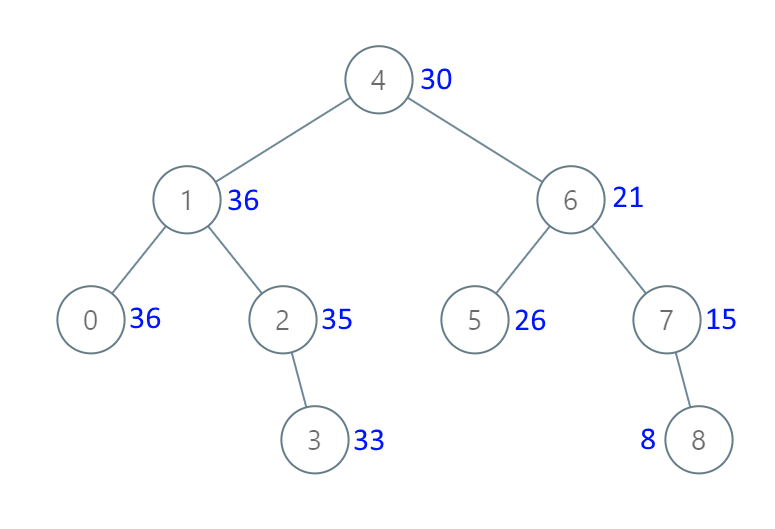
输入: [4,1,6,0,2,5,7,null,null,null,3,null,null,null,8]
输出: [30,36,21,36,35,26,15,null,null,null,33,null,null,null,8]
示例 2:
输入: root = [0,null,1]
输出: [1,null,1]
示例 3:
输入: root = [1,0,2]
输出: [3,3,2]
示例 4:
输入: root = [3,2,4,1]
输出: [7,9,4,10]
提示:
树中的节点数介于 0 和 104 之间。 每个节点的值介于 -104 和 104 之间。 树中的所有值 互不相同 。 给定的树为二叉搜索树。 解法 方法一:递归 思考
把每个节点改成「不小于它的所有值之和」。BST 中这些值正好是反中序(右-根-左)已经走过的节点。
反中序累加到 \(s\) ,再写回当前节点。右子树先于左子树处理,保证用到的都是更大的键。一次遍历完成。
按照“右根左”的顺序,递归遍历二叉搜索树,累加遍历到的所有节点值到 \(s\) 中,然后每次赋值给对应的 node 节点。
时间复杂度 \(O(n)\) ,空间复杂度 \(O(n)\) 。其中 \(n\) 是二叉搜索树的节点数。
Python3 Java C++ Go JavaScript
 1
 2
 3
 4
 5
 6
 7
 8
 9
10
11
12
13
14
15
16
17
18
19
20
# Definition for a binary tree node.
# class TreeNode:
# def __init__(self, val=0, left=None, right=None):
# self.val = val
# self.left = left
# self.right = right
class Solution :
def convertBST ( self , root : TreeNode ) -> TreeNode :
def dfs ( root ):
nonlocal s
if root is None :
return
dfs ( root . right )
s += root . val
root . val = s
dfs ( root . left )
s = 0
dfs ( root )
return root
 1
 2
 3
 4
 5
 6
 7
 8
 9
10
11
12
13
14
15
16
17
18
19
20
21
22
23
24
25
26
27
28
29
30
31
32
33
/**
* Definition for a binary tree node.
* public class TreeNode {
* int val;
* TreeNode left;
* TreeNode right;
* TreeNode() {}
* TreeNode(int val) { this.val = val; }
* TreeNode(int val, TreeNode left, TreeNode right) {
* this.val = val;
* this.left = left;
* this.right = right;
* }
* }
*/
class Solution {
private int s ;
public TreeNode convertBST ( TreeNode root ) {
dfs ( root );
return root ;
}
private void dfs ( TreeNode root ) {
if ( root == null ) {
return ;
}
dfs ( root . right );
s += root . val ;
root . val = s ;
dfs ( root . left );
}
}
 1
 2
 3
 4
 5
 6
 7
 8
 9
10
11
12
13
14
15
16
17
18
19
20
21
22
23
24
25
26
27
28
/**
* Definition for a binary tree node.
* struct TreeNode {
* int val;
* TreeNode *left;
* TreeNode *right;
* TreeNode() : val(0), left(nullptr), right(nullptr) {}
* TreeNode(int x) : val(x), left(nullptr), right(nullptr) {}
* TreeNode(int x, TreeNode *left, TreeNode *right) : val(x), left(left), right(right) {}
* };
*/
class Solution {
public :
int s = 0 ;
TreeNode * convertBST ( TreeNode * root ) {
dfs ( root );
return root ;
}
void dfs ( TreeNode * root ) {
if ( ! root ) return ;
dfs ( root -> right );
s += root -> val ;
root -> val = s ;
dfs ( root -> left );
}
};
 1
 2
 3
 4
 5
 6
 7
 8
 9
10
11
12
13
14
15
16
17
18
19
20
21
22
23
/**
* Definition for a binary tree node.
* type TreeNode struct {
* Val int
* Left *TreeNode
* Right *TreeNode
* }
*/
func convertBST ( root * TreeNode ) * TreeNode {
s := 0
var dfs func ( * TreeNode )
dfs = func ( root * TreeNode ) {
if root == nil {
return
}
dfs ( root . Right )
s += root . Val
root . Val = s
dfs ( root . Left )
}
dfs ( root )
return root
}
 1
 2
 3
 4
 5
 6
 7
 8
 9
10
11
12
13
14
15
16
17
18
19
20
21
22
23
24
25
26
/**
* Definition for a binary tree node.
* function TreeNode(val, left, right) {
* this.val = (val===undefined ? 0 : val)
* this.left = (left===undefined ? null : left)
* this.right = (right===undefined ? null : right)
* }
*/
/**
* @param {TreeNode} root
* @return {TreeNode}
*/
var convertBST = function ( root ) {
let s = 0 ;
function dfs ( root ) {
if ( ! root ) {
return ;
}
dfs ( root . right );
s += root . val ;
root . val = s ;
dfs ( root . left );
}
dfs ( root );
return root ;
};
方法二:Morris 遍历 思考
递归反中序需要 \(O(h)\) 栈。Morris 用右子树的最左空指针暂存后继,把递归栈省掉。
向右走时穿线,回到节点时累加并写回,再拆线向左。访问顺序仍是右-根-左,语义与方法一相同,额外空间为常数。
Morris 遍历无需使用栈,时间复杂度 \(O(n)\) ,空间复杂度为 \(O(1)\) 。核心思想是:
定义 s 表示二叉搜索树节点值累加和。遍历二叉树节点:
若当前节点 root 的右子树为空,将当前节点值添加至 s 中,更新当前节点值为 s,并将当前节点更新为 root.left。 若当前节点 root 的右子树不为空,找到右子树的最左节点 next(也即是 root 节点在中序遍历下的后继节点): 若后继节点 next 的左子树为空,将后继节点的左子树指向当前节点 root,并将当前节点更新为 root.right。 若后继节点 next 的左子树不为空,将当前节点值添加 s 中,更新当前节点值为 s,然后将后继节点左子树指向空(即解除 next 与 root 的指向关系),并将当前节点更新为 root.left。 循环以上步骤,直至二叉树节点为空,遍历结束。 最后返回二叉搜索树根节点即可。 Morris 反序中序遍历跟 Morris 中序遍历思路一致,只是将中序遍历的“左根右”变为“右根左”。
Python3 Java C++ Go
 1
 2
 3
 4
 5
 6
 7
 8
 9
10
11
12
13
14
15
16
17
18
19
20
21
22
23
24
25
26
27
28
# Definition for a binary tree node.
# class TreeNode:
# def __init__(self, val=0, left=None, right=None):
# self.val = val
# self.left = left
# self.right = right
class Solution :
def convertBST ( self , root : TreeNode ) -> TreeNode :
s = 0
node = root
while root :
if root . right is None :
s += root . val
root . val = s
root = root . left
else :
next = root . right
while next . left and next . left != root :
next = next . left
if next . left is None :
next . left = root
root = root . right
else :
s += root . val
root . val = s
next . left = None
root = root . left
return node
 1
 2
 3
 4
 5
 6
 7
 8
 9
10
11
12
13
14
15
16
17
18
19
20
21
22
23
24
25
26
27
28
29
30
31
32
33
34
35
36
37
38
39
40
41
42
43
/**
* Definition for a binary tree node.
* public class TreeNode {
* int val;
* TreeNode left;
* TreeNode right;
* TreeNode() {}
* TreeNode(int val) { this.val = val; }
* TreeNode(int val, TreeNode left, TreeNode right) {
* this.val = val;
* this.left = left;
* this.right = right;
* }
* }
*/
class Solution {
public TreeNode convertBST ( TreeNode root ) {
int s = 0 ;
TreeNode node = root ;
while ( root != null ) {
if ( root . right == null ) {
s += root . val ;
root . val = s ;
root = root . left ;
} else {
TreeNode next = root . right ;
while ( next . left != null && next . left != root ) {
next = next . left ;
}
if ( next . left == null ) {
next . left = root ;
root = root . right ;
} else {
s += root . val ;
root . val = s ;
next . left = null ;
root = root . left ;
}
}
}
return node ;
}
}
 1
 2
 3
 4
 5
 6
 7
 8
 9
10
11
12
13
14
15
16
17
18
19
20
21
22
23
24
25
26
27
28
29
30
31
32
33
34
35
36
37
38
39
40
/**
* Definition for a binary tree node.
* struct TreeNode {
* int val;
* TreeNode *left;
* TreeNode *right;
* TreeNode() : val(0), left(nullptr), right(nullptr) {}
* TreeNode(int x) : val(x), left(nullptr), right(nullptr) {}
* TreeNode(int x, TreeNode *left, TreeNode *right) : val(x), left(left), right(right) {}
* };
*/
class Solution {
public :
TreeNode * convertBST ( TreeNode * root ) {
int s = 0 ;
TreeNode * node = root ;
while ( root ) {
if ( root -> right == nullptr ) {
s += root -> val ;
root -> val = s ;
root = root -> left ;
} else {
TreeNode * next = root -> right ;
while ( next -> left && next -> left != root ) {
next = next -> left ;
}
if ( next -> left == nullptr ) {
next -> left = root ;
root = root -> right ;
} else {
s += root -> val ;
root -> val = s ;
next -> left = nullptr ;
root = root -> left ;
}
}
}
return node ;
}
};
 1
 2
 3
 4
 5
 6
 7
 8
 9
10
11
12
13
14
15
16
17
18
19
20
21
22
23
24
25
26
27
28
29
30
31
32
33
34
/**
* Definition for a binary tree node.
* type TreeNode struct {
* Val int
* Left *TreeNode
* Right *TreeNode
* }
*/
func convertBST ( root * TreeNode ) * TreeNode {
s := 0
node := root
for root != nil {
if root . Right == nil {
s += root . Val
root . Val = s
root = root . Left
} else {
next := root . Right
for next . Left != nil && next . Left != root {
next = next . Left
}
if next . Left == nil {
next . Left = root
root = root . Right
} else {
s += root . Val
root . Val = s
next . Left = nil
root = root . Left
}
}
}
return node
}
方法三:显式栈 思考
把每个结点改成不小于它的所有值之和。二叉搜索树里这些值正好是反中序(右、根、左)已经走过的结点。先递归走右子树再写回,在较短的树上是对的。
结点个数可达 \(10^4\) 。右链使这次遍历按结点个数递归,调用栈会溢出。
累加和只依赖已经访问过的更大的键,每个结点不需要子树的返回值,只要先处理右孩子、再改自己、再处理左孩子。
因此用显式栈做反中序。进入结点时压入退出标记和右孩子;退出时把当前值累加进 \(s\) 并写回,再压入左孩子。
我们用显式栈按“右、根、左”的顺序遍历二叉搜索树。进入结点时压入退出标记和右孩子;退出时把结点值累加到 \(s\) ,再把 \(s\) 写回该结点,然后压入左孩子。
时间复杂度 \(O(n)\) ,空间复杂度 \(O(n)\) 。其中 \(n\) 是二叉搜索树的节点数。
Python3 Java C++ Go JavaScript
 1
 2
 3
 4
 5
 6
 7
 8
 9
10
11
12
13
14
15
16
17
18
19
20
21
22
# Definition for a binary tree node.
# class TreeNode:
# def __init__(self, val=0, left=None, right=None):
# self.val = val
# self.left = left
# self.right = right
class Solution :
def convertBST ( self , root : TreeNode ) -> TreeNode :
s = 0
stk = [( root , 0 )]
while stk :
node , state = stk . pop ()
if node is None :
continue
if state == 0 :
stk . append (( node , 1 ))
stk . append (( node . right , 0 ))
continue
s += node . val
node . val = s
stk . append (( node . left , 0 ))
return root
 1
 2
 3
 4
 5
 6
 7
 8
 9
10
11
12
13
14
15
16
17
18
19
20
21
22
23
24
25
26
27
28
29
30
31
32
33
34
35
36
37
38
39
40
41
42
43
44
45
46
47
48
49
50
51
52
/**
* Definition for a binary tree node.
* public class TreeNode {
* int val;
* TreeNode left;
* TreeNode right;
* TreeNode() {}
* TreeNode(int val) { this.val = val; }
* TreeNode(int val, TreeNode left, TreeNode right) {
* this.val = val;
* this.left = left;
* this.right = right;
* }
* }
*/
class Solution {
private static class Frame {
TreeNode node ;
int state ;
Frame ( TreeNode node , int state ) {
this . node = node ;
this . state = state ;
}
}
public TreeNode convertBST ( TreeNode root ) {
int s = 0 ;
if ( root == null ) {
return null ;
}
Deque < Frame > stk = new ArrayDeque <> ();
stk . push ( new Frame ( root , 0 ));
while ( ! stk . isEmpty ()) {
Frame cur = stk . pop ();
TreeNode node = cur . node ;
if ( cur . state == 0 ) {
stk . push ( new Frame ( node , 1 ));
if ( node . right != null ) {
stk . push ( new Frame ( node . right , 0 ));
}
continue ;
}
s += node . val ;
node . val = s ;
if ( node . left != null ) {
stk . push ( new Frame ( node . left , 0 ));
}
}
return root ;
}
}
 1
 2
 3
 4
 5
 6
 7
 8
 9
10
11
12
13
14
15
16
17
18
19
20
21
22
23
24
25
26
27
28
29
30
31
32
33
34
/**
* Definition for a binary tree node.
* struct TreeNode {
* int val;
* TreeNode *left;
* TreeNode *right;
* TreeNode() : val(0), left(nullptr), right(nullptr) {}
* TreeNode(int x) : val(x), left(nullptr), right(nullptr) {}
* TreeNode(int x, TreeNode *left, TreeNode *right) : val(x), left(left), right(right) {}
* };
*/
class Solution {
public :
TreeNode * convertBST ( TreeNode * root ) {
int s = 0 ;
vector < pair < TreeNode * , int >> stk {{ root , 0 }};
while ( ! stk . empty ()) {
auto [ node , state ] = stk . back ();
stk . pop_back ();
if ( ! node ) {
continue ;
}
if ( state == 0 ) {
stk . emplace_back ( node , 1 );
stk . emplace_back ( node -> right , 0 );
continue ;
}
s += node -> val ;
node -> val = s ;
stk . emplace_back ( node -> left , 0 );
}
return root ;
}
};
 1
 2
 3
 4
 5
 6
 7
 8
 9
10
11
12
13
14
15
16
17
18
19
20
21
22
23
24
25
26
27
28
29
30
31
32
/**
* Definition for a binary tree node.
* type TreeNode struct {
* Val int
* Left *TreeNode
* Right *TreeNode
* }
*/
func convertBST ( root * TreeNode ) * TreeNode {
s := 0
type frame struct {
node * TreeNode
state int
}
stk := [] frame {{ root , 0 }}
for len ( stk ) > 0 {
cur := stk [ len ( stk ) - 1 ]
stk = stk [: len ( stk ) - 1 ]
node , state := cur . node , cur . state
if node == nil {
continue
}
if state == 0 {
stk = append ( stk , frame { node , 1 }, frame { node . Right , 0 })
continue
}
s += node . Val
node . Val = s
stk = append ( stk , frame { node . Left , 0 })
}
return root
}
 1
 2
 3
 4
 5
 6
 7
 8
 9
10
11
12
13
14
15
16
17
18
19
20
21
22
23
24
25
26
27
28
29
30
31
/**
* Definition for a binary tree node.
* function TreeNode(val, left, right) {
* this.val = (val===undefined ? 0 : val)
* this.left = (left===undefined ? null : left)
* this.right = (right===undefined ? null : right)
* }
*/
/**
* @param {TreeNode} root
* @return {TreeNode}
*/
var convertBST = function ( root ) {
let s = 0 ;
const stk = [[ root , 0 ]];
while ( stk . length ) {
const [ node , state ] = stk . pop ();
if ( ! node ) {
continue ;
}
if ( state === 0 ) {
stk . push ([ node , 1 ]);
stk . push ([ node . right , 0 ]);
continue ;
}
s += node . val ;
node . val = s ;
stk . push ([ node . left , 0 ]);
}
return root ;
};
GitHub