来源第 120 场双周赛 Q4难度困难分数2276
题目描述
给你一棵 n 个节点的 无向 树,节点编号为 0 到 n - 1 ,树的根节点在节点 0 处。同时给你一个长度为 n - 1 的二维整数数组 edges ,其中 edges[i] = [ai, bi] 表示树中节点 ai 和 bi 之间有一条边。
给你一个长度为 n 下标从 0 开始的整数数组 cost ,其中 cost[i] 是第 i 个节点的 开销 。
你需要在树中每个节点都放置金币,在节点 i 处的金币数目计算方法如下:
- 如果节点
i 对应的子树中的节点数目小于 3 ,那么放 1 个金币。 - 否则,计算节点
i 对应的子树内 3 个不同节点的开销乘积的 最大值 ,并在节点 i 处放置对应数目的金币。如果最大乘积是 负数 ,那么放置 0 个金币。
请你返回一个长度为 n 的数组 coin ,coin[i]是节点 i 处的金币数目。
示例 1:
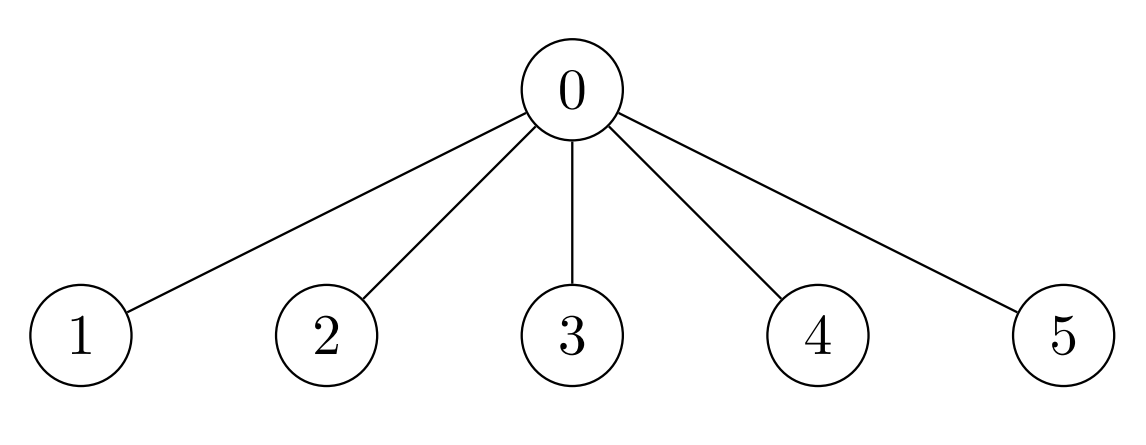
输入:edges = [[0,1],[0,2],[0,3],[0,4],[0,5]], cost = [1,2,3,4,5,6]
输出:[120,1,1,1,1,1]
解释:在节点 0 处放置 6 * 5 * 4 = 120 个金币。所有其他节点都是叶子节点,子树中只有 1 个节点,所以其他每个节点都放 1 个金币。
示例 2:
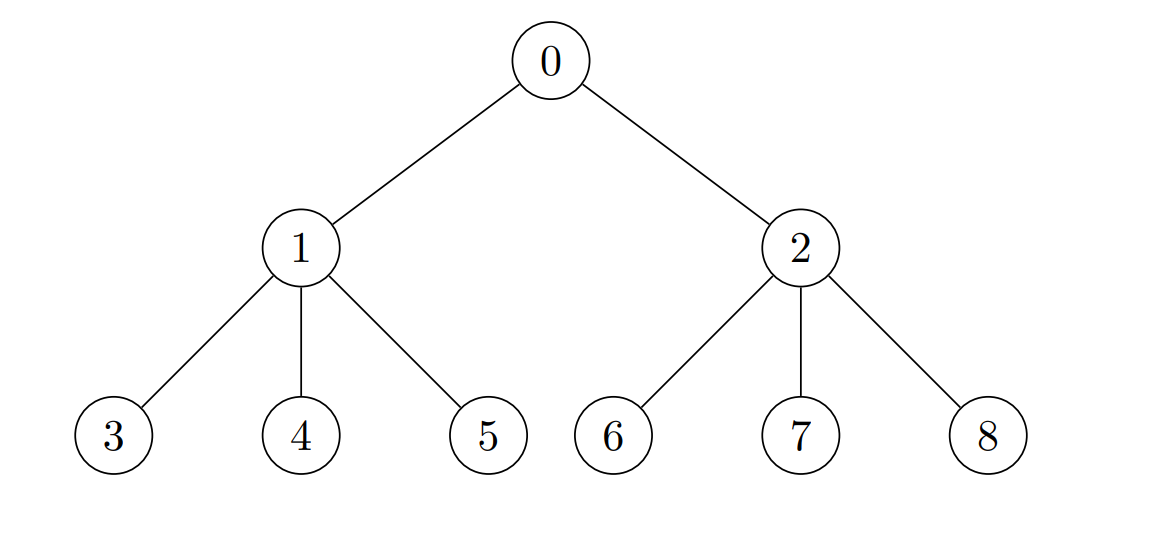
输入:edges = [[0,1],[0,2],[1,3],[1,4],[1,5],[2,6],[2,7],[2,8]], cost = [1,4,2,3,5,7,8,-4,2]
输出:[280,140,32,1,1,1,1,1,1]
解释:每个节点放置的金币数分别为:
- 节点 0 处放置 8 * 7 * 5 = 280 个金币。
- 节点 1 处放置 7 * 5 * 4 = 140 个金币。
- 节点 2 处放置 8 * 2 * 2 = 32 个金币。
- 其他节点都是叶子节点,子树内节点数目为 1 ,所以其他每个节点都放 1 个金币。
示例 3:
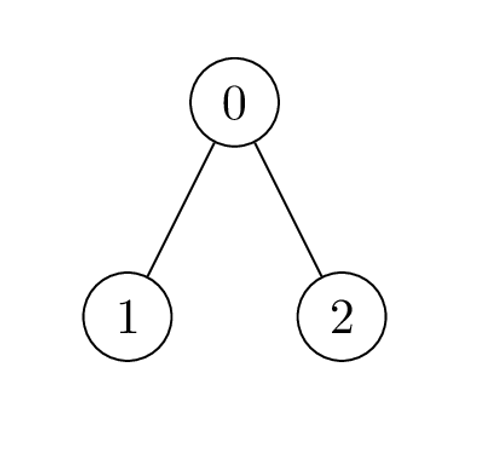
输入:edges = [[0,1],[0,2]], cost = [1,2,-2]
输出:[0,1,1]
解释:节点 1 和 2 都是叶子节点,子树内节点数目为 1 ,各放置 1 个金币。节点 0 处唯一的开销乘积是 2 * 1 * -2 = -4 。所以在节点 0 处放置 0 个金币。
提示:
2 <= n <= 2 * 104edges.length == n - 1edges[i].length == 20 <= ai, bi < ncost.length == n1 <= |cost[i]| <= 104edges 一定是一棵合法的树。
解法
方法一:DFS + 排序
思考
子树不足三个节点则放 \(1\);否则放三个 \(\textit{cost}\) 乘积的最大值(若为负则 \(0\))。乘积最大只可能来自三个最大正数,或两个最小负数配一个最大正数。子树节点可达 \(n\),不能把全部 \(\textit{cost}\) 上传。
DFS 返回排序后的值,只保留最小两个与最大三个。合并儿子后排序截断,再算当前节点的答案。
根据题目描述,每个节点 \(a\) 的放置的金币数有两种情况:
- 如果节点 \(a\) 对应的子树中的节点数目小于 \(3\),那么放 \(1\) 个金币;
- 如果节点 \(a\) 对应的子树中的节点数目大于等于 \(3\),那么我们需要取出子树中的 \(3\) 个不同节点,计算它们的开销乘积的最大值,然后在节点 \(a\) 处放置对应数目的金币,如果最大乘积是负数,那么放置 \(0\) 个金币。
第一种情况比较简单,我们只需要在遍历的过程中,统计每个节点的子树中的节点数目即可。
而对于第二种情况,如果开销都是正数,那么应该取开销最大的 \(3\) 个节点;如果开销中有负数,那么应该取开销最小的 \(2\) 个节点和开销最大的 \(1\) 个节点。因此,我们需要维护每个子树最小的 \(2\) 个开销和最大的 \(3\) 个开销。
我们先根据题目给定的二维数组 \(\textit{edges}\) 构建邻接表 \(g\),其中 \(g[a]\) 表示节点 \(a\) 的所有邻居节点。
接下来,我们设计一个函数 \(\textit{dfs}(a, fa)\),该函数返回一个数组 \(\textit{res}\),其中存储了节点 \(a\) 的子树中最小的 \(2\) 个开销和最大的 \(3\) 个开销(可能不足 \(5\) 个)。
在函数 \(\textit{dfs}(a, fa)\) 中,我们将节点 \(a\) 的开销 \(\textit{cost}[a]\) 加入数组 \(\textit{res}\) 中,然后遍历节点 \(a\) 的所有邻居节点 \(b\),如果 \(b\) 不是节点 \(a\) 的父节点 \(fa\),那么我们将 \(\textit{dfs}(b, a)\) 的结果加入数组 \(\textit{res}\) 中。
然后,我们对数组 \(\textit{res}\) 进行排序,然后根据数组 \(\textit{res}\) 的长度 \(m\) 计算节点 \(a\) 的放置金币数目,更新 \(\textit{ans}[a]\):
- 如果 \(m \ge 3\),那么节点 \(a\) 的放置金币数目为 \(\max(0, \textit{res}[m - 1] \times \textit{res}[m - 2] \times \textit{res}[m - 3], \textit{res}[0] \times \textit{res}[1] \times \textit{res}[m - 1])\),否则节点 \(a\) 的放置金币数目为 \(1\);
- 如果 \(m > 5\),那么我们只需要保留数组 \(\textit{res}\) 的前 \(2\) 个元素和后 \(3\) 个元素。
最后,我们调用函数 \(\textit{dfs}(0, -1)\),并且返回答案数组 \(\textit{ans}\) 即可。
时间复杂度 \(O(n \log n)\),空间复杂度 \(O(n)\)。其中 \(n\) 是节点的数目。
 1
 2
 3
 4
 5
 6
 7
 8
 9
10
11
12
13
14
15
16
17
18
19
20
21
22 | class Solution:
def placedCoins(self, edges: list[list[int]], cost: list[int]) -> list[int]:
def dfs(a: int, fa: int) -> list[int]:
res = [cost[a]]
for b in g[a]:
if b != fa:
res.extend(dfs(b, a))
res.sort()
if len(res) >= 3:
ans[a] = max(res[-3] * res[-2] * res[-1], res[0] * res[1] * res[-1], 0)
if len(res) > 5:
res = res[:2] + res[-3:]
return res
n = len(cost)
g = [[] for _ in range(n)]
for a, b in edges:
g[a].append(b)
g[b].append(a)
ans = [1] * n
dfs(0, -1)
return ans
|
 1
 2
 3
 4
 5
 6
 7
 8
 9
10
11
12
13
14
15
16
17
18
19
20
21
22
23
24
25
26
27
28
29
30
31
32
33
34
35
36
37
38
39
40
41
42 | class Solution {
private int[] cost;
private List<Integer>[] g;
private long[] ans;
public long[] placedCoins(int[][] edges, int[] cost) {
int n = cost.length;
this.cost = cost;
ans = new long[n];
g = new List[n];
Arrays.fill(ans, 1);
Arrays.setAll(g, i -> new ArrayList<>());
for (int[] e : edges) {
int a = e[0], b = e[1];
g[a].add(b);
g[b].add(a);
}
dfs(0, -1);
return ans;
}
private List<Integer> dfs(int a, int fa) {
List<Integer> res = new ArrayList<>();
res.add(cost[a]);
for (int b : g[a]) {
if (b != fa) {
res.addAll(dfs(b, a));
}
}
Collections.sort(res);
int m = res.size();
if (m >= 3) {
long x = (long) res.get(m - 1) * res.get(m - 2) * res.get(m - 3);
long y = (long) res.get(0) * res.get(1) * res.get(m - 1);
ans[a] = Math.max(0, Math.max(x, y));
}
if (m >= 5) {
res = List.of(res.get(0), res.get(1), res.get(m - 3), res.get(m - 2), res.get(m - 1));
}
return res;
}
}
|
 1
 2
 3
 4
 5
 6
 7
 8
 9
10
11
12
13
14
15
16
17
18
19
20
21
22
23
24
25
26
27
28
29
30
31
32
33
34
35 | class Solution {
public:
vector<long long> placedCoins(vector<vector<int>>& edges, vector<int>& cost) {
int n = cost.size();
vector<long long> ans(n, 1);
vector<int> g[n];
for (auto& e : edges) {
int a = e[0], b = e[1];
g[a].push_back(b);
g[b].push_back(a);
}
function<vector<int>(int, int)> dfs = [&](int a, int fa) -> vector<int> {
vector<int> res = {cost[a]};
for (int b : g[a]) {
if (b != fa) {
auto t = dfs(b, a);
res.insert(res.end(), t.begin(), t.end());
}
}
sort(res.begin(), res.end());
int m = res.size();
if (m >= 3) {
long long x = 1LL * res[m - 1] * res[m - 2] * res[m - 3];
long long y = 1LL * res[0] * res[1] * res[m - 1];
ans[a] = max({0LL, x, y});
}
if (m >= 5) {
res = {res[0], res[1], res[m - 1], res[m - 2], res[m - 3]};
}
return res;
};
dfs(0, -1);
return ans;
}
};
|
 1
 2
 3
 4
 5
 6
 7
 8
 9
10
11
12
13
14
15
16
17
18
19
20
21
22
23
24
25
26
27
28
29
30
31
32
33
34
35 | func placedCoins(edges [][]int, cost []int) []int64 {
n := len(cost)
g := make([][]int, n)
for _, e := range edges {
a, b := e[0], e[1]
g[a] = append(g[a], b)
g[b] = append(g[b], a)
}
ans := make([]int64, n)
for i := range ans {
ans[i] = int64(1)
}
var dfs func(a, fa int) []int
dfs = func(a, fa int) []int {
res := []int{cost[a]}
for _, b := range g[a] {
if b != fa {
res = append(res, dfs(b, a)...)
}
}
sort.Ints(res)
m := len(res)
if m >= 3 {
x := res[m-1] * res[m-2] * res[m-3]
y := res[0] * res[1] * res[m-1]
ans[a] = max(0, int64(x), int64(y))
}
if m >= 5 {
res = append(res[:2], res[m-3:]...)
}
return res
}
dfs(0, -1)
return ans
}
|
 1
 2
 3
 4
 5
 6
 7
 8
 9
10
11
12
13
14
15
16
17
18
19
20
21
22
23
24
25
26
27
28
29
30 | function placedCoins(edges: number[][], cost: number[]): number[] {
const n = cost.length;
const ans: number[] = Array(n).fill(1);
const g: number[][] = Array.from({ length: n }, () => []);
for (const [a, b] of edges) {
g[a].push(b);
g[b].push(a);
}
const dfs = (a: number, fa: number): number[] => {
const res: number[] = [cost[a]];
for (const b of g[a]) {
if (b !== fa) {
res.push(...dfs(b, a));
}
}
res.sort((a, b) => a - b);
const m = res.length;
if (m >= 3) {
const x = res[m - 1] * res[m - 2] * res[m - 3];
const y = res[0] * res[1] * res[m - 1];
ans[a] = Math.max(0, x, y);
}
if (m > 5) {
res.splice(2, m - 5);
}
return res;
};
dfs(0, -1);
return ans;
}
|
方法二:显式栈 + 排序
思考
子树不足三个节点则放 \(1\) 枚金币,否则放置三个开销乘积的最大值,乘积为负时放 \(0\)。最大乘积只可能是三个最大开销,或两个最小开销配上最大开销。子树节点数可达 \(n\),不能把全部开销向上传递,因此每个子树只保留最小的两个和最大的三个。沿一条链递归合并这些值时,调用深度等于节点数, \(n\) 达到 \(1000\) 就会超出 Python 的递归上限,而 \(n\) 最大为 \(2 \times 10^4\)。栈中保存 \((\text{节点}, \text{父节点}, \text{状态})\):状态 \(0\) 先压入退出标记再压入子节点,状态 \(1\) 在子列表就绪后合并、排序并截断,同时写下当前答案。
根据题目描述,每个节点 \(a\) 放置的金币数有两种情况:
- 如果节点 \(a\) 对应的子树中的节点数目小于 \(3\),那么放 \(1\) 个金币;
- 如果节点 \(a\) 对应的子树中的节点数目大于等于 \(3\),那么取出子树中 \(3\) 个不同节点,计算它们的开销乘积的最大值,并在节点 \(a\) 处放置对应数目的金币。如果最大乘积是负数,那么放置 \(0\) 个金币。
开销都是正数时,应取最大的 \(3\) 个;出现负数时,还要考虑最小的 \(2\) 个与最大的 \(1\) 个。因此每个子树只维护最小的 \(2\) 个开销和最大的 \(3\) 个开销。
先根据 \(\textit{edges}\) 建图,并把每个节点的答案初值设为 \(1\)。用显式栈按后序处理,栈中元素为 \((a, fa, \textit{state})\)。 \(\textit{state} = 0\) 时先压入 \((a, fa, 1)\),再把除父节点以外的邻接点以状态 \(0\) 压入。 \(\textit{state} = 1\) 时,把 \(\textit{cost}[a]\) 与各子节点已经截好的开销列表合并,排序后得到 \(\textit{res}\),长度记为 \(m\):
- 如果 \(m \ge 3\),节点 \(a\) 的金币数为 \(\max(0, \textit{res}[m - 1] \times \textit{res}[m - 2] \times \textit{res}[m - 3], \textit{res}[0] \times \textit{res}[1] \times \textit{res}[m - 1])\),否则保持 \(1\);
- 如果 \(m > 5\),只保留 \(\textit{res}\) 的前 \(2\) 个元素和后 \(3\) 个元素,供父节点合并。
合并之后会重新排序,所以子节点入栈的先后不影响答案。
时间复杂度 \(O(n \log n)\),空间复杂度 \(O(n)\)。其中 \(n\) 是节点的数目。
 1
 2
 3
 4
 5
 6
 7
 8
 9
10
11
12
13
14
15
16
17
18
19
20
21
22
23
24
25
26
27
28
29
30
31 | class Solution:
def placedCoins(self, edges: list[list[int]], cost: list[int]) -> list[int]:
n = len(cost)
g = [[] for _ in range(n)]
for a, b in edges:
g[a].append(b)
g[b].append(a)
ans = [1] * n
sub = [None] * n
stk = [(0, -1, 0)]
while stk:
a, fa, state = stk.pop()
if state == 0:
stk.append((a, fa, 1))
for b in g[a]:
if b != fa:
stk.append((b, a, 0))
else:
res = [cost[a]]
for b in g[a]:
if b != fa:
res.extend(sub[b])
res.sort()
if len(res) >= 3:
ans[a] = max(
res[-3] * res[-2] * res[-1], res[0] * res[1] * res[-1], 0
)
if len(res) > 5:
res = res[:2] + res[-3:]
sub[a] = res
return ans
|
 1
 2
 3
 4
 5
 6
 7
 8
 9
10
11
12
13
14
15
16
17
18
19
20
21
22
23
24
25
26
27
28
29
30
31
32
33
34
35
36
37
38
39
40
41
42
43
44
45
46
47
48
49
50 | class Solution {
public long[] placedCoins(int[][] edges, int[] cost) {
int n = cost.length;
List<Integer>[] g = new List[n];
Arrays.setAll(g, i -> new ArrayList<>());
for (int[] e : edges) {
int a = e[0], b = e[1];
g[a].add(b);
g[b].add(a);
}
long[] ans = new long[n];
Arrays.fill(ans, 1);
List<Integer>[] sub = new List[n];
Deque<int[]> stk = new ArrayDeque<>();
stk.push(new int[] {0, -1, 0});
while (!stk.isEmpty()) {
int[] cur = stk.pop();
int a = cur[0], fa = cur[1], state = cur[2];
if (state == 0) {
stk.push(new int[] {a, fa, 1});
for (int b : g[a]) {
if (b != fa) {
stk.push(new int[] {b, a, 0});
}
}
} else {
List<Integer> res = new ArrayList<>();
res.add(cost[a]);
for (int b : g[a]) {
if (b != fa) {
res.addAll(sub[b]);
}
}
Collections.sort(res);
int m = res.size();
if (m >= 3) {
long x = (long) res.get(m - 1) * res.get(m - 2) * res.get(m - 3);
long y = (long) res.get(0) * res.get(1) * res.get(m - 1);
ans[a] = Math.max(0, Math.max(x, y));
}
if (m > 5) {
res = new ArrayList<>(List.of(
res.get(0), res.get(1), res.get(m - 3), res.get(m - 2), res.get(m - 1)));
}
sub[a] = res;
}
}
return ans;
}
}
|
 1
 2
 3
 4
 5
 6
 7
 8
 9
10
11
12
13
14
15
16
17
18
19
20
21
22
23
24
25
26
27
28
29
30
31
32
33
34
35
36
37
38
39
40
41
42
43
44
45
46 | class Solution {
public:
vector<long long> placedCoins(vector<vector<int>>& edges, vector<int>& cost) {
int n = cost.size();
vector<vector<int>> g(n);
for (auto& e : edges) {
int a = e[0], b = e[1];
g[a].push_back(b);
g[b].push_back(a);
}
vector<long long> ans(n, 1);
vector<vector<int>> sub(n);
vector<array<int, 3>> stk{{0, -1, 0}};
while (!stk.empty()) {
auto [a, fa, state] = stk.back();
stk.pop_back();
if (state == 0) {
stk.push_back({a, fa, 1});
for (int b : g[a]) {
if (b != fa) {
stk.push_back({b, a, 0});
}
}
} else {
vector<int> res = {cost[a]};
for (int b : g[a]) {
if (b != fa) {
res.insert(res.end(), sub[b].begin(), sub[b].end());
}
}
sort(res.begin(), res.end());
int m = res.size();
if (m >= 3) {
long long x = 1LL * res[m - 1] * res[m - 2] * res[m - 3];
long long y = 1LL * res[0] * res[1] * res[m - 1];
ans[a] = max({0LL, x, y});
}
if (m > 5) {
res = {res[0], res[1], res[m - 3], res[m - 2], res[m - 1]};
}
sub[a] = std::move(res);
}
}
return ans;
}
};
|
 1
 2
 3
 4
 5
 6
 7
 8
 9
10
11
12
13
14
15
16
17
18
19
20
21
22
23
24
25
26
27
28
29
30
31
32
33
34
35
36
37
38
39
40
41
42
43
44
45
46
47
48 | func placedCoins(edges [][]int, cost []int) []int64 {
n := len(cost)
g := make([][]int, n)
for _, e := range edges {
a, b := e[0], e[1]
g[a] = append(g[a], b)
g[b] = append(g[b], a)
}
ans := make([]int64, n)
for i := range ans {
ans[i] = 1
}
sub := make([][]int, n)
type frame struct{ a, fa, state int }
stk := []frame{{0, -1, 0}}
for len(stk) > 0 {
cur := stk[len(stk)-1]
stk = stk[:len(stk)-1]
a, fa, state := cur.a, cur.fa, cur.state
if state == 0 {
stk = append(stk, frame{a, fa, 1})
for _, b := range g[a] {
if b != fa {
stk = append(stk, frame{b, a, 0})
}
}
} else {
res := []int{cost[a]}
for _, b := range g[a] {
if b != fa {
res = append(res, sub[b]...)
}
}
sort.Ints(res)
m := len(res)
if m >= 3 {
x := int64(res[m-1]) * int64(res[m-2]) * int64(res[m-3])
y := int64(res[0]) * int64(res[1]) * int64(res[m-1])
ans[a] = max(x, y, int64(0))
}
if m > 5 {
res = []int{res[0], res[1], res[m-3], res[m-2], res[m-1]}
}
sub[a] = res
}
}
return ans
}
|
 1
 2
 3
 4
 5
 6
 7
 8
 9
10
11
12
13
14
15
16
17
18
19
20
21
22
23
24
25
26
27
28
29
30
31
32
33
34
35
36
37
38
39
40
41
42 | function placedCoins(edges: number[][], cost: number[]): number[] {
const n = cost.length;
const ans: number[] = Array(n).fill(1);
const g: number[][] = Array.from({ length: n }, () => []);
for (const [a, b] of edges) {
g[a].push(b);
g[b].push(a);
}
const sub: number[][] = Array(n);
const stk: number[][] = [[0, -1, 0]];
while (stk.length) {
const [a, fa, state] = stk.pop()!;
if (state === 0) {
stk.push([a, fa, 1]);
for (const b of g[a]) {
if (b !== fa) {
stk.push([b, a, 0]);
}
}
} else {
const res: number[] = [cost[a]];
for (const b of g[a]) {
if (b !== fa) {
res.push(...sub[b]);
}
}
res.sort((x, y) => x - y);
const m = res.length;
if (m >= 3) {
const x = res[m - 1] * res[m - 2] * res[m - 3];
const y = res[0] * res[1] * res[m - 1];
ans[a] = Math.max(0, x, y);
}
if (m > 5) {
sub[a] = [res[0], res[1], res[m - 3], res[m - 2], res[m - 1]];
} else {
sub[a] = res;
}
}
}
return ans;
}
|