二叉搜索树 二叉树 树 深度优先搜索 难度 简单
题目描述 给你一个含重复值的二叉搜索树(BST)的根节点 root ,找出并返回 BST 中的所有 众数 (即,出现频率最高的元素)。
如果树中有不止一个众数,可以按 任意顺序 返回。
假定 BST 满足如下定义:
结点左子树中所含节点的值 小于等于 当前节点的值 结点右子树中所含节点的值 大于等于 当前节点的值 左子树和右子树都是二叉搜索树
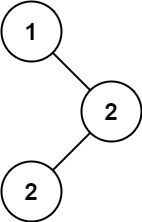
示例 1:
输入: root = [1,null,2,2]
输出: [2]
示例 2:
输入: root = [0]
输出: [0]
提示:
树中节点的数目在范围 [1, 104 ] 内 -105 <= Node.val <= 105
进阶: 你可以不使用额外的空间吗?(假设由递归产生的隐式调用栈的开销不被计算在内)
解法 方法一 思考
众数即出现次数最多的值。若先遍历整棵树再哈希计数,时间和空间均为 \(O(n)\) ,在 \(n \le 10^4\) 时可以接受,但没有用到二叉搜索树的有序性。
中序遍历得到的是非降序列,相同值必然相邻。因此只需在中序过程中维护前驱、当前连续次数与历史最大次数:次数更大则重置答案,次数持平则追加。一遍中序即可在 \(O(h)\) 额外空间内收集全部众数。
Python3 Java C++ Go C#
 1
 2
 3
 4
 5
 6
 7
 8
 9
10
11
12
13
14
15
16
17
18
19
20
21
22
23
24
25
26
27
# Definition for a binary tree node.
# class TreeNode:
# def __init__(self, val=0, left=None, right=None):
# self.val = val
# self.left = left
# self.right = right
class Solution :
def findMode ( self , root : TreeNode ) -> list [ int ]:
def dfs ( root ):
if root is None :
return
nonlocal mx , prev , ans , cnt
dfs ( root . left )
cnt = cnt + 1 if prev == root . val else 1
if cnt > mx :
ans = [ root . val ]
mx = cnt
elif cnt == mx :
ans . append ( root . val )
prev = root . val
dfs ( root . right )
prev = None
mx = cnt = 0
ans = []
dfs ( root )
return ans
 1
 2
 3
 4
 5
 6
 7
 8
 9
10
11
12
13
14
15
16
17
18
19
20
21
22
23
24
25
26
27
28
29
30
31
32
33
34
35
36
37
38
39
40
41
42
43
44
45
46
47
/**
* Definition for a binary tree node.
* public class TreeNode {
* int val;
* TreeNode left;
* TreeNode right;
* TreeNode() {}
* TreeNode(int val) { this.val = val; }
* TreeNode(int val, TreeNode left, TreeNode right) {
* this.val = val;
* this.left = left;
* this.right = right;
* }
* }
*/
class Solution {
private int mx ;
private int cnt ;
private TreeNode prev ;
private List < Integer > res ;
public int [] findMode ( TreeNode root ) {
res = new ArrayList <> ();
dfs ( root );
int [] ans = new int [ res . size () ] ;
for ( int i = 0 ; i < res . size (); ++ i ) {
ans [ i ] = res . get ( i );
}
return ans ;
}
private void dfs ( TreeNode root ) {
if ( root == null ) {
return ;
}
dfs ( root . left );
cnt = prev != null && prev . val == root . val ? cnt + 1 : 1 ;
if ( cnt > mx ) {
res = new ArrayList <> ( Arrays . asList ( root . val ));
mx = cnt ;
} else if ( cnt == mx ) {
res . add ( root . val );
}
prev = root ;
dfs ( root . right );
}
}
 1
 2
 3
 4
 5
 6
 7
 8
 9
10
11
12
13
14
15
16
17
18
19
20
21
22
23
24
25
26
27
28
29
30
31
32
33
34
35
36
/**
* Definition for a binary tree node.
* struct TreeNode {
* int val;
* TreeNode *left;
* TreeNode *right;
* TreeNode() : val(0), left(nullptr), right(nullptr) {}
* TreeNode(int x) : val(x), left(nullptr), right(nullptr) {}
* TreeNode(int x, TreeNode *left, TreeNode *right) : val(x), left(left), right(right) {}
* };
*/
class Solution {
public :
TreeNode * prev ;
int mx , cnt ;
vector < int > ans ;
vector < int > findMode ( TreeNode * root ) {
dfs ( root );
return ans ;
}
void dfs ( TreeNode * root ) {
if ( ! root ) return ;
dfs ( root -> left );
cnt = prev != nullptr && prev -> val == root -> val ? cnt + 1 : 1 ;
if ( cnt > mx ) {
ans . clear ();
ans . push_back ( root -> val );
mx = cnt ;
} else if ( cnt == mx )
ans . push_back ( root -> val );
prev = root ;
dfs ( root -> right );
}
};
 1
 2
 3
 4
 5
 6
 7
 8
 9
10
11
12
13
14
15
16
17
18
19
20
21
22
23
24
25
26
27
28
29
30
31
32
33
34
35
/**
* Definition for a binary tree node.
* type TreeNode struct {
* Val int
* Left *TreeNode
* Right *TreeNode
* }
*/
func findMode ( root * TreeNode ) [] int {
mx , cnt := 0 , 0
var prev * TreeNode
var ans [] int
var dfs func ( root * TreeNode )
dfs = func ( root * TreeNode ) {
if root == nil {
return
}
dfs ( root . Left )
if prev != nil && prev . Val == root . Val {
cnt ++
} else {
cnt = 1
}
if cnt > mx {
ans = [] int { root . Val }
mx = cnt
} else if cnt == mx {
ans = append ( ans , root . Val )
}
prev = root
dfs ( root . Right )
}
dfs ( root )
return ans
}
 1
 2
 3
 4
 5
 6
 7
 8
 9
10
11
12
13
14
15
16
17
18
19
20
21
22
23
24
25
26
27
28
29
30
31
32
public class Solution {
private int mx ;
private int cnt ;
private TreeNode prev ;
private List < int > res ;
public int [] FindMode ( TreeNode root ) {
res = new List < int > ();
Dfs ( root );
int [] ans = new int [ res . Count ];
for ( int i = 0 ; i < res . Count ; ++ i ) {
ans [ i ] = res [ i ];
}
return ans ;
}
private void Dfs ( TreeNode root ) {
if ( root == null ) {
return ;
}
Dfs ( root . left );
cnt = prev != null && prev . val == root . val ? cnt + 1 : 1 ;
if ( cnt > mx ) {
res = new List < int > ( new int [] { root . val });
mx = cnt ;
} else if ( cnt == mx ) {
res . Add ( root . val );
}
prev = root ;
Dfs ( root . right );
}
}
方法二:显式栈中序遍历 思考
众数是出现次数最多的值。先遍历整棵树再哈希计数,在 \(n \le 10^4\) 时时间够用,但没有用到二叉搜索树的有序性。
中序会先走进左孩子。一条长度为 \(10^4\) 的链按结点个数递归,调用栈会溢出。
中序得到的是非降序列,相同值必然相邻。因此只需要前一个值、当前连续次数和历史最大次数,不必等子树返回。
用显式栈做中序遍历。进入结点时压入退出标记和左孩子;退出时按连续次数更新答案,再压入右孩子。次数更大就重置答案,次数持平就追加。
二叉搜索树的中序遍历是非降序列,相同的值必然相邻。我们用显式栈完成这次中序遍历,并维护前一个值、当前连续次数和历史最大次数。进入结点时压入退出标记和左孩子;退出时,若当前值与前一个值相同则连续次数加一,否则置为 \(1\) 。连续次数超过历史最大次数时重置答案,相等时把当前值追加进答案,然后压入右孩子。
时间复杂度 \(O(n)\) ,空间复杂度 \(O(n)\) 。其中 \(n\) 是二叉搜索树的节点数。
Python3 Java C++ Go C#
 1
 2
 3
 4
 5
 6
 7
 8
 9
10
11
12
13
14
15
16
17
18
19
20
21
22
23
24
25
26
27
28
29
# Definition for a binary tree node.
# class TreeNode:
# def __init__(self, val=0, left=None, right=None):
# self.val = val
# self.left = left
# self.right = right
class Solution :
def findMode ( self , root : TreeNode ) -> list [ int ]:
prev = None
mx = cnt = 0
ans = []
stk = [( root , 0 )]
while stk :
node , state = stk . pop ()
if node is None :
continue
if state == 0 :
stk . append (( node , 1 ))
stk . append (( node . left , 0 ))
continue
cnt = cnt + 1 if prev == node . val else 1
if cnt > mx :
ans = [ node . val ]
mx = cnt
elif cnt == mx :
ans . append ( node . val )
prev = node . val
stk . append (( node . right , 0 ))
return ans
 1
 2
 3
 4
 5
 6
 7
 8
 9
10
11
12
13
14
15
16
17
18
19
20
21
22
23
24
25
26
27
28
29
30
31
32
33
34
35
36
37
38
39
40
41
42
43
44
45
46
47
48
49
50
51
52
53
54
55
56
57
58
59
60
61
62
63
64
/**
* Definition for a binary tree node.
* public class TreeNode {
* int val;
* TreeNode left;
* TreeNode right;
* TreeNode() {}
* TreeNode(int val) { this.val = val; }
* TreeNode(int val, TreeNode left, TreeNode right) {
* this.val = val;
* this.left = left;
* this.right = right;
* }
* }
*/
class Solution {
private static class Frame {
TreeNode node ;
int state ;
Frame ( TreeNode node , int state ) {
this . node = node ;
this . state = state ;
}
}
public int [] findMode ( TreeNode root ) {
Integer prev = null ;
int mx = 0 ;
int cnt = 0 ;
List < Integer > res = new ArrayList <> ();
if ( root != null ) {
Deque < Frame > stk = new ArrayDeque <> ();
stk . push ( new Frame ( root , 0 ));
while ( ! stk . isEmpty ()) {
Frame cur = stk . pop ();
TreeNode node = cur . node ;
if ( cur . state == 0 ) {
stk . push ( new Frame ( node , 1 ));
if ( node . left != null ) {
stk . push ( new Frame ( node . left , 0 ));
}
continue ;
}
cnt = prev != null && prev == node . val ? cnt + 1 : 1 ;
if ( cnt > mx ) {
res = new ArrayList <> ( Arrays . asList ( node . val ));
mx = cnt ;
} else if ( cnt == mx ) {
res . add ( node . val );
}
prev = node . val ;
if ( node . right != null ) {
stk . push ( new Frame ( node . right , 0 ));
}
}
}
int [] ans = new int [ res . size () ] ;
for ( int i = 0 ; i < res . size (); ++ i ) {
ans [ i ] = res . get ( i );
}
return ans ;
}
}
 1
 2
 3
 4
 5
 6
 7
 8
 9
10
11
12
13
14
15
16
17
18
19
20
21
22
23
24
25
26
27
28
29
30
31
32
33
34
35
36
37
38
39
40
41
42
43
44
/**
* Definition for a binary tree node.
* struct TreeNode {
* int val;
* TreeNode *left;
* TreeNode *right;
* TreeNode() : val(0), left(nullptr), right(nullptr) {}
* TreeNode(int x) : val(x), left(nullptr), right(nullptr) {}
* TreeNode(int x, TreeNode *left, TreeNode *right) : val(x), left(left), right(right) {}
* };
*/
class Solution {
public :
vector < int > findMode ( TreeNode * root ) {
bool has = false ;
int prev = 0 , mx = 0 , cnt = 0 ;
vector < int > ans ;
vector < pair < TreeNode * , int >> stk {{ root , 0 }};
while ( ! stk . empty ()) {
auto [ node , state ] = stk . back ();
stk . pop_back ();
if ( ! node ) {
continue ;
}
if ( state == 0 ) {
stk . emplace_back ( node , 1 );
stk . emplace_back ( node -> left , 0 );
continue ;
}
cnt = has && prev == node -> val ? cnt + 1 : 1 ;
if ( cnt > mx ) {
ans . clear ();
ans . push_back ( node -> val );
mx = cnt ;
} else if ( cnt == mx ) {
ans . push_back ( node -> val );
}
prev = node -> val ;
has = true ;
stk . emplace_back ( node -> right , 0 );
}
return ans ;
}
};
 1
 2
 3
 4
 5
 6
 7
 8
 9
10
11
12
13
14
15
16
17
18
19
20
21
22
23
24
25
26
27
28
29
30
31
32
33
34
35
36
37
38
39
40
41
42
43
44
45
/**
* Definition for a binary tree node.
* type TreeNode struct {
* Val int
* Left *TreeNode
* Right *TreeNode
* }
*/
func findMode ( root * TreeNode ) [] int {
mx , cnt , prev := 0 , 0 , 0
has := false
var ans [] int
type frame struct {
node * TreeNode
state int
}
stk := [] frame {{ root , 0 }}
for len ( stk ) > 0 {
cur := stk [ len ( stk ) - 1 ]
stk = stk [: len ( stk ) - 1 ]
node , state := cur . node , cur . state
if node == nil {
continue
}
if state == 0 {
stk = append ( stk , frame { node , 1 }, frame { node . Left , 0 })
continue
}
if has && prev == node . Val {
cnt ++
} else {
cnt = 1
}
if cnt > mx {
ans = [] int { node . Val }
mx = cnt
} else if cnt == mx {
ans = append ( ans , node . Val )
}
prev = node . Val
has = true
stk = append ( stk , frame { node . Right , 0 })
}
return ans
}
 1
 2
 3
 4
 5
 6
 7
 8
 9
10
11
12
13
14
15
16
17
18
19
20
21
22
23
24
25
26
27
28
29
30
31
32
33
34
35
36
37
38
39
40
41
42
43
44
45
46
47
48
49
50
51
public class Solution {
private class Frame {
public TreeNode node ;
public int state ;
public Frame ( TreeNode node , int state ) {
this . node = node ;
this . state = state ;
}
}
public int [] FindMode ( TreeNode root ) {
int mx = 0 ;
int cnt = 0 ;
int prev = 0 ;
bool has = false ;
List < int > res = new List < int > ();
if ( root != null ) {
Stack < Frame > stk = new Stack < Frame > ();
stk . Push ( new Frame ( root , 0 ));
while ( stk . Count > 0 ) {
Frame cur = stk . Pop ();
TreeNode node = cur . node ;
if ( cur . state == 0 ) {
stk . Push ( new Frame ( node , 1 ));
if ( node . left != null ) {
stk . Push ( new Frame ( node . left , 0 ));
}
continue ;
}
cnt = has && prev == node . val ? cnt + 1 : 1 ;
if ( cnt > mx ) {
res = new List < int > ( new int [] { node . val });
mx = cnt ;
} else if ( cnt == mx ) {
res . Add ( node . val );
}
prev = node . val ;
has = true ;
if ( node . right != null ) {
stk . Push ( new Frame ( node . right , 0 ));
}
}
}
int [] ans = new int [ res . Count ];
for ( int i = 0 ; i < res . Count ; ++ i ) {
ans [ i ] = res [ i ];
}
return ans ;
}
}
GitHub