二叉树 广度优先搜索 树 深度优先搜索 来源 第 26 场双周赛 Q3 难度 中等 分数 1360
题目描述 给你一棵根为 root 的二叉树,请你返回二叉树中好节点的数目。
「好节点」X 定义为:从根到该节点 X 所经过的节点中,没有任何节点的值大于 X 的值。
示例 1:
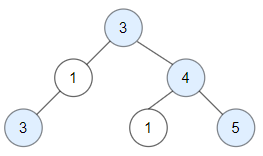
输入: root = [3,1,4,3,null,1,5]
输出: 4
解释: 图中蓝色节点为好节点。
根节点 (3) 永远是个好节点。
节点 4 -> (3,4) 是路径中的最大值。
节点 5 -> (3,4,5) 是路径中的最大值。
节点 3 -> (3,1,3) 是路径中的最大值。示例 2:
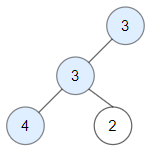
输入: root = [3,3,null,4,2]
输出: 3
解释: 节点 2 -> (3, 3, 2) 不是好节点,因为 "3" 比它大。示例 3:
输入: root = [1]
输出: 1
解释: 根节点是好节点。
提示:
二叉树中节点数目范围是 [1, 10^5] 。 每个节点权值的范围是 [-10^4, 10^4] 。 解法 方法一:DFS 思考
好节点要求根到该点路径上没有更大的值。 \(n\le 10^5\) ,在 DFS 中下传路径最大值 \(mx\) ,当前值不小于 \(mx\) 则计数并更新 \(mx\) 。
我们设计一个函数 \(dfs(root, mx)\) ,表示从当前节点 \(root\) 开始搜索好节点,其中 \(mx\) 表示从根节点到当前节点的路径(不包括当前节点)上的最大值。
函数 \(dfs(root, mx)\) 的执行逻辑如下:
如果 \(root\) 为空,说明搜索结束,直接返回;
否则,我们判断 \(root.val\) 与 \(mx\) 的大小关系。如果 \(mx \leq root.val\) ,说明 \(root\) 是好节点,答案加一,并且我们需要更新 \(mx\) 的值为 \(root.val\) 。
接下来,我们递归调用 \(dfs(root.left, mx)\) 和 \(dfs(root.right, mx)\) 。
在主函数中,我们调用 \(dfs(root, -10^6)\) ,其中 \(-10^6\) 表示负无穷,因为题目中说明了每个节点权值的范围是 \([-10^4, 10^4]\) ,所以 \(-10^6\) 肯定是一个比所有节点权值都小的值,这样就能保证 \(dfs(root, -10^6)\) 一定会把根节点 \(root\) 算作好节点。
时间复杂度 \(O(n)\) ,空间复杂度 \(O(n)\) 。其中 \(n\) 是二叉树的节点数。
Python3 Java C++ Go TypeScript
 1
 2
 3
 4
 5
 6
 7
 8
 9
10
11
12
13
14
15
16
17
18
19
20
21
# Definition for a binary tree node.
# class TreeNode:
# def __init__(self, val=0, left=None, right=None):
# self.val = val
# self.left = left
# self.right = right
class Solution :
def goodNodes ( self , root : TreeNode ) -> int :
def dfs ( root : TreeNode , mx : int ):
if root is None :
return
nonlocal ans
if mx <= root . val :
ans += 1
mx = root . val
dfs ( root . left , mx )
dfs ( root . right , mx )
ans = 0
dfs ( root , - 1000000 )
return ans
 1
 2
 3
 4
 5
 6
 7
 8
 9
10
11
12
13
14
15
16
17
18
19
20
21
22
23
24
25
26
27
28
29
30
31
32
33
34
35
/**
* Definition for a binary tree node.
* public class TreeNode {
* int val;
* TreeNode left;
* TreeNode right;
* TreeNode() {}
* TreeNode(int val) { this.val = val; }
* TreeNode(int val, TreeNode left, TreeNode right) {
* this.val = val;
* this.left = left;
* this.right = right;
* }
* }
*/
class Solution {
private int ans = 0 ;
public int goodNodes ( TreeNode root ) {
dfs ( root , - 100000 );
return ans ;
}
private void dfs ( TreeNode root , int mx ) {
if ( root == null ) {
return ;
}
if ( mx <= root . val ) {
++ ans ;
mx = root . val ;
}
dfs ( root . left , mx );
dfs ( root . right , mx );
}
}
 1
 2
 3
 4
 5
 6
 7
 8
 9
10
11
12
13
14
15
16
17
18
19
20
21
22
23
24
25
26
27
28
29
30
/**
* Definition for a binary tree node.
* struct TreeNode {
* int val;
* TreeNode *left;
* TreeNode *right;
* TreeNode() : val(0), left(nullptr), right(nullptr) {}
* TreeNode(int x) : val(x), left(nullptr), right(nullptr) {}
* TreeNode(int x, TreeNode *left, TreeNode *right) : val(x), left(left), right(right) {}
* };
*/
class Solution {
public :
int goodNodes ( TreeNode * root ) {
int ans = 0 ;
function < void ( TreeNode * , int ) > dfs = [ & ]( TreeNode * root , int mx ) {
if ( ! root ) {
return ;
}
if ( mx <= root -> val ) {
++ ans ;
mx = root -> val ;
}
dfs ( root -> left , mx );
dfs ( root -> right , mx );
};
dfs ( root , -1e6 );
return ans ;
}
};
 1
 2
 3
 4
 5
 6
 7
 8
 9
10
11
12
13
14
15
16
17
18
19
20
21
22
23
24
/**
* Definition for a binary tree node.
* type TreeNode struct {
* Val int
* Left *TreeNode
* Right *TreeNode
* }
*/
func goodNodes ( root * TreeNode ) ( ans int ) {
var dfs func ( * TreeNode , int )
dfs = func ( root * TreeNode , mx int ) {
if root == nil {
return
}
if mx <= root . Val {
ans ++
mx = root . Val
}
dfs ( root . Left , mx )
dfs ( root . Right , mx )
}
dfs ( root , - 10001 )
return
}
 1
 2
 3
 4
 5
 6
 7
 8
 9
10
11
12
13
14
15
16
17
18
19
20
21
22
23
24
25
26
27
28
29
30
/**
* Definition for a binary tree node.
* class TreeNode {
* val: number
* left: TreeNode | null
* right: TreeNode | null
* constructor(val?: number, left?: TreeNode | null, right?: TreeNode | null) {
* this.val = (val===undefined ? 0 : val)
* this.left = (left===undefined ? null : left)
* this.right = (right===undefined ? null : right)
* }
* }
*/
function goodNodes ( root : TreeNode | null ) : number {
let ans = 0 ;
const dfs = ( root : TreeNode | null , mx : number ) => {
if ( ! root ) {
return ;
}
if ( mx <= root . val ) {
++ ans ;
mx = root . val ;
}
dfs ( root . left , mx );
dfs ( root . right , mx );
};
dfs ( root , - 1e6 );
return ans ;
}
方法二:显式栈 思考
好节点要求从根到该点的路径上没有更大的值。 \(n\) 可以到 \(10^5\) ,下传路径最大值 \(mx\) ,当前值不小于 \(mx\) 就计数并更新 \(mx\) ,一次遍历就能数完。
搜索先进入左孩子。一条左链的长度可以到 \(n\) ,递归会在计数完成前溢出。每个结点只和自己路径上的最大值比较,左右孩子互不影响。
待访问的结点可以连同到达它之前的 \(mx\) 放进显式栈。弹出后若当前值不小于 \(mx\) 就计数,并把 \(mx\) 更新为当前值,再把右孩子和左孩子连同这个 \(mx\) 压栈。左孩子后压入,因此先被处理。
初始 \(mx\) 小于结点值的下界 \(-10^4\) ,根一定被算作好节点。每个结点入栈一次。
我们用显式栈从根开始统计好节点。栈中每个元素是一个结点,以及从根到它的父结点路径上的最大值 \(mx\) 。弹出结点后,若结点为空则跳过;若 \(mx \le \textit{val}\) ,答案加一,并把 \(mx\) 更新为当前结点的值。随后先压入右孩子,再压入左孩子,二者都带上更新后的 \(mx\) 。初始 \(mx\) 小于题目给出的最小结点值 \(-10^4\) ,因此根一定被计入。
时间复杂度 \(O(n)\) ,空间复杂度 \(O(n)\) 。其中 \(n\) 是二叉树的节点数。
Python3 Java C++ Go TypeScript
 1
 2
 3
 4
 5
 6
 7
 8
 9
10
11
12
13
14
15
16
17
18
19
20
# Definition for a binary tree node.
# class TreeNode:
# def __init__(self, val=0, left=None, right=None):
# self.val = val
# self.left = left
# self.right = right
class Solution :
def goodNodes ( self , root : TreeNode ) -> int :
ans = 0
stk = [( root , - 1000000 )]
while stk :
node , mx = stk . pop ()
if node is None :
continue
if mx <= node . val :
ans += 1
mx = node . val
stk . append (( node . right , mx ))
stk . append (( node . left , mx ))
return ans
 1
 2
 3
 4
 5
 6
 7
 8
 9
10
11
12
13
14
15
16
17
18
19
20
21
22
23
24
25
26
27
28
29
30
31
32
33
34
35
36
37
38
39
40
41
42
43
/**
* Definition for a binary tree node.
* public class TreeNode {
* int val;
* TreeNode left;
* TreeNode right;
* TreeNode() {}
* TreeNode(int val) { this.val = val; }
* TreeNode(int val, TreeNode left, TreeNode right) {
* this.val = val;
* this.left = left;
* this.right = right;
* }
* }
*/
class Solution {
public int goodNodes ( TreeNode root ) {
int ans = 0 ;
Deque < TreeNode > nodes = new ArrayDeque <> ();
Deque < Integer > limits = new ArrayDeque <> ();
if ( root != null ) {
nodes . push ( root );
limits . push ( - 100000 );
}
while ( ! nodes . isEmpty ()) {
TreeNode node = nodes . pop ();
int mx = limits . pop ();
if ( mx <= node . val ) {
++ ans ;
mx = node . val ;
}
if ( node . right != null ) {
nodes . push ( node . right );
limits . push ( mx );
}
if ( node . left != null ) {
nodes . push ( node . left );
limits . push ( mx );
}
}
return ans ;
}
}
 1
 2
 3
 4
 5
 6
 7
 8
 9
10
11
12
13
14
15
16
17
18
19
20
21
22
23
24
25
26
27
28
29
30
31
32
33
/**
* Definition for a binary tree node.
* struct TreeNode {
* int val;
* TreeNode *left;
* TreeNode *right;
* TreeNode() : val(0), left(nullptr), right(nullptr) {}
* TreeNode(int x) : val(x), left(nullptr), right(nullptr) {}
* TreeNode(int x, TreeNode *left, TreeNode *right) : val(x), left(left), right(right) {}
* };
*/
class Solution {
public :
int goodNodes ( TreeNode * root ) {
int ans = 0 ;
vector < pair < TreeNode * , int >> stk ;
stk . emplace_back ( root , -1000000 );
while ( ! stk . empty ()) {
auto [ node , mx ] = stk . back ();
stk . pop_back ();
if ( ! node ) {
continue ;
}
if ( mx <= node -> val ) {
++ ans ;
mx = node -> val ;
}
stk . emplace_back ( node -> right , mx );
stk . emplace_back ( node -> left , mx );
}
return ans ;
}
};
 1
 2
 3
 4
 5
 6
 7
 8
 9
10
11
12
13
14
15
16
17
18
19
20
21
22
23
24
25
26
27
28
29
30
31
32
33
34
/**
* Definition for a binary tree node.
* type TreeNode struct {
* Val int
* Left *TreeNode
* Right *TreeNode
* }
*/
func goodNodes ( root * TreeNode ) ( ans int ) {
stk := [] struct {
node * TreeNode
mx int
}{{ root , - 10001 }}
for len ( stk ) > 0 {
cur := stk [ len ( stk ) - 1 ]
stk = stk [: len ( stk ) - 1 ]
node , mx := cur . node , cur . mx
if node == nil {
continue
}
if mx <= node . Val {
ans ++
mx = node . Val
}
stk = append ( stk , struct {
node * TreeNode
mx int
}{ node . Right , mx }, struct {
node * TreeNode
mx int
}{ node . Left , mx })
}
return
}
 1
 2
 3
 4
 5
 6
 7
 8
 9
10
11
12
13
14
15
16
17
18
19
20
21
22
23
24
25
26
27
28
29
30
31
32
/**
* Definition for a binary tree node.
* class TreeNode {
* val: number
* left: TreeNode | null
* right: TreeNode | null
* constructor(val?: number, left?: TreeNode | null, right?: TreeNode | null) {
* this.val = (val===undefined ? 0 : val)
* this.left = (left===undefined ? null : left)
* this.right = (right===undefined ? null : right)
* }
* }
*/
function goodNodes ( root : TreeNode | null ) : number {
let ans = 0 ;
const stk : [ TreeNode | null , number ][] = [[ root , - 1e6 ]];
while ( stk . length ) {
const [ node , limit ] = stk . pop () ! ;
if ( ! node ) {
continue ;
}
let mx = limit ;
if ( mx <= node . val ) {
++ ans ;
mx = node . val ;
}
stk . push ([ node . right , mx ]);
stk . push ([ node . left , mx ]);
}
return ans ;
}
GitHub