二叉树 字符串 最近公共祖先 树 深度优先搜索 来源 第 270 场周赛 Q3 难度 中等 分数 1804
题目描述 给你一棵 二叉树 的根节点 root ,这棵二叉树总共有 n 个节点。每个节点的值为 1 到 n 中的一个整数,且互不相同。给你一个整数 startValue ,表示起点节点 s 的值,和另一个不同的整数 destValue ,表示终点节点 t 的值。
请找到从节点 s 到节点 t 的 最短路径 ,并以字符串的形式返回每一步的方向。每一步用 大写 字母 'L' ,'R' 和 'U' 分别表示一种方向:
'L' 表示从一个节点前往它的 左孩子 节点。'R' 表示从一个节点前往它的 右孩子 节点。'U' 表示从一个节点前往它的 父 节点。 请你返回从 s 到 t 最短路径 每一步的方向。
示例 1:
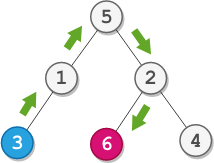
输入: root = [5,1,2,3,null,6,4], startValue = 3, destValue = 6
输出: "UURL"
解释: 最短路径为:3 → 1 → 5 → 2 → 6 。
示例 2:
输入: root = [2,1], startValue = 2, destValue = 1
输出: "L"
解释: 最短路径为:2 → 1 。
提示:
树中节点数目为 n 。 2 <= n <= 105 1 <= Node.val <= n树中所有节点的值 互不相同 。 1 <= startValue, destValue <= nstartValue != destValue 解法 方法一:最近公共祖先 + DFS 思考
从起点到终点的路径必经过 LCA。向上一律走 U,再沿 LCA 到终点的左右孩子走 L/R。 \(n \le 10^5\) ,三次遍历可接受。
先求 LCA,再两次 DFS 记录从 LCA 到两端的方向串,把去程改成等长的 U 后拼接。
我们可以先找到节点 \(\textit{startValue}\) 和 \(\textit{destValue}\) 的最近公共祖先,记为 \(\textit{node}\) ,然后分别从 \(\textit{node}\) 出发,找到 \(\textit{startValue}\) 和 \(\textit{destValue}\) 的路径。那么从 \(\textit{startValue}\) 到 \(\textit{node}\) 的路径就是 \(\textit{U}\) 的个数,从 \(\textit{node}\) 到 \(\textit{destValue}\) 的路径就是 \(\textit{path}\) 的路径,最后将这两个路径拼接起来即可。
时间复杂度 \(O(n)\) ,空间复杂度 \(O(n)\) 。其中 \(n\) 为二叉树的节点数。
Python3 Java C++ Go TypeScript JavaScript
 1
 2
 3
 4
 5
 6
 7
 8
 9
10
11
12
13
14
15
16
17
18
19
20
21
22
23
24
25
26
27
28
29
30
31
32
33
34
35
36
37
38
39
40
41
42
43
44
# Definition for a binary tree node.
# class TreeNode:
# def __init__(self, val=0, left=None, right=None):
# self.val = val
# self.left = left
# self.right = right
class Solution :
def getDirections (
self , root : Optional [ TreeNode ], startValue : int , destValue : int
) -> str :
def lca ( node : Optional [ TreeNode ], p : int , q : int ):
if node is None or node . val in ( p , q ):
return node
left = lca ( node . left , p , q )
right = lca ( node . right , p , q )
if left and right :
return node
return left or right
def dfs ( node : Optional [ TreeNode ], x : int , path : List [ str ]):
if node is None :
return False
if node . val == x :
return True
path . append ( "L" )
if dfs ( node . left , x , path ):
return True
path [ - 1 ] = "R"
if dfs ( node . right , x , path ):
return True
path . pop ()
return False
node = lca ( root , startValue , destValue )
path_to_start = []
path_to_dest = []
dfs ( node , startValue , path_to_start )
dfs ( node , destValue , path_to_dest )
return "U" * len ( path_to_start ) + "" . join ( path_to_dest )
 1
 2
 3
 4
 5
 6
 7
 8
 9
10
11
12
13
14
15
16
17
18
19
20
21
22
23
24
25
26
27
28
29
30
31
32
33
34
35
36
37
38
39
40
41
class Solution {
public String getDirections ( TreeNode root , int startValue , int destValue ) {
TreeNode node = lca ( root , startValue , destValue );
StringBuilder pathToStart = new StringBuilder ();
StringBuilder pathToDest = new StringBuilder ();
dfs ( node , startValue , pathToStart );
dfs ( node , destValue , pathToDest );
return "U" . repeat ( pathToStart . length ()) + pathToDest . toString ();
}
private TreeNode lca ( TreeNode node , int p , int q ) {
if ( node == null || node . val == p || node . val == q ) {
return node ;
}
TreeNode left = lca ( node . left , p , q );
TreeNode right = lca ( node . right , p , q );
if ( left != null && right != null ) {
return node ;
}
return left != null ? left : right ;
}
private boolean dfs ( TreeNode node , int x , StringBuilder path ) {
if ( node == null ) {
return false ;
}
if ( node . val == x ) {
return true ;
}
path . append ( 'L' );
if ( dfs ( node . left , x , path )) {
return true ;
}
path . setCharAt ( path . length () - 1 , 'R' );
if ( dfs ( node . right , x , path )) {
return true ;
}
path . deleteCharAt ( path . length () - 1 );
return false ;
}
}
 1
 2
 3
 4
 5
 6
 7
 8
 9
10
11
12
13
14
15
16
17
18
19
20
21
22
23
24
25
26
27
28
29
30
31
32
33
34
35
36
37
38
39
40
41
42
43
44
45
46
47
48
49
50
51
52
53
/**
* Definition for a binary tree node.
* struct TreeNode {
* int val;
* TreeNode *left;
* TreeNode *right;
* TreeNode() : val(0), left(nullptr), right(nullptr) {}
* TreeNode(int x) : val(x), left(nullptr), right(nullptr) {}
* TreeNode(int x, TreeNode *left, TreeNode *right) : val(x), left(left), right(right) {}
* };
*/
class Solution {
public :
string getDirections ( TreeNode * root , int startValue , int destValue ) {
TreeNode * node = lca ( root , startValue , destValue );
string pathToStart , pathToDest ;
dfs ( node , startValue , pathToStart );
dfs ( node , destValue , pathToDest );
return string ( pathToStart . size (), 'U' ) + pathToDest ;
}
private :
TreeNode * lca ( TreeNode * node , int p , int q ) {
if ( node == nullptr || node -> val == p || node -> val == q ) {
return node ;
}
TreeNode * left = lca ( node -> left , p , q );
TreeNode * right = lca ( node -> right , p , q );
if ( left != nullptr && right != nullptr ) {
return node ;
}
return left != nullptr ? left : right ;
}
bool dfs ( TreeNode * node , int x , string & path ) {
if ( node == nullptr ) {
return false ;
}
if ( node -> val == x ) {
return true ;
}
path . push_back ( 'L' );
if ( dfs ( node -> left , x , path )) {
return true ;
}
path . back () = 'R' ;
if ( dfs ( node -> right , x , path )) {
return true ;
}
path . pop_back ();
return false ;
}
};
 1
 2
 3
 4
 5
 6
 7
 8
 9
10
11
12
13
14
15
16
17
18
19
20
21
22
23
24
25
26
27
28
29
30
31
32
33
34
35
36
37
38
39
40
41
42
43
44
45
46
47
48
49
50
51
/**
* Definition for a binary tree node.
* type TreeNode struct {
* Val int
* Left *TreeNode
* Right *TreeNode
* }
*/
func getDirections ( root * TreeNode , startValue int , destValue int ) string {
var lca func ( node * TreeNode , p , q int ) * TreeNode
lca = func ( node * TreeNode , p , q int ) * TreeNode {
if node == nil || node . Val == p || node . Val == q {
return node
}
left := lca ( node . Left , p , q )
right := lca ( node . Right , p , q )
if left != nil && right != nil {
return node
}
if left != nil {
return left
}
return right
}
var dfs func ( node * TreeNode , x int , path * [] byte ) bool
dfs = func ( node * TreeNode , x int , path * [] byte ) bool {
if node == nil {
return false
}
if node . Val == x {
return true
}
* path = append ( * path , 'L' )
if dfs ( node . Left , x , path ) {
return true
}
( * path )[ len ( * path ) - 1 ] = 'R'
if dfs ( node . Right , x , path ) {
return true
}
* path = ( * path )[: len ( * path ) - 1 ]
return false
}
node := lca ( root , startValue , destValue )
pathToStart := [] byte {}
pathToDest := [] byte {}
dfs ( node , startValue , & pathToStart )
dfs ( node , destValue , & pathToDest )
return string ( bytes . Repeat ([] byte { 'U' }, len ( pathToStart ))) + string ( pathToDest )
}
 1
 2
 3
 4
 5
 6
 7
 8
 9
10
11
12
13
14
15
16
17
18
19
20
21
22
23
24
25
26
27
28
29
30
31
32
33
34
35
36
37
38
39
40
41
42
43
44
45
46
47
48
49
50
51
/**
* Definition for a binary tree node.
* class TreeNode {
* val: number
* left: TreeNode | null
* right: TreeNode | null
* constructor(val?: number, left?: TreeNode | null, right?: TreeNode | null) {
* this.val = (val===undefined ? 0 : val)
* this.left = (left===undefined ? null : left)
* this.right = (right===undefined ? null : right)
* }
* }
*/
function getDirections ( root : TreeNode | null , startValue : number , destValue : number ) : string {
const lca = ( node : TreeNode | null , p : number , q : number ) : TreeNode | null => {
if ( node === null || [ p , q ]. includes ( node . val )) {
return node ;
}
const left = lca ( node . left , p , q );
const right = lca ( node . right , p , q );
return left && right ? node : ( left ?? right );
};
const dfs = ( node : TreeNode | null , x : number , path : string []) : boolean => {
if ( node === null ) {
return false ;
}
if ( node . val === x ) {
return true ;
}
path . push ( 'L' );
if ( dfs ( node . left , x , path )) {
return true ;
}
path [ path . length - 1 ] = 'R' ;
if ( dfs ( node . right , x , path )) {
return true ;
}
path . pop ();
return false ;
};
const node = lca ( root , startValue , destValue );
const pathToStart : string [] = [];
const pathToDest : string [] = [];
dfs ( node , startValue , pathToStart );
dfs ( node , destValue , pathToDest );
return 'U' . repeat ( pathToStart . length ) + pathToDest . join ( '' );
}
 1
 2
 3
 4
 5
 6
 7
 8
 9
10
11
12
13
14
15
16
17
18
19
20
21
22
23
24
25
26
27
28
29
30
31
32
33
34
35
36
37
38
39
40
41
42
43
44
45
46
47
48
49
50
51
/**
* Definition for a binary tree node.
* function TreeNode(val, left, right) {
* this.val = (val===undefined ? 0 : val)
* this.left = (left===undefined ? null : left)
* this.right = (right===undefined ? null : right)
* }
*/
/**
* @param {TreeNode} root
* @param {number} startValue
* @param {number} destValue
* @return {string}
*/
var getDirections = function ( root , startValue , destValue ) {
const lca = ( node , p , q ) => {
if ( node === null || [ p , q ]. includes ( node . val )) {
return node ;
}
const left = lca ( node . left , p , q );
const right = lca ( node . right , p , q );
return left && right ? node : ( left ?? right );
};
const dfs = ( node , x , path ) => {
if ( node === null ) {
return false ;
}
if ( node . val === x ) {
return true ;
}
path . push ( 'L' );
if ( dfs ( node . left , x , path )) {
return true ;
}
path [ path . length - 1 ] = 'R' ;
if ( dfs ( node . right , x , path )) {
return true ;
}
path . pop ();
return false ;
};
const node = lca ( root , startValue , destValue );
const pathToStart = [];
const pathToDest = [];
dfs ( node , startValue , pathToStart );
dfs ( node , destValue , pathToDest );
return 'U' . repeat ( pathToStart . length ) + pathToDest . join ( '' );
};
方法二:最近公共祖先 + DFS(优化) 思考
方法一先找 LCA 再走两遍。从根到两端的路径共享一段前缀,去掉该前缀后剩余即「回到 LCA 再下去」。少一次 LCA 专用搜索。
两次 DFS 得到方向串,对齐公共前缀长度 \(i\) ,答案为 \((|start|-i)\) 个 U 加终点后缀。
我们可以从 \(\textit{root}\) 出发,找到 \(\textit{startValue}\) 和 \(\textit{destValue}\) 的路径,记为 \(\textit{pathToStart}\) 和 \(\textit{pathToDest}\) ,然后去除 \(\textit{pathToStart}\) 和 \(\textit{pathToDest}\) 的最长公共前缀,此时 \(\textit{pathToStart}\) 的路径长度就是答案中 \(\textit{U}\) 的个数,而 \(\textit{pathToDest}\) 的路径就是答案中的路径,我们只需要将这两个路径拼接起来即可。
时间复杂度 \(O(n)\) ,空间复杂度 \(O(n)\) 。其中 \(n\) 为二叉树的节点数。
Python3 Java C++ Go TypeScript JavaScript
 1
 2
 3
 4
 5
 6
 7
 8
 9
10
11
12
13
14
15
16
17
18
19
20
21
22
23
24
25
26
27
28
29
30
31
32
33
34
35
36
37
38
39
# Definition for a binary tree node.
# class TreeNode:
# def __init__(self, val=0, left=None, right=None):
# self.val = val
# self.left = left
# self.right = right
class Solution :
def getDirections (
self , root : Optional [ TreeNode ], startValue : int , destValue : int
) -> str :
def dfs ( node : Optional [ TreeNode ], x : int , path : List [ str ]):
if node is None :
return False
if node . val == x :
return True
path . append ( "L" )
if dfs ( node . left , x , path ):
return True
path [ - 1 ] = "R"
if dfs ( node . right , x , path ):
return True
path . pop ()
return False
path_to_start = []
path_to_dest = []
dfs ( root , startValue , path_to_start )
dfs ( root , destValue , path_to_dest )
i = 0
while (
i < len ( path_to_start )
and i < len ( path_to_dest )
and path_to_start [ i ] == path_to_dest [ i ]
):
i += 1
return "U" * ( len ( path_to_start ) - i ) + "" . join ( path_to_dest [ i :])
 1
 2
 3
 4
 5
 6
 7
 8
 9
10
11
12
13
14
15
16
17
18
19
20
21
22
23
24
25
26
27
28
29
30
31
32
33
class Solution {
public String getDirections ( TreeNode root , int startValue , int destValue ) {
StringBuilder pathToStart = new StringBuilder ();
StringBuilder pathToDest = new StringBuilder ();
dfs ( root , startValue , pathToStart );
dfs ( root , destValue , pathToDest );
int i = 0 ;
while ( i < pathToStart . length () && i < pathToDest . length ()
&& pathToStart . charAt ( i ) == pathToDest . charAt ( i )) {
++ i ;
}
return "U" . repeat ( pathToStart . length () - i ) + pathToDest . substring ( i );
}
private boolean dfs ( TreeNode node , int x , StringBuilder path ) {
if ( node == null ) {
return false ;
}
if ( node . val == x ) {
return true ;
}
path . append ( 'L' );
if ( dfs ( node . left , x , path )) {
return true ;
}
path . setCharAt ( path . length () - 1 , 'R' );
if ( dfs ( node . right , x , path )) {
return true ;
}
path . deleteCharAt ( path . length () - 1 );
return false ;
}
}
 1
 2
 3
 4
 5
 6
 7
 8
 9
10
11
12
13
14
15
16
17
18
19
20
21
22
23
24
25
26
27
28
29
30
31
32
33
34
35
36
37
38
39
40
41
42
43
44
/**
* Definition for a binary tree node.
* struct TreeNode {
* int val;
* TreeNode *left;
* TreeNode *right;
* TreeNode() : val(0), left(nullptr), right(nullptr) {}
* TreeNode(int x) : val(x), left(nullptr), right(nullptr) {}
* TreeNode(int x, TreeNode *left, TreeNode *right) : val(x), left(left), right(right) {}
* };
*/
class Solution {
public :
string getDirections ( TreeNode * root , int startValue , int destValue ) {
string pathToStart , pathToDest ;
dfs ( root , startValue , pathToStart );
dfs ( root , destValue , pathToDest );
int i = 0 ;
while ( i < pathToStart . size () && i < pathToDest . size () && pathToStart [ i ] == pathToDest [ i ]) {
i ++ ;
}
return string ( pathToStart . size () - i , 'U' ) + pathToDest . substr ( i );
}
private :
bool dfs ( TreeNode * node , int x , string & path ) {
if ( node == nullptr ) {
return false ;
}
if ( node -> val == x ) {
return true ;
}
path . push_back ( 'L' );
if ( dfs ( node -> left , x , path )) {
return true ;
}
path . back () = 'R' ;
if ( dfs ( node -> right , x , path )) {
return true ;
}
path . pop_back ();
return false ;
}
};
 1
 2
 3
 4
 5
 6
 7
 8
 9
10
11
12
13
14
15
16
17
18
19
20
21
22
23
24
25
26
27
28
29
30
31
32
33
34
35
36
37
38
39
/**
* Definition for a binary tree node.
* type TreeNode struct {
* Val int
* Left *TreeNode
* Right *TreeNode
* }
*/
func getDirections ( root * TreeNode , startValue int , destValue int ) string {
var dfs func ( node * TreeNode , x int , path * [] byte ) bool
dfs = func ( node * TreeNode , x int , path * [] byte ) bool {
if node == nil {
return false
}
if node . Val == x {
return true
}
* path = append ( * path , 'L' )
if dfs ( node . Left , x , path ) {
return true
}
( * path )[ len ( * path ) - 1 ] = 'R'
if dfs ( node . Right , x , path ) {
return true
}
* path = ( * path )[: len ( * path ) - 1 ]
return false
}
pathToStart := [] byte {}
pathToDest := [] byte {}
dfs ( root , startValue , & pathToStart )
dfs ( root , destValue , & pathToDest )
i := 0
for i < len ( pathToStart ) && i < len ( pathToDest ) && pathToStart [ i ] == pathToDest [ i ] {
i ++
}
return string ( bytes . Repeat ([] byte { 'U' }, len ( pathToStart ) - i )) + string ( pathToDest [ i :])
}
 1
 2
 3
 4
 5
 6
 7
 8
 9
10
11
12
13
14
15
16
17
18
19
20
21
22
23
24
25
26
27
28
29
30
31
32
33
34
35
36
37
38
39
40
41
42
43
/**
* Definition for a binary tree node.
* class TreeNode {
* val: number
* left: TreeNode | null
* right: TreeNode | null
* constructor(val?: number, left?: TreeNode | null, right?: TreeNode | null) {
* this.val = (val===undefined ? 0 : val)
* this.left = (left===undefined ? null : left)
* this.right = (right===undefined ? null : right)
* }
* }
*/
function getDirections ( root : TreeNode | null , startValue : number , destValue : number ) : string {
const dfs = ( node : TreeNode | null , x : number , path : string []) : boolean => {
if ( node === null ) {
return false ;
}
if ( node . val === x ) {
return true ;
}
path . push ( 'L' );
if ( dfs ( node . left , x , path )) {
return true ;
}
path [ path . length - 1 ] = 'R' ;
if ( dfs ( node . right , x , path )) {
return true ;
}
path . pop ();
return false ;
};
const pathToStart : string [] = [];
const pathToDest : string [] = [];
dfs ( root , startValue , pathToStart );
dfs ( root , destValue , pathToDest );
let i = 0 ;
while ( pathToStart [ i ] === pathToDest [ i ]) {
++ i ;
}
return 'U' . repeat ( pathToStart . length - i ) + pathToDest . slice ( i ). join ( '' );
}
 1
 2
 3
 4
 5
 6
 7
 8
 9
10
11
12
13
14
15
16
17
18
19
20
21
22
23
24
25
26
27
28
29
30
31
32
33
34
35
36
37
38
39
40
41
42
43
/**
* Definition for a binary tree node.
* function TreeNode(val, left, right) {
* this.val = (val===undefined ? 0 : val)
* this.left = (left===undefined ? null : left)
* this.right = (right===undefined ? null : right)
* }
*/
/**
* @param {TreeNode} root
* @param {number} startValue
* @param {number} destValue
* @return {string}
*/
var getDirections = function ( root , startValue , destValue ) {
const dfs = ( node , x , path ) => {
if ( node === null ) {
return false ;
}
if ( node . val === x ) {
return true ;
}
path . push ( 'L' );
if ( dfs ( node . left , x , path )) {
return true ;
}
path [ path . length - 1 ] = 'R' ;
if ( dfs ( node . right , x , path )) {
return true ;
}
path . pop ();
return false ;
};
const pathToStart = [];
const pathToDest = [];
dfs ( root , startValue , pathToStart );
dfs ( root , destValue , pathToDest );
let i = 0 ;
while ( pathToStart [ i ] === pathToDest [ i ]) {
++ i ;
}
return 'U' . repeat ( pathToStart . length - i ) + pathToDest . slice ( i ). join ( '' );
};
方法三:显式栈求最近公共祖先 思考
从起点到终点的最短路径一定经过二者的最近公共祖先。祖先之上的每一步都是 U,从祖先到终点再按左右孩子记 L 或 R。 \(n\) 可以到 \(10^5\) ,三次线性遍历都在时限内。
求祖先和记录方向都先走进左孩子。一条左链的长度可以到 \(n\) ,递归会在方向串写完之前溢出。
最近公共祖先要等左右子树都返回后才能决定:两边都找到目标时当前结点就是祖先,否则把非空的一侧传上去。显式栈用状态把“先展开左右孩子”和“孩子都已返回”分开,弹出完成标记时再做这个选择。方向搜索同样先压入回退标记,再压左孩子;左子树失败后把路径末尾改成 R 并搜索右孩子,找到目标就停。
起点到祖先的方向串长度就是 U 的个数,拼上祖先到终点的方向串。
我们用显式栈找到节点 \(\textit{startValue}\) 和 \(\textit{destValue}\) 的最近公共祖先,记为 \(\textit{node}\) 。栈里的状态 \(0\) 展开左右孩子,状态 \(1\) 在两侧都返回后决定祖先:两侧都非空则当前结点是祖先,否则取非空的一侧。然后再用同一个栈从 \(\textit{node}\) 出发,先向左记录 L,左子树没有目标时把末尾改成 R 继续向右,找到目标即停止。从 \(\textit{startValue}\) 回到 \(\textit{node}\) 的步数就是 U 的个数,接上从 \(\textit{node}\) 到 \(\textit{destValue}\) 的方向串。
时间复杂度 \(O(n)\) ,空间复杂度 \(O(n)\) 。其中 \(n\) 为二叉树的节点数。
Python3 Java C++ Go TypeScript JavaScript
 1
 2
 3
 4
 5
 6
 7
 8
 9
10
11
12
13
14
15
16
17
18
19
20
21
22
23
24
25
26
27
28
29
30
31
32
33
34
35
36
37
38
39
40
41
42
43
44
45
46
47
48
49
50
51
52
53
54
55
56
57
58
59
60
61
# Definition for a binary tree node.
# class TreeNode:
# def __init__(self, val=0, left=None, right=None):
# self.val = val
# self.left = left
# self.right = right
class Solution :
def getDirections (
self , root : Optional [ TreeNode ], startValue : int , destValue : int
) -> str :
def lca ( root : Optional [ TreeNode ], p : int , q : int ):
ret = {}
stk = [( root , 0 )]
while stk :
node , state = stk . pop ()
if state == 0 :
if node is None :
continue
if node . val in ( p , q ):
ret [ id ( node )] = node
continue
stk . append (( node , 1 ))
stk . append (( node . right , 0 ))
stk . append (( node . left , 0 ))
else :
left = ret . get ( id ( node . left )) if node . left is not None else None
right = ret . get ( id ( node . right )) if node . right is not None else None
if left and right :
ret [ id ( node )] = node
else :
ret [ id ( node )] = left or right
return ret . get ( id ( root ))
def dfs ( start : Optional [ TreeNode ], x : int , path : List [ str ]) -> bool :
stk = [( start , 0 )]
while stk :
node , state = stk . pop ()
if state == 0 :
if node is None :
continue
if node . val == x :
return True
path . append ( 'L' )
stk . append (( node , 1 ))
stk . append (( node . left , 0 ))
elif state == 1 :
path [ - 1 ] = 'R'
stk . append (( node , 2 ))
stk . append (( node . right , 0 ))
else :
path . pop ()
return False
node = lca ( root , startValue , destValue )
path_to_start : List [ str ] = []
path_to_dest : List [ str ] = []
dfs ( node , startValue , path_to_start )
dfs ( node , destValue , path_to_dest )
return 'U' * len ( path_to_start ) + '' . join ( path_to_dest )
 1
 2
 3
 4
 5
 6
 7
 8
 9
10
11
12
13
14
15
16
17
18
19
20
21
22
23
24
25
26
27
28
29
30
31
32
33
34
35
36
37
38
39
40
41
42
43
44
45
46
47
48
49
50
51
52
53
54
55
56
57
58
59
60
61
62
63
64
65
66
67
68
69
70
71
72
73
74
75
76
77
78
class Solution {
private static class Frame {
TreeNode node ;
int state ;
Frame ( TreeNode node , int state ) {
this . node = node ;
this . state = state ;
}
}
public String getDirections ( TreeNode root , int startValue , int destValue ) {
TreeNode node = lca ( root , startValue , destValue );
StringBuilder pathToStart = new StringBuilder ();
StringBuilder pathToDest = new StringBuilder ();
dfs ( node , startValue , pathToStart );
dfs ( node , destValue , pathToDest );
return "U" . repeat ( pathToStart . length ()) + pathToDest . toString ();
}
private TreeNode lca ( TreeNode root , int p , int q ) {
Map < TreeNode , TreeNode > ret = new IdentityHashMap <> ();
Deque < Frame > stk = new ArrayDeque <> ();
stk . push ( new Frame ( root , 0 ));
while ( ! stk . isEmpty ()) {
Frame cur = stk . pop ();
TreeNode node = cur . node ;
if ( cur . state == 0 ) {
if ( node == null ) {
continue ;
}
if ( node . val == p || node . val == q ) {
ret . put ( node , node );
continue ;
}
stk . push ( new Frame ( node , 1 ));
stk . push ( new Frame ( node . right , 0 ));
stk . push ( new Frame ( node . left , 0 ));
} else {
TreeNode left = node . left == null ? null : ret . get ( node . left );
TreeNode right = node . right == null ? null : ret . get ( node . right );
if ( left != null && right != null ) {
ret . put ( node , node );
} else {
ret . put ( node , left != null ? left : right );
}
}
}
return ret . get ( root );
}
private boolean dfs ( TreeNode start , int x , StringBuilder path ) {
Deque < Frame > stk = new ArrayDeque <> ();
stk . push ( new Frame ( start , 0 ));
while ( ! stk . isEmpty ()) {
Frame cur = stk . pop ();
TreeNode node = cur . node ;
if ( cur . state == 0 ) {
if ( node == null ) {
continue ;
}
if ( node . val == x ) {
return true ;
}
path . append ( 'L' );
stk . push ( new Frame ( node , 1 ));
stk . push ( new Frame ( node . left , 0 ));
} else if ( cur . state == 1 ) {
path . setCharAt ( path . length () - 1 , 'R' );
stk . push ( new Frame ( node , 2 ));
stk . push ( new Frame ( node . right , 0 ));
} else {
path . deleteCharAt ( path . length () - 1 );
}
}
return false ;
}
}
 1
 2
 3
 4
 5
 6
 7
 8
 9
10
11
12
13
14
15
16
17
18
19
20
21
22
23
24
25
26
27
28
29
30
31
32
33
34
35
36
37
38
39
40
41
42
43
44
45
46
47
48
49
50
51
52
53
54
55
56
57
58
59
60
61
62
63
64
65
66
67
68
69
70
71
72
73
74
75
76
77
78
79
80
/**
* Definition for a binary tree node.
* struct TreeNode {
* int val;
* TreeNode *left;
* TreeNode *right;
* TreeNode() : val(0), left(nullptr), right(nullptr) {}
* TreeNode(int x) : val(x), left(nullptr), right(nullptr) {}
* TreeNode(int x, TreeNode *left, TreeNode *right) : val(x), left(left), right(right) {}
* };
*/
class Solution {
public :
string getDirections ( TreeNode * root , int startValue , int destValue ) {
TreeNode * node = lca ( root , startValue , destValue );
string pathToStart , pathToDest ;
dfs ( node , startValue , pathToStart );
dfs ( node , destValue , pathToDest );
return string ( pathToStart . size (), 'U' ) + pathToDest ;
}
private :
TreeNode * lca ( TreeNode * root , int p , int q ) {
unordered_map < TreeNode * , TreeNode *> ret ;
vector < pair < TreeNode * , int >> stk ;
stk . emplace_back ( root , 0 );
while ( ! stk . empty ()) {
auto [ node , state ] = stk . back ();
stk . pop_back ();
if ( state == 0 ) {
if ( node == nullptr ) {
continue ;
}
if ( node -> val == p || node -> val == q ) {
ret [ node ] = node ;
continue ;
}
stk . emplace_back ( node , 1 );
stk . emplace_back ( node -> right , 0 );
stk . emplace_back ( node -> left , 0 );
} else {
TreeNode * left = node -> left && ret . count ( node -> left ) ? ret [ node -> left ] : nullptr ;
TreeNode * right = node -> right && ret . count ( node -> right ) ? ret [ node -> right ] : nullptr ;
if ( left != nullptr && right != nullptr ) {
ret [ node ] = node ;
} else {
ret [ node ] = left != nullptr ? left : right ;
}
}
}
return ret . count ( root ) ? ret [ root ] : nullptr ;
}
bool dfs ( TreeNode * start , int x , string & path ) {
vector < pair < TreeNode * , int >> stk ;
stk . emplace_back ( start , 0 );
while ( ! stk . empty ()) {
auto [ node , state ] = stk . back ();
stk . pop_back ();
if ( state == 0 ) {
if ( node == nullptr ) {
continue ;
}
if ( node -> val == x ) {
return true ;
}
path . push_back ( 'L' );
stk . emplace_back ( node , 1 );
stk . emplace_back ( node -> left , 0 );
} else if ( state == 1 ) {
path . back () = 'R' ;
stk . emplace_back ( node , 2 );
stk . emplace_back ( node -> right , 0 );
} else {
path . pop_back ();
}
}
return false ;
}
};
 1
 2
 3
 4
 5
 6
 7
 8
 9
10
11
12
13
14
15
16
17
18
19
20
21
22
23
24
25
26
27
28
29
30
31
32
33
34
35
36
37
38
39
40
41
42
43
44
45
46
47
48
49
50
51
52
53
54
55
56
57
58
59
60
61
62
63
64
65
66
67
68
69
70
71
72
73
74
75
76
77
78
/**
* Definition for a binary tree node.
* type TreeNode struct {
* Val int
* Left *TreeNode
* Right *TreeNode
* }
*/
func getDirections ( root * TreeNode , startValue int , destValue int ) string {
lca := func ( root * TreeNode , p , q int ) * TreeNode {
ret := map [ * TreeNode ] * TreeNode {}
stk := [][ 2 ] interface {}{{ root , 0 }}
for len ( stk ) > 0 {
cur := stk [ len ( stk ) - 1 ]
stk = stk [: len ( stk ) - 1 ]
node , _ := cur [ 0 ].( * TreeNode )
state := cur [ 1 ].( int )
if state == 0 {
if node == nil {
continue
}
if node . Val == p || node . Val == q {
ret [ node ] = node
continue
}
stk = append ( stk , [ 2 ] interface {}{ node , 1 }, [ 2 ] interface {}{ node . Right , 0 }, [ 2 ] interface {}{ node . Left , 0 })
} else {
var left , right * TreeNode
if node . Left != nil {
left = ret [ node . Left ]
}
if node . Right != nil {
right = ret [ node . Right ]
}
if left != nil && right != nil {
ret [ node ] = node
} else if left != nil {
ret [ node ] = left
} else {
ret [ node ] = right
}
}
}
return ret [ root ]
}
dfs := func ( start * TreeNode , x int , path * [] byte ) bool {
stk := [][ 2 ] interface {}{{ start , 0 }}
for len ( stk ) > 0 {
cur := stk [ len ( stk ) - 1 ]
stk = stk [: len ( stk ) - 1 ]
node , _ := cur [ 0 ].( * TreeNode )
state := cur [ 1 ].( int )
if state == 0 {
if node == nil {
continue
}
if node . Val == x {
return true
}
* path = append ( * path , 'L' )
stk = append ( stk , [ 2 ] interface {}{ node , 1 }, [ 2 ] interface {}{ node . Left , 0 })
} else if state == 1 {
( * path )[ len ( * path ) - 1 ] = 'R'
stk = append ( stk , [ 2 ] interface {}{ node , 2 }, [ 2 ] interface {}{ node . Right , 0 })
} else {
* path = ( * path )[: len ( * path ) - 1 ]
}
}
return false
}
node := lca ( root , startValue , destValue )
pathToStart := [] byte {}
pathToDest := [] byte {}
dfs ( node , startValue , & pathToStart )
dfs ( node , destValue , & pathToDest )
return string ( bytes . Repeat ([] byte { 'U' }, len ( pathToStart ))) + string ( pathToDest )
}
 1
 2
 3
 4
 5
 6
 7
 8
 9
10
11
12
13
14
15
16
17
18
19
20
21
22
23
24
25
26
27
28
29
30
31
32
33
34
35
36
37
38
39
40
41
42
43
44
45
46
47
48
49
50
51
52
53
54
55
56
57
58
59
60
61
62
63
64
65
66
67
68
69
70
71
72
/**
* Definition for a binary tree node.
* class TreeNode {
* val: number
* left: TreeNode | null
* right: TreeNode | null
* constructor(val?: number, left?: TreeNode | null, right?: TreeNode | null) {
* this.val = (val===undefined ? 0 : val)
* this.left = (left===undefined ? null : left)
* this.right = (right===undefined ? null : right)
* }
* }
*/
function getDirections ( root : TreeNode | null , startValue : number , destValue : number ) : string {
const lca = ( root : TreeNode | null , p : number , q : number ) : TreeNode | null => {
const ret = new Map < TreeNode , TreeNode | null > ();
const stk : [ TreeNode | null , number ][] = [[ root , 0 ]];
while ( stk . length ) {
const [ node , state ] = stk . pop () ! ;
if ( state === 0 ) {
if ( node === null ) {
continue ;
}
if ( node . val === p || node . val === q ) {
ret . set ( node , node );
continue ;
}
stk . push ([ node , 1 ]);
stk . push ([ node . right , 0 ]);
stk . push ([ node . left , 0 ]);
} else {
const left = node ! . left ? ret . get ( node ! . left ) : null ;
const right = node ! . right ? ret . get ( node ! . right ) : null ;
ret . set ( node ! , left && right ? node : ( left ?? right ));
}
}
return ret . get ( root ! ) ?? null ;
};
const dfs = ( start : TreeNode | null , x : number , path : string []) : boolean => {
const stk : [ TreeNode | null , number ][] = [[ start , 0 ]];
while ( stk . length ) {
const [ node , state ] = stk . pop () ! ;
if ( state === 0 ) {
if ( node === null ) {
continue ;
}
if ( node . val === x ) {
return true ;
}
path . push ( 'L' );
stk . push ([ node , 1 ]);
stk . push ([ node . left , 0 ]);
} else if ( state === 1 ) {
path [ path . length - 1 ] = 'R' ;
stk . push ([ node , 2 ]);
stk . push ([ node ! . right , 0 ]);
} else {
path . pop ();
}
}
return false ;
};
const node = lca ( root , startValue , destValue );
const pathToStart : string [] = [];
const pathToDest : string [] = [];
dfs ( node , startValue , pathToStart );
dfs ( node , destValue , pathToDest );
return 'U' . repeat ( pathToStart . length ) + pathToDest . join ( '' );
}
 1
 2
 3
 4
 5
 6
 7
 8
 9
10
11
12
13
14
15
16
17
18
19
20
21
22
23
24
25
26
27
28
29
30
31
32
33
34
35
36
37
38
39
40
41
42
43
44
45
46
47
48
49
50
51
52
53
54
55
56
57
58
59
60
61
62
63
64
65
66
67
68
69
70
71
72
/**
* Definition for a binary tree node.
* function TreeNode(val, left, right) {
* this.val = (val===undefined ? 0 : val)
* this.left = (left===undefined ? null : left)
* this.right = (right===undefined ? null : right)
* }
*/
/**
* @param {TreeNode} root
* @param {number} startValue
* @param {number} destValue
* @return {string}
*/
var getDirections = function ( root , startValue , destValue ) {
const lca = ( root , p , q ) => {
const ret = new Map ();
const stk = [[ root , 0 ]];
while ( stk . length ) {
const [ node , state ] = stk . pop ();
if ( state === 0 ) {
if ( node === null ) {
continue ;
}
if ( node . val === p || node . val === q ) {
ret . set ( node , node );
continue ;
}
stk . push ([ node , 1 ]);
stk . push ([ node . right , 0 ]);
stk . push ([ node . left , 0 ]);
} else {
const left = node . left ? ret . get ( node . left ) : null ;
const right = node . right ? ret . get ( node . right ) : null ;
ret . set ( node , left && right ? node : ( left ?? right ));
}
}
return ret . get ( root ) ?? null ;
};
const dfs = ( start , x , path ) => {
const stk = [[ start , 0 ]];
while ( stk . length ) {
const [ node , state ] = stk . pop ();
if ( state === 0 ) {
if ( node === null ) {
continue ;
}
if ( node . val === x ) {
return true ;
}
path . push ( 'L' );
stk . push ([ node , 1 ]);
stk . push ([ node . left , 0 ]);
} else if ( state === 1 ) {
path [ path . length - 1 ] = 'R' ;
stk . push ([ node , 2 ]);
stk . push ([ node . right , 0 ]);
} else {
path . pop ();
}
}
return false ;
};
const node = lca ( root , startValue , destValue );
const pathToStart = [];
const pathToDest = [];
dfs ( node , startValue , pathToStart );
dfs ( node , destValue , pathToDest );
return 'U' . repeat ( pathToStart . length ) + pathToDest . join ( '' );
};
方法四:显式栈对齐根路径 思考
方法一仍然单独求一次最近公共祖先,再从祖先出发走两遍。从根到两端的路径共享一段前缀,去掉这段前缀就等于先回到祖先再向下,那一次专门的祖先搜索可以省掉。
两次方向搜索仍可能沿着一条长度为 \(n\) 的链往下走,所以同样放进显式栈:先压回退标记,再压左孩子,左子树失败后把末尾改成 R。
对齐公共前缀长度 \(i\) 之后,答案是 \((|\textit{start}|-i)\) 个 U 加上终点路径的后缀。
我们用显式栈从 \(\textit{root}\) 出发,分别找到 \(\textit{startValue}\) 和 \(\textit{destValue}\) 的方向串,记为 \(\textit{pathToStart}\) 和 \(\textit{pathToDest}\) 。栈在向左失败后把路径末尾改成 R 再向右,因此方向串与原先的深度优先搜索一致。去掉二者的最长公共前缀后, \(\textit{pathToStart}\) 剩下的长度就是答案中 U 的个数, \(\textit{pathToDest}\) 剩下的部分就是向下的方向,把两段拼接起来即可。
时间复杂度 \(O(n)\) ,空间复杂度 \(O(n)\) 。其中 \(n\) 为二叉树的节点数。
Python3 Java C++ Go TypeScript JavaScript
 1
 2
 3
 4
 5
 6
 7
 8
 9
10
11
12
13
14
15
16
17
18
19
20
21
22
23
24
25
26
27
28
29
30
31
32
33
34
35
36
37
38
39
40
41
42
43
44
# Definition for a binary tree node.
# class TreeNode:
# def __init__(self, val=0, left=None, right=None):
# self.val = val
# self.left = left
# self.right = right
class Solution :
def getDirections (
self , root : Optional [ TreeNode ], startValue : int , destValue : int
) -> str :
def dfs ( start : Optional [ TreeNode ], x : int , path : List [ str ]) -> bool :
stk = [( start , 0 )]
while stk :
node , state = stk . pop ()
if state == 0 :
if node is None :
continue
if node . val == x :
return True
path . append ( 'L' )
stk . append (( node , 1 ))
stk . append (( node . left , 0 ))
elif state == 1 :
path [ - 1 ] = 'R'
stk . append (( node , 2 ))
stk . append (( node . right , 0 ))
else :
path . pop ()
return False
path_to_start : List [ str ] = []
path_to_dest : List [ str ] = []
dfs ( root , startValue , path_to_start )
dfs ( root , destValue , path_to_dest )
i = 0
while (
i < len ( path_to_start )
and i < len ( path_to_dest )
and path_to_start [ i ] == path_to_dest [ i ]
):
i += 1
return 'U' * ( len ( path_to_start ) - i ) + '' . join ( path_to_dest [ i :])
 1
 2
 3
 4
 5
 6
 7
 8
 9
10
11
12
13
14
15
16
17
18
19
20
21
22
23
24
25
26
27
28
29
30
31
32
33
34
35
36
37
38
39
40
41
42
43
44
45
46
47
48
49
50
51
class Solution {
private static class Frame {
TreeNode node ;
int state ;
Frame ( TreeNode node , int state ) {
this . node = node ;
this . state = state ;
}
}
public String getDirections ( TreeNode root , int startValue , int destValue ) {
StringBuilder pathToStart = new StringBuilder ();
StringBuilder pathToDest = new StringBuilder ();
dfs ( root , startValue , pathToStart );
dfs ( root , destValue , pathToDest );
int i = 0 ;
while ( i < pathToStart . length () && i < pathToDest . length ()
&& pathToStart . charAt ( i ) == pathToDest . charAt ( i )) {
++ i ;
}
return "U" . repeat ( pathToStart . length () - i ) + pathToDest . substring ( i );
}
private boolean dfs ( TreeNode start , int x , StringBuilder path ) {
Deque < Frame > stk = new ArrayDeque <> ();
stk . push ( new Frame ( start , 0 ));
while ( ! stk . isEmpty ()) {
Frame cur = stk . pop ();
TreeNode node = cur . node ;
if ( cur . state == 0 ) {
if ( node == null ) {
continue ;
}
if ( node . val == x ) {
return true ;
}
path . append ( 'L' );
stk . push ( new Frame ( node , 1 ));
stk . push ( new Frame ( node . left , 0 ));
} else if ( cur . state == 1 ) {
path . setCharAt ( path . length () - 1 , 'R' );
stk . push ( new Frame ( node , 2 ));
stk . push ( new Frame ( node . right , 0 ));
} else {
path . deleteCharAt ( path . length () - 1 );
}
}
return false ;
}
}
 1
 2
 3
 4
 5
 6
 7
 8
 9
10
11
12
13
14
15
16
17
18
19
20
21
22
23
24
25
26
27
28
29
30
31
32
33
34
35
36
37
38
39
40
41
42
43
44
45
46
47
48
49
50
51
52
/**
* Definition for a binary tree node.
* struct TreeNode {
* int val;
* TreeNode *left;
* TreeNode *right;
* TreeNode() : val(0), left(nullptr), right(nullptr) {}
* TreeNode(int x) : val(x), left(nullptr), right(nullptr) {}
* TreeNode(int x, TreeNode *left, TreeNode *right) : val(x), left(left), right(right) {}
* };
*/
class Solution {
public :
string getDirections ( TreeNode * root , int startValue , int destValue ) {
string pathToStart , pathToDest ;
dfs ( root , startValue , pathToStart );
dfs ( root , destValue , pathToDest );
int i = 0 ;
while ( i < pathToStart . size () && i < pathToDest . size () && pathToStart [ i ] == pathToDest [ i ]) {
i ++ ;
}
return string ( pathToStart . size () - i , 'U' ) + pathToDest . substr ( i );
}
private :
bool dfs ( TreeNode * start , int x , string & path ) {
vector < pair < TreeNode * , int >> stk ;
stk . emplace_back ( start , 0 );
while ( ! stk . empty ()) {
auto [ node , state ] = stk . back ();
stk . pop_back ();
if ( state == 0 ) {
if ( node == nullptr ) {
continue ;
}
if ( node -> val == x ) {
return true ;
}
path . push_back ( 'L' );
stk . emplace_back ( node , 1 );
stk . emplace_back ( node -> left , 0 );
} else if ( state == 1 ) {
path . back () = 'R' ;
stk . emplace_back ( node , 2 );
stk . emplace_back ( node -> right , 0 );
} else {
path . pop_back ();
}
}
return false ;
}
};
 1
 2
 3
 4
 5
 6
 7
 8
 9
10
11
12
13
14
15
16
17
18
19
20
21
22
23
24
25
26
27
28
29
30
31
32
33
34
35
36
37
38
39
40
41
42
43
44
45
/**
* Definition for a binary tree node.
* type TreeNode struct {
* Val int
* Left *TreeNode
* Right *TreeNode
* }
*/
func getDirections ( root * TreeNode , startValue int , destValue int ) string {
dfs := func ( start * TreeNode , x int , path * [] byte ) bool {
stk := [][ 2 ] interface {}{{ start , 0 }}
for len ( stk ) > 0 {
cur := stk [ len ( stk ) - 1 ]
stk = stk [: len ( stk ) - 1 ]
node , _ := cur [ 0 ].( * TreeNode )
state := cur [ 1 ].( int )
if state == 0 {
if node == nil {
continue
}
if node . Val == x {
return true
}
* path = append ( * path , 'L' )
stk = append ( stk , [ 2 ] interface {}{ node , 1 }, [ 2 ] interface {}{ node . Left , 0 })
} else if state == 1 {
( * path )[ len ( * path ) - 1 ] = 'R'
stk = append ( stk , [ 2 ] interface {}{ node , 2 }, [ 2 ] interface {}{ node . Right , 0 })
} else {
* path = ( * path )[: len ( * path ) - 1 ]
}
}
return false
}
pathToStart := [] byte {}
pathToDest := [] byte {}
dfs ( root , startValue , & pathToStart )
dfs ( root , destValue , & pathToDest )
i := 0
for i < len ( pathToStart ) && i < len ( pathToDest ) && pathToStart [ i ] == pathToDest [ i ] {
i ++
}
return string ( bytes . Repeat ([] byte { 'U' }, len ( pathToStart ) - i )) + string ( pathToDest [ i :])
}
 1
 2
 3
 4
 5
 6
 7
 8
 9
10
11
12
13
14
15
16
17
18
19
20
21
22
23
24
25
26
27
28
29
30
31
32
33
34
35
36
37
38
39
40
41
42
43
44
45
46
47
48
49
/**
* Definition for a binary tree node.
* class TreeNode {
* val: number
* left: TreeNode | null
* right: TreeNode | null
* constructor(val?: number, left?: TreeNode | null, right?: TreeNode | null) {
* this.val = (val===undefined ? 0 : val)
* this.left = (left===undefined ? null : left)
* this.right = (right===undefined ? null : right)
* }
* }
*/
function getDirections ( root : TreeNode | null , startValue : number , destValue : number ) : string {
const dfs = ( start : TreeNode | null , x : number , path : string []) : boolean => {
const stk : [ TreeNode | null , number ][] = [[ start , 0 ]];
while ( stk . length ) {
const [ node , state ] = stk . pop () ! ;
if ( state === 0 ) {
if ( node === null ) {
continue ;
}
if ( node . val === x ) {
return true ;
}
path . push ( 'L' );
stk . push ([ node , 1 ]);
stk . push ([ node . left , 0 ]);
} else if ( state === 1 ) {
path [ path . length - 1 ] = 'R' ;
stk . push ([ node , 2 ]);
stk . push ([ node ! . right , 0 ]);
} else {
path . pop ();
}
}
return false ;
};
const pathToStart : string [] = [];
const pathToDest : string [] = [];
dfs ( root , startValue , pathToStart );
dfs ( root , destValue , pathToDest );
let i = 0 ;
while ( i < pathToStart . length && i < pathToDest . length && pathToStart [ i ] === pathToDest [ i ]) {
++ i ;
}
return 'U' . repeat ( pathToStart . length - i ) + pathToDest . slice ( i ). join ( '' );
}
 1
 2
 3
 4
 5
 6
 7
 8
 9
10
11
12
13
14
15
16
17
18
19
20
21
22
23
24
25
26
27
28
29
30
31
32
33
34
35
36
37
38
39
40
41
42
43
44
45
46
47
48
49
/**
* Definition for a binary tree node.
* function TreeNode(val, left, right) {
* this.val = (val===undefined ? 0 : val)
* this.left = (left===undefined ? null : left)
* this.right = (right===undefined ? null : right)
* }
*/
/**
* @param {TreeNode} root
* @param {number} startValue
* @param {number} destValue
* @return {string}
*/
var getDirections = function ( root , startValue , destValue ) {
const dfs = ( start , x , path ) => {
const stk = [[ start , 0 ]];
while ( stk . length ) {
const [ node , state ] = stk . pop ();
if ( state === 0 ) {
if ( node === null ) {
continue ;
}
if ( node . val === x ) {
return true ;
}
path . push ( 'L' );
stk . push ([ node , 1 ]);
stk . push ([ node . left , 0 ]);
} else if ( state === 1 ) {
path [ path . length - 1 ] = 'R' ;
stk . push ([ node , 2 ]);
stk . push ([ node . right , 0 ]);
} else {
path . pop ();
}
}
return false ;
};
const pathToStart = [];
const pathToDest = [];
dfs ( root , startValue , pathToStart );
dfs ( root , destValue , pathToDest );
let i = 0 ;
while ( i < pathToStart . length && i < pathToDest . length && pathToStart [ i ] === pathToDest [ i ]) {
++ i ;
}
return 'U' . repeat ( pathToStart . length - i ) + pathToDest . slice ( i ). join ( '' );
};