难度困难
题目描述
有一条由 n 个点连接而成的折线图。给定一个 下标从 1 开始 的整数数组 y,第 k 个点的坐标是 (k, y[k])。图中没有水平线,即没有两个相邻的点有相同的 y 坐标。
假设在图中任意画一条无限长的水平线。请返回这条水平线与折线相交的最多交点数。
示例 1:
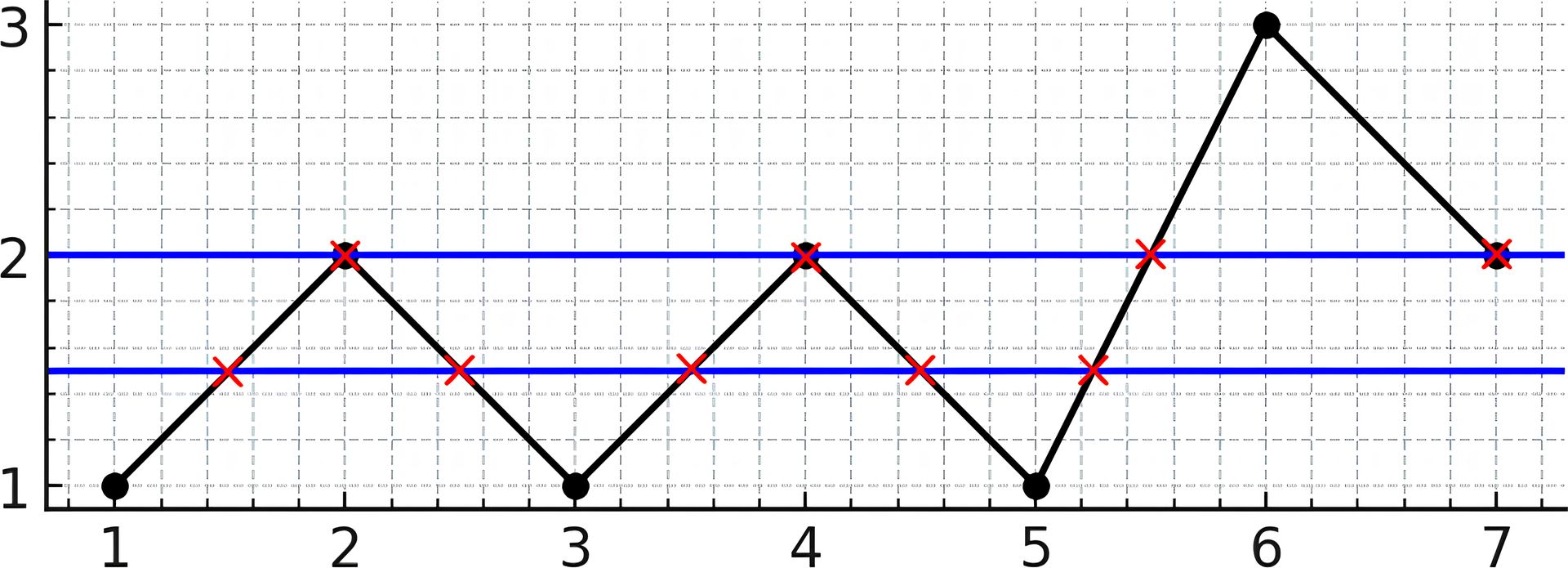
输入:y = [1,2,1,2,1,3,2]
输出:5
解释:如上图所示,水平线 y = 1.5 与折线相交了 5 次(用红叉表示)。水平线 y = 2 与折线相交了 4 次(用红叉表示)。可以证明没有其他水平线可以与折线有超过 5 个点相交。因此,答案是 5。
示例 2:
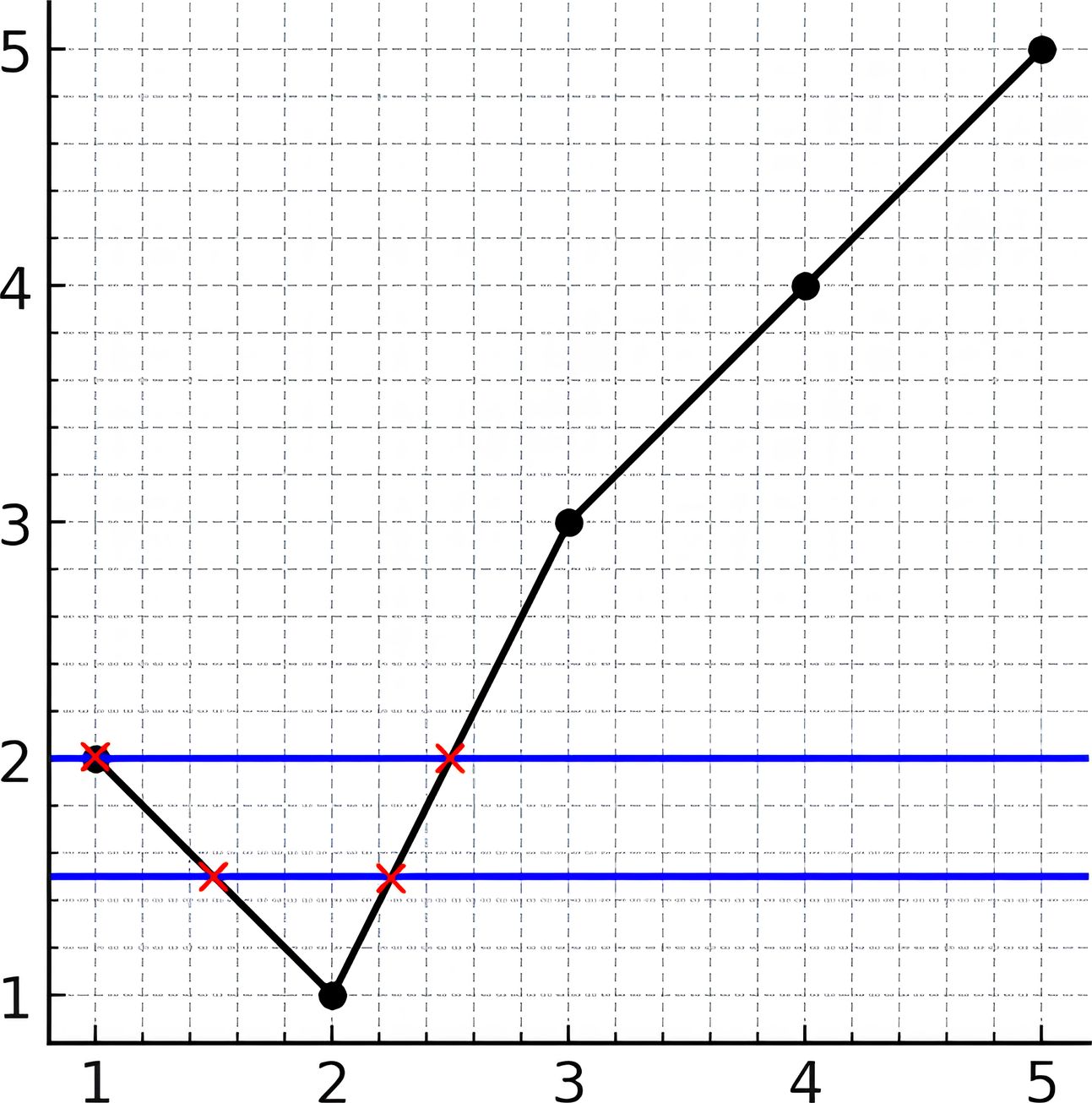
输入:y = [2,1,3,4,5]
输出:2
解释:如上图所示,水平线 y=1.5 与折线相交了 2 次(用红叉表示)。水平线 y=2 与折线相交了 2 次(用红叉表示)。可以证明没有其他水平线可以与折线有超过 2 个点相交。因此,答案是 2。
提示:
2 <= y.length <= 1051 <= y[i] <= 109- 对于范围
[1, n - 1] 内的所有 i,都有 y[i] != y[i + 1]
解法
方法一
思考
折线有 \(n \le 10^5\) 段,枚举所有段对求交为平方级。需要的是水平线 \(y=k+0.5\) 上最多穿过多少段。
将每段投影到竖直方向上的半开区间后,问题化为区间覆盖的最大重叠。坐标先乘 \(2\),并把非端点的端点内缩 \(1\),以避免整点处的重复计数。
用有序表对每个区间做差分数 \(+1/-1\),再扫描前缀即得最大重叠。
 1
 2
 3
 4
 5
 6
 7
 8
 9
10
11
12
13
14 | class Solution:
def maxIntersectionCount(self, y: List[int]) -> int:
n = len(y)
line = defaultdict(int)
for i in range(1, n):
start = 2 * y[i - 1]
end = 2 * y[i] + (0 if i == n - 1 else (-1 if y[i] > y[i - 1] else 1))
line[min(start, end)] += 1
line[max(start, end) + 1] -= 1
ans = intersection = 0
for _, count in sorted(line.items()):
intersection += count
ans = max(ans, intersection)
return ans
|
 1
 2
 3
 4
 5
 6
 7
 8
 9
10
11
12
13
14
15
16
17
18
19
20
21
22 | class Solution {
public int maxIntersectionCount(int[] y) {
final int n = y.length;
int ans = 0;
int intersectionCount = 0;
TreeMap<Integer, Integer> line = new TreeMap<>();
for (int i = 1; i < n; ++i) {
final int start = 2 * y[i - 1];
final int end = 2 * y[i] + (i == n - 1 ? 0 : y[i] > y[i - 1] ? -1 : 1);
line.merge(Math.min(start, end), 1, Integer::sum);
line.merge(Math.max(start, end) + 1, -1, Integer::sum);
}
for (final int count : line.values()) {
intersectionCount += count;
ans = Math.max(ans, intersectionCount);
}
return ans;
}
}
|
 1
 2
 3
 4
 5
 6
 7
 8
 9
10
11
12
13
14
15
16
17
18
19 | class Solution {
public:
int maxIntersectionCount(vector<int>& y) {
int n = y.size();
map<int, int> line;
for (int i = 1; i < n; ++i) {
int start = 2 * y[i - 1];
int end = 2 * y[i] + (i == n - 1 ? 0 : (y[i] > y[i - 1] ? -1 : 1));
++line[min(start, end)];
--line[max(start, end) + 1];
}
int ans = 0, intersection = 0;
for (auto& [_, count] : line) {
intersection += count;
ans = max(ans, intersection);
}
return ans;
}
};
|
 1
 2
 3
 4
 5
 6
 7
 8
 9
10
11
12
13
14
15
16
17
18
19
20
21
22
23
24
25
26
27
28
29
30
31 | func maxIntersectionCount(y []int) (ans int) {
n := len(y)
line := map[int]int{}
for i := 1; i < n; i++ {
start := 2 * y[i-1]
end := 2 * y[i]
if i != n-1 {
if y[i] > y[i-1] {
end--
} else {
end++
}
}
a, b := min(start, end), max(start, end)
line[a]++
line[b+1]--
}
keys := make([]int, 0, len(line))
for k := range line {
keys = append(keys, k)
}
sort.Ints(keys)
intersection := 0
for _, k := range keys {
intersection += line[k]
if ans < intersection {
ans = intersection
}
}
return
}
|