跳转至

2069. 模拟行走机器人 II

题目描述

给你一个在 XY 平面上的 width x height 的网格图,左下角 的格子为 (0, 0) ,右上角 的格子为 (width - 1, height - 1) 。网格图中相邻格子为四个基本方向之一("North""East""South" 和 "West")。一个机器人 初始 在格子 (0, 0) ,方向为 "East" 。

机器人可以根据指令移动指定的 步数 。每一步,它可以执行以下操作。

  1. 沿着当前方向尝试 往前一步 。
  2. 如果机器人下一步将到达的格子 超出了边界 ,机器人会 逆时针 转 90 度,然后再尝试往前一步。

如果机器人完成了指令要求的移动步数,它将停止移动并等待下一个指令。

请你实现 Robot 类:

  • Robot(int width, int height) 初始化一个 width x height 的网格图,机器人初始在 (0, 0) ,方向朝 "East" 。
  • void step(int num) 给机器人下达前进 num 步的指令。
  • int[] getPos() 返回机器人当前所处的格子位置,用一个长度为 2 的数组 [x, y] 表示。
  • String getDir() 返回当前机器人的朝向,为 "North" ,"East" ,"South" 或者 "West" 。


示例 1:

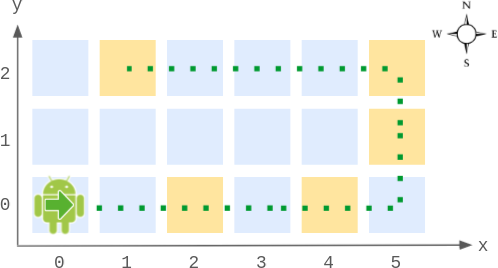
example-1

输入:
["Robot", "step", "step", "getPos", "getDir", "step", "step", "step", "getPos", "getDir"]
[[6, 3], [2], [2], [], [], [2], [1], [4], [], []]
输出:
[null, null, null, [4, 0], "East", null, null, null, [1, 2], "West"]

解释:
Robot robot = new Robot(6, 3); // 初始化网格图,机器人在 (0, 0) ,朝东。
robot.step(2);  // 机器人朝东移动 2 步,到达 (2, 0) ,并朝东。
robot.step(2);  // 机器人朝东移动 2 步,到达 (4, 0) ,并朝东。
robot.getPos(); // 返回 [4, 0]
robot.getDir(); // 返回 "East"
robot.step(2);  // 朝东移动 1 步到达 (5, 0) ,并朝东。
                // 下一步继续往东移动将出界,所以逆时针转变方向朝北。
                // 然后,往北移动 1 步到达 (5, 1) ,并朝北。
robot.step(1);  // 朝北移动 1 步到达 (5, 2) ,并朝  (不是朝西)。
robot.step(4);  // 下一步继续往北移动将出界,所以逆时针转变方向朝西。
                // 然后,移动 4 步到 (1, 2) ,并朝西。
robot.getPos(); // 返回 [1, 2]
robot.getDir(); // 返回 "West"


提示:

  • 2 <= width, height <= 100
  • 1 <= num <= 105
  • stepgetPos 和 getDir 总共 调用次数不超过 104 次。

解法

方法一:分类讨论

我们记 \(mx = width - 1\)\(my = height - 1\),则机器人的运动轨迹是一个以 \((0, 0)\) 为左下角,而 \((mx, my)\) 为右上角的矩形的边界。我们可以将机器人的运动轨迹分为四段:

  1. \((0, 0)\) 沿着 \(x\) 轴正方向运动到 \((mx, 0)\),此时机器人的朝向为 "East"。
  2. \((mx, 0)\) 沿着 \(y\) 轴正方向运动到 \((mx, my)\),此时机器人的朝向为 "North"。
  3. \((mx, my)\) 沿着 \(x\) 轴负方向运动到 \((0, my)\),此时机器人的朝向为 "West"。
  4. \((0, my)\) 沿着 \(y\) 轴负方向运动到 \((0, 0)\),此时机器人的朝向为 "South"。

因此,我们可以将机器人的运动轨迹看作是一个长度为 \(p = 2 \cdot mx + 2 \cdot my\) 的循环。对于每次调用 step(num),我们可以将机器人的当前位置加上 num,然后对 \(p\) 取模,得到机器人的新位置。根据机器人的新位置,我们可以判断出机器人的朝向和坐标。

注意,如果机器人没有移动过,那么它的朝向应该是 "East"。如果机器人移动过,且位置为 \((0, 0)\),则机器人的朝向应该是 "South"。

时间复杂度 \(O(1)\),空间复杂度 \(O(1)\)

 1
 2
 3
 4
 5
 6
 7
 8
 9
10
11
12
13
14
15
16
17
18
19
20
21
22
23
24
25
26
27
28
29
30
31
32
33
34
35
36
37
38
39
40
41
42
43
class Robot:

    def __init__(self, width: int, height: int):
        self.mx = width - 1
        self.my = height - 1
        self.p = 2 * self.mx + 2 * self.my
        self.cur = 0
        self.moved = False

    def step(self, num: int) -> None:
        self.moved = True
        self.cur = (self.cur + num) % self.p

    def getPos(self) -> List[int]:
        d = self.cur
        mx, my = self.mx, self.my
        if 0 <= d <= mx:
            return [d, 0]
        if mx < d <= mx + my:
            return [mx, d - mx]
        if mx + my < d <= 2 * mx + my:
            return [mx - (d - (mx + my)), my]
        return [0, my - (d - (2 * mx + my))]

    def getDir(self) -> str:
        d = self.cur
        mx, my = self.mx, self.my
        if not self.moved:
            return "East"
        if 1 <= d <= mx:
            return "East"
        elif mx < d <= mx + my:
            return "North"
        elif mx + my < d <= 2 * mx + my:
            return "West"
        return "South"


# Your Robot object will be instantiated and called as such:
# obj = Robot(width, height)
# obj.step(num)
# param_2 = obj.getPos()
# param_3 = obj.getDir()
 1
 2
 3
 4
 5
 6
 7
 8
 9
10
11
12
13
14
15
16
17
18
19
20
21
22
23
24
25
26
27
28
29
30
31
32
33
34
35
36
37
38
39
40
41
42
43
44
45
46
47
48
49
50
51
52
53
54
55
56
57
58
59
class Robot {

    private int mx, my, p, cur;
    private boolean moved;

    public Robot(int width, int height) {
        this.mx = width - 1;
        this.my = height - 1;
        this.p = 2 * this.mx + 2 * this.my;
        this.cur = 0;
        this.moved = false;
    }

    public void step(int num) {
        this.moved = true;
        this.cur = (this.cur + num) % this.p;
    }

    public int[] getPos() {
        int d = this.cur;
        int mx = this.mx, my = this.my;

        if (0 <= d && d <= mx) {
            return new int[] {d, 0};
        }
        if (mx < d && d <= mx + my) {
            return new int[] {mx, d - mx};
        }
        if (mx + my < d && d <= 2 * mx + my) {
            return new int[] {mx - (d - (mx + my)), my};
        }
        return new int[] {0, my - (d - (2 * mx + my))};
    }

    public String getDir() {
        int d = this.cur;
        int mx = this.mx, my = this.my;

        if (!this.moved) {
            return "East";
        }
        if (1 <= d && d <= mx) {
            return "East";
        } else if (mx < d && d <= mx + my) {
            return "North";
        } else if (mx + my < d && d <= 2 * mx + my) {
            return "West";
        }
        return "South";
    }
}

/**
 * Your Robot object will be instantiated and called as such:
 * Robot obj = new Robot(width, height);
 * obj.step(num);
 * int[] param_2 = obj.getPos();
 * String param_3 = obj.getDir();
 */
 1
 2
 3
 4
 5
 6
 7
 8
 9
10
11
12
13
14
15
16
17
18
19
20
21
22
23
24
25
26
27
28
29
30
31
32
33
34
35
36
37
38
39
40
41
42
43
44
45
46
47
48
49
50
51
52
53
54
55
56
57
58
59
class Robot {
public:
    int mx, my, p, cur;
    bool moved;

    Robot(int width, int height) {
        mx = width - 1;
        my = height - 1;
        p = 2 * mx + 2 * my;
        cur = 0;
        moved = false;
    }

    void step(int num) {
        moved = true;
        cur = (cur + num) % p;
    }

    vector<int> getPos() {
        int d = cur;
        int mx = this->mx, my = this->my;

        if (0 <= d && d <= mx) {
            return {d, 0};
        }
        if (mx < d && d <= mx + my) {
            return {mx, d - mx};
        }
        if (mx + my < d && d <= 2 * mx + my) {
            return {mx - (d - (mx + my)), my};
        }
        return {0, my - (d - (2 * mx + my))};
    }

    string getDir() {
        int d = cur;
        int mx = this->mx, my = this->my;

        if (!moved) {
            return "East";
        }
        if (1 <= d && d <= mx) {
            return "East";
        } else if (mx < d && d <= mx + my) {
            return "North";
        } else if (mx + my < d && d <= 2 * mx + my) {
            return "West";
        }
        return "South";
    }
};

/**
 * Your Robot object will be instantiated and called as such:
 * Robot* obj = new Robot(width, height);
 * obj->step(num);
 * vector<int> param_2 = obj->getPos();
 * string param_3 = obj->getDir();
 */
 1
 2
 3
 4
 5
 6
 7
 8
 9
10
11
12
13
14
15
16
17
18
19
20
21
22
23
24
25
26
27
28
29
30
31
32
33
34
35
36
37
38
39
40
41
42
43
44
45
46
47
48
49
50
51
52
53
54
55
56
57
58
59
60
61
62
type Robot struct {
    mx, my, p, cur int
    moved          bool
}

func Constructor(width int, height int) Robot {
    mx := width - 1
    my := height - 1
    return Robot{
        mx:    mx,
        my:    my,
        p:     2*mx + 2*my,
        cur:   0,
        moved: false,
    }
}

func (this *Robot) Step(num int) {
    this.moved = true
    this.cur = (this.cur + num) % this.p
}

func (this *Robot) GetPos() []int {
    d := this.cur
    mx, my := this.mx, this.my

    if 0 <= d && d <= mx {
        return []int{d, 0}
    }
    if mx < d && d <= mx+my {
        return []int{mx, d - mx}
    }
    if mx+my < d && d <= 2*mx+my {
        return []int{mx - (d - (mx + my)), my}
    }
    return []int{0, my - (d - (2*mx + my))}
}

func (this *Robot) GetDir() string {
    d := this.cur
    mx, my := this.mx, this.my

    if !this.moved {
        return "East"
    }
    if 1 <= d && d <= mx {
        return "East"
    } else if mx < d && d <= mx+my {
        return "North"
    } else if mx+my < d && d <= 2*mx+my {
        return "West"
    }
    return "South"
}

/**
 * Your Robot object will be instantiated and called as such:
 * obj := Constructor(width, height);
 * obj.Step(num);
 * param_2 := obj.GetPos();
 * param_3 := obj.GetDir();
 */
 1
 2
 3
 4
 5
 6
 7
 8
 9
10
11
12
13
14
15
16
17
18
19
20
21
22
23
24
25
26
27
28
29
30
31
32
33
34
35
36
37
38
39
40
41
42
43
44
45
46
47
48
49
50
51
52
53
54
55
56
57
58
59
60
61
62
63
class Robot {
    private mx: number;
    private my: number;
    private p: number;
    private cur: number;
    private moved: boolean;

    constructor(width: number, height: number) {
        this.mx = width - 1;
        this.my = height - 1;
        this.p = 2 * this.mx + 2 * this.my;
        this.cur = 0;
        this.moved = false;
    }

    step(num: number): void {
        this.moved = true;
        this.cur = (this.cur + num) % this.p;
    }

    getPos(): number[] {
        const d = this.cur;
        const mx = this.mx,
            my = this.my;

        if (0 <= d && d <= mx) {
            return [d, 0];
        }
        if (mx < d && d <= mx + my) {
            return [mx, d - mx];
        }
        if (mx + my < d && d <= 2 * mx + my) {
            return [mx - (d - (mx + my)), my];
        }
        return [0, my - (d - (2 * mx + my))];
    }

    getDir(): string {
        const d = this.cur;
        const mx = this.mx,
            my = this.my;

        if (!this.moved) {
            return 'East';
        }
        if (1 <= d && d <= mx) {
            return 'East';
        } else if (mx < d && d <= mx + my) {
            return 'North';
        } else if (mx + my < d && d <= 2 * mx + my) {
            return 'West';
        }
        return 'South';
    }
}

/**
 * Your Robot object will be instantiated and called as such:
 * var obj = new Robot(width, height)
 * obj.step(num)
 * var param_2 = obj.getPos()
 * var param_3 = obj.getDir()
 */
评论