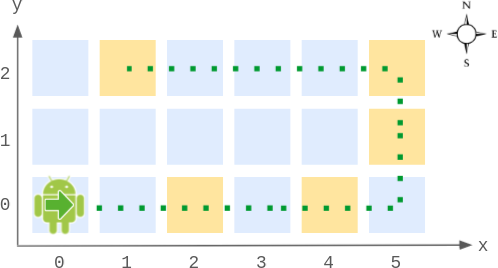
A width x height grid is on an XY-plane with the bottom-left cell at (0, 0) and the top-right cell at (width - 1, height - 1). The grid is aligned with the four cardinal directions ("North", "East", "South", and "West"). A robot is initially at cell (0, 0) facing direction "East".
The robot can be instructed to move for a specific number of steps. For each step, it does the following.
Attempts to move forward one cell in the direction it is facing.
If the cell the robot is moving to is out of bounds, the robot instead turns 90 degrees counterclockwise and retries the step.
After the robot finishes moving the number of steps required, it stops and awaits the next instruction.
Implement the Robot class:
Robot(int width, int height) Initializes the width x height grid with the robot at (0, 0) facing "East".
void step(int num) Instructs the robot to move forward num steps.
int[] getPos() Returns the current cell the robot is at, as an array of length 2, [x, y].
String getDir() Returns the current direction of the robot, "North", "East", "South", or "West".
Example 1:
Input
["Robot", "step", "step", "getPos", "getDir", "step", "step", "step", "getPos", "getDir"]
[[6, 3], [2], [2], [], [], [2], [1], [4], [], []]
Output
[null, null, null, [4, 0], "East", null, null, null, [1, 2], "West"]

Explanation
Robot robot = new Robot(6, 3); // Initialize the grid and the robot at (0, 0) facing East.
robot.step(2); // It moves two steps East to (2, 0), and faces East.
robot.step(2); // It moves two steps East to (4, 0), and faces East.
robot.getPos(); // return [4, 0]
robot.getDir(); // return "East"
robot.step(2); // It moves one step East to (5, 0), and faces East.
// Moving the next step East would be out of bounds, so it turns and faces North.
// Then, it moves one step North to (5, 1), and faces North.
robot.step(1); // It moves one step North to (5, 2), and faces North (not West).
robot.step(4); // Moving the next step North would be out of bounds, so it turns and faces West.
// Then, it moves four steps West to (1, 2), and faces West.
robot.getPos(); // return [1, 2]
robot.getDir(); // return "West"
Constraints:
2 <= width, height <= 100
1 <= num <= 105
At most 104 calls in total will be made to step, getPos, and getDir.
Solutions
Solution 1: Case Analysis
Thinking
num and the call count are large, so stepping cell by cell is too slow. The robot loops the rectangle boundary of length \(p=2(w+h-2)\). Position modulo \(p\) falls on one of four sides.
Map the distance to coordinates and facing. Before any move face East; after moving, the origin faces South (end of the last edge).
Let \(mx = width - 1\) and \(my = height - 1\). The robot's trajectory forms the boundary of a rectangle with \((0, 0)\) as the bottom-left corner and \((mx, my)\) as the top-right corner. We can divide the robot's trajectory into four segments:
From \((0, 0)\) moving along the positive \(x\)-axis to \((mx, 0)\), where the robot faces "East".
From \((mx, 0)\) moving along the positive \(y\)-axis to \((mx, my)\), where the robot faces "North".
From \((mx, my)\) moving along the negative \(x\)-axis to \((0, my)\), where the robot faces "West".
From \((0, my)\) moving along the negative \(y\)-axis to \((0, 0)\), where the robot faces "South".
Therefore, the robot's trajectory can be viewed as a cycle of length \(p = 2 \cdot mx + 2 \cdot my\). For each call to step(num), we add num to the robot's current position and take the result modulo \(p\) to get the robot's new position. Based on the new position, we can determine the robot's direction and coordinates.
Note that if the robot has never moved, its direction should be "East". If the robot has moved and its position is \((0, 0)\), then its direction should be "South".
The time complexity is \(O(1)\), and the space complexity is \(O(1)\).
classRobot:def__init__(self,width:int,height:int):self.mx=width-1self.my=height-1self.p=2*self.mx+2*self.myself.cur=0self.moved=Falsedefstep(self,num:int)->None:self.moved=Trueself.cur=(self.cur+num)%self.pdefgetPos(self)->List[int]:d=self.curmx,my=self.mx,self.myif0<=d<=mx:return[d,0]ifmx<d<=mx+my:return[mx,d-mx]ifmx+my<d<=2*mx+my:return[mx-(d-(mx+my)),my]return[0,my-(d-(2*mx+my))]defgetDir(self)->str:d=self.curmx,my=self.mx,self.myifnotself.moved:return"East"if1<=d<=mx:return"East"elifmx<d<=mx+my:return"North"elifmx+my<d<=2*mx+my:return"West"return"South"# Your Robot object will be instantiated and called as such:# obj = Robot(width, height)# obj.step(num)# param_2 = obj.getPos()# param_3 = obj.getDir()
classRobot{privateintmx,my,p,cur;privatebooleanmoved;publicRobot(intwidth,intheight){this.mx=width-1;this.my=height-1;this.p=2*this.mx+2*this.my;this.cur=0;this.moved=false;}publicvoidstep(intnum){this.moved=true;this.cur=(this.cur+num)%this.p;}publicint[]getPos(){intd=this.cur;intmx=this.mx,my=this.my;if(0<=d&&d<=mx){returnnewint[]{d,0};}if(mx<d&&d<=mx+my){returnnewint[]{mx,d-mx};}if(mx+my<d&&d<=2*mx+my){returnnewint[]{mx-(d-(mx+my)),my};}returnnewint[]{0,my-(d-(2*mx+my))};}publicStringgetDir(){intd=this.cur;intmx=this.mx,my=this.my;if(!this.moved){return"East";}if(1<=d&&d<=mx){return"East";}elseif(mx<d&&d<=mx+my){return"North";}elseif(mx+my<d&&d<=2*mx+my){return"West";}return"South";}}/** * Your Robot object will be instantiated and called as such: * Robot obj = new Robot(width, height); * obj.step(num); * int[] param_2 = obj.getPos(); * String param_3 = obj.getDir(); */
classRobot{public:intmx,my,p,cur;boolmoved;Robot(intwidth,intheight){mx=width-1;my=height-1;p=2*mx+2*my;cur=0;moved=false;}voidstep(intnum){moved=true;cur=(cur+num)%p;}vector<int>getPos(){intd=cur;intmx=this->mx,my=this->my;if(0<=d&&d<=mx){return{d,0};}if(mx<d&&d<=mx+my){return{mx,d-mx};}if(mx+my<d&&d<=2*mx+my){return{mx-(d-(mx+my)),my};}return{0,my-(d-(2*mx+my))};}stringgetDir(){intd=cur;intmx=this->mx,my=this->my;if(!moved){return"East";}if(1<=d&&d<=mx){return"East";}elseif(mx<d&&d<=mx+my){return"North";}elseif(mx+my<d&&d<=2*mx+my){return"West";}return"South";}};/** * Your Robot object will be instantiated and called as such: * Robot* obj = new Robot(width, height); * obj->step(num); * vector<int> param_2 = obj->getPos(); * string param_3 = obj->getDir(); */
typeRobotstruct{mx,my,p,curintmovedbool}funcConstructor(widthint,heightint)Robot{mx:=width-1my:=height-1returnRobot{mx:mx,my:my,p:2*mx+2*my,cur:0,moved:false,}}func(this*Robot)Step(numint){this.moved=truethis.cur=(this.cur+num)%this.p}func(this*Robot)GetPos()[]int{d:=this.curmx,my:=this.mx,this.myif0<=d&&d<=mx{return[]int{d,0}}ifmx<d&&d<=mx+my{return[]int{mx,d-mx}}ifmx+my<d&&d<=2*mx+my{return[]int{mx-(d-(mx+my)),my}}return[]int{0,my-(d-(2*mx+my))}}func(this*Robot)GetDir()string{d:=this.curmx,my:=this.mx,this.myif!this.moved{return"East"}if1<=d&&d<=mx{return"East"}elseifmx<d&&d<=mx+my{return"North"}elseifmx+my<d&&d<=2*mx+my{return"West"}return"South"}/** * Your Robot object will be instantiated and called as such: * obj := Constructor(width, height); * obj.Step(num); * param_2 := obj.GetPos(); * param_3 := obj.GetDir(); */
classRobot{privatemx:number;privatemy:number;privatep:number;privatecur:number;privatemoved:boolean;constructor(width:number,height:number){this.mx=width-1;this.my=height-1;this.p=2*this.mx+2*this.my;this.cur=0;this.moved=false;}step(num:number):void{this.moved=true;this.cur=(this.cur+num)%this.p;}getPos():number[]{constd=this.cur;constmx=this.mx,my=this.my;if(0<=d&&d<=mx){return[d,0];}if(mx<d&&d<=mx+my){return[mx,d-mx];}if(mx+my<d&&d<=2*mx+my){return[mx-(d-(mx+my)),my];}return[0,my-(d-(2*mx+my))];}getDir():string{constd=this.cur;constmx=this.mx,my=this.my;if(!this.moved){return'East';}if(1<=d&&d<=mx){return'East';}elseif(mx<d&&d<=mx+my){return'North';}elseif(mx+my<d&&d<=2*mx+my){return'West';}return'South';}}/** * Your Robot object will be instantiated and called as such: * var obj = new Robot(width, height) * obj.step(num) * var param_2 = obj.getPos() * var param_3 = obj.getDir() */