Skip to content

2646. Minimize the Total Price of the Trips

SourceWeekly Contest 341 Q4DifficultyHardRating2238

Description

There exists an undirected and unrooted tree with n nodes indexed from 0 to n - 1. You are given the integer n and a 2D integer array edges of length n - 1, where edges[i] = [ai, bi] indicates that there is an edge between nodes ai and bi in the tree.

Each node has an associated price. You are given an integer array price, where price[i] is the price of the ith node.

The price sum of a given path is the sum of the prices of all nodes lying on that path.

Additionally, you are given a 2D integer array trips, where trips[i] = [starti, endi] indicates that you start the ith trip from the node starti and travel to the node endi by any path you like.

Before performing your first trip, you can choose some non-adjacent nodes and halve the prices.

Return the minimum total price sum to perform all the given trips.


Example 1:
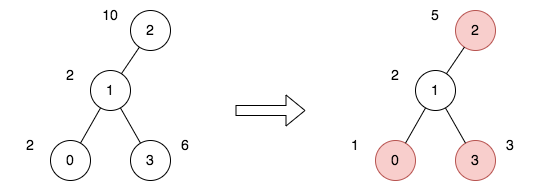
Input: n = 4, edges = [[0,1],[1,2],[1,3]], price = [2,2,10,6], trips = [[0,3],[2,1],[2,3]]
Output: 23
Explanation: The diagram above denotes the tree after rooting it at node 2. The first part shows the initial tree and the second part shows the tree after choosing nodes 0, 2, and 3, and making their price half.
For the 1st trip, we choose path [0,1,3]. The price sum of that path is 1 + 2 + 3 = 6.
For the 2nd trip, we choose path [2,1]. The price sum of that path is 2 + 5 = 7.
For the 3rd trip, we choose path [2,1,3]. The price sum of that path is 5 + 2 + 3 = 10.
The total price sum of all trips is 6 + 7 + 10 = 23.
It can be proven, that 23 is the minimum answer that we can achieve.

Example 2:
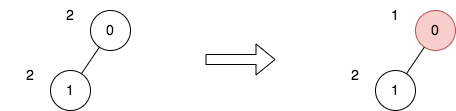
Input: n = 2, edges = [[0,1]], price = [2,2], trips = [[0,0]]
Output: 1
Explanation: The diagram above denotes the tree after rooting it at node 0. The first part shows the initial tree and the second part shows the tree after choosing node 0, and making its price half.
For the 1st trip, we choose path [0]. The price sum of that path is 1.
The total price sum of all trips is 1. It can be proven, that 1 is the minimum answer that we can achieve.


Constraints:

  • 1 <= n <= 50
  • edges.length == n - 1
  • 0 <= ai, bi <= n - 1
  • edges represents a valid tree.
  • price.length == n
  • price[i] is an even integer.
  • 1 <= price[i] <= 1000
  • 1 <= trips.length <= 100
  • 0 <= starti, endi <= n - 1

Solutions

Solution 1: Tree DP

Thinking

Trip nodes are priced, and adjacent nodes cannot both be halved. Searching the half-price set after listing paths is exponential; \(n \le 50\) allows counting visits, then a tree DP decides the halves.

DFS each trip into \(cnt\). The DP returns (full price, half price) at a node: children may take either min if this node stays full, and must stay full if this node is halved. The root takes the better of the two.

Count the nodes each trip passes and store the totals in \(cnt\), where \(cnt[i]\) is how many trips visit node \(i\). The search \(dfs(i, fa, k)\) walks from \(i\) toward \(k\). It increments every node on the path and rolls the count back when \(k\) is not in that subtree. \(fa\) is the parent of \(i\).

A second search, \(dfs2(i, fa)\), returns the minimum price of the subtree in two cases: node \(i\) keeps its price, or node \(i\) is halved. For node \(i\) those costs start at \(a = cnt[i] \times price[i]\) and \(b = a / 2\).

Each child \(j\) likewise returns \((x, y) = dfs2(j, i)\). If \(i\) stays at full price, \(j\) may choose either option, so \(a = a + \min(x, y)\). If \(i\) is halved, \(j\) must stay at full price, so \(b = b + x\).

\(dfs2\) returns \((a, b)\). Calling \(dfs2(0, -1)\) and taking the smaller component is the answer.

The time complexity is \(O(mn)\), and the space complexity is \(O(n)\), where \(m\) is the number of trips and \(n\) is the number of nodes.

 1
 2
 3
 4
 5
 6
 7
 8
 9
10
11
12
13
14
15
16
17
18
19
20
21
22
23
24
25
26
27
28
29
30
31
class Solution:
    def minimumTotalPrice(
        self, n: int, edges: List[List[int]], price: List[int], trips: List[List[int]]
    ) -> int:
        def dfs(i: int, fa: int, k: int) -> bool:
            cnt[i] += 1
            if i == k:
                return True
            ok = any(j != fa and dfs(j, i, k) for j in g[i])
            if not ok:
                cnt[i] -= 1
            return ok

        def dfs2(i: int, fa: int) -> (int, int):
            a = cnt[i] * price[i]
            b = a // 2
            for j in g[i]:
                if j != fa:
                    x, y = dfs2(j, i)
                    a += min(x, y)
                    b += x
            return a, b

        g = [[] for _ in range(n)]
        for a, b in edges:
            g[a].append(b)
            g[b].append(a)
        cnt = Counter()
        for start, end in trips:
            dfs(start, -1, end)
        return min(dfs2(0, -1))
 1
 2
 3
 4
 5
 6
 7
 8
 9
10
11
12
13
14
15
16
17
18
19
20
21
22
23
24
25
26
27
28
29
30
31
32
33
34
35
36
37
38
39
40
41
42
43
44
45
46
47
48
49
50
51
52
53
54
55
56
class Solution {
    private List<Integer>[] g;
    private int[] price;
    private int[] cnt;

    public int minimumTotalPrice(int n, int[][] edges, int[] price, int[][] trips) {
        this.price = price;
        cnt = new int[n];
        g = new List[n];
        Arrays.setAll(g, k -> new ArrayList<>());
        for (var e : edges) {
            int a = e[0], b = e[1];
            g[a].add(b);
            g[b].add(a);
        }
        for (var t : trips) {
            int start = t[0], end = t[1];
            dfs(start, -1, end);
        }
        int[] ans = dfs2(0, -1);
        return Math.min(ans[0], ans[1]);
    }

    private boolean dfs(int i, int fa, int k) {
        ++cnt[i];
        if (i == k) {
            return true;
        }
        boolean ok = false;
        for (int j : g[i]) {
            if (j != fa) {
                ok = dfs(j, i, k);
                if (ok) {
                    break;
                }
            }
        }
        if (!ok) {
            --cnt[i];
        }
        return ok;
    }

    private int[] dfs2(int i, int fa) {
        int a = cnt[i] * price[i];
        int b = a >> 1;
        for (int j : g[i]) {
            if (j != fa) {
                var t = dfs2(j, i);
                a += Math.min(t[0], t[1]);
                b += t[0];
            }
        }
        return new int[] {a, b};
    }
}
 1
 2
 3
 4
 5
 6
 7
 8
 9
10
11
12
13
14
15
16
17
18
19
20
21
22
23
24
25
26
27
28
29
30
31
32
33
34
35
36
37
38
39
40
41
42
43
44
45
46
47
48
49
class Solution {
public:
    int minimumTotalPrice(int n, vector<vector<int>>& edges, vector<int>& price, vector<vector<int>>& trips) {
        vector<vector<int>> g(n);
        vector<int> cnt(n);
        for (auto& e : edges) {
            int a = e[0], b = e[1];
            g[a].push_back(b);
            g[b].push_back(a);
        }
        function<bool(int, int, int)> dfs = [&](int i, int fa, int k) -> bool {
            ++cnt[i];
            if (i == k) {
                return true;
            }
            bool ok = false;
            for (int j : g[i]) {
                if (j != fa) {
                    ok = dfs(j, i, k);
                    if (ok) {
                        break;
                    }
                }
            }
            if (!ok) {
                --cnt[i];
            }
            return ok;
        };
        function<pair<int, int>(int, int)> dfs2 = [&](int i, int fa) -> pair<int, int> {
            int a = cnt[i] * price[i];
            int b = a >> 1;
            for (int j : g[i]) {
                if (j != fa) {
                    auto [x, y] = dfs2(j, i);
                    a += min(x, y);
                    b += x;
                }
            }
            return {a, b};
        };
        for (auto& t : trips) {
            int start = t[0], end = t[1];
            dfs(start, -1, end);
        }
        auto [a, b] = dfs2(0, -1);
        return min(a, b);
    }
};
 1
 2
 3
 4
 5
 6
 7
 8
 9
10
11
12
13
14
15
16
17
18
19
20
21
22
23
24
25
26
27
28
29
30
31
32
33
34
35
36
37
38
39
40
41
42
43
44
45
46
47
48
func minimumTotalPrice(n int, edges [][]int, price []int, trips [][]int) int {
    g := make([][]int, n)
    for _, e := range edges {
        a, b := e[0], e[1]
        g[a] = append(g[a], b)
        g[b] = append(g[b], a)
    }
    cnt := make([]int, n)
    var dfs func(int, int, int) bool
    dfs = func(i, fa, k int) bool {
        cnt[i]++
        if i == k {
            return true
        }
        ok := false
        for _, j := range g[i] {
            if j != fa {
                ok = dfs(j, i, k)
                if ok {
                    break
                }
            }
        }
        if !ok {
            cnt[i]--
        }
        return ok
    }
    for _, t := range trips {
        start, end := t[0], t[1]
        dfs(start, -1, end)
    }
    var dfs2 func(int, int) (int, int)
    dfs2 = func(i, fa int) (int, int) {
        a := price[i] * cnt[i]
        b := a >> 1
        for _, j := range g[i] {
            if j != fa {
                x, y := dfs2(j, i)
                a += min(x, y)
                b += x
            }
        }
        return a, b
    }
    a, b := dfs2(0, -1)
    return min(a, b)
}
 1
 2
 3
 4
 5
 6
 7
 8
 9
10
11
12
13
14
15
16
17
18
19
20
21
22
23
24
25
26
27
28
29
30
31
32
33
34
35
36
37
38
39
40
41
42
43
44
45
46
47
48
49
function minimumTotalPrice(
    n: number,
    edges: number[][],
    price: number[],
    trips: number[][],
): number {
    const g: number[][] = Array.from({ length: n }, () => []);
    for (const [a, b] of edges) {
        g[a].push(b);
        g[b].push(a);
    }
    const cnt: number[] = new Array(n).fill(0);
    const dfs = (i: number, fa: number, k: number): boolean => {
        ++cnt[i];
        if (i === k) {
            return true;
        }
        let ok = false;
        for (const j of g[i]) {
            if (j !== fa) {
                ok = dfs(j, i, k);
                if (ok) {
                    break;
                }
            }
        }
        if (!ok) {
            --cnt[i];
        }
        return ok;
    };
    for (const [start, end] of trips) {
        dfs(start, -1, end);
    }
    const dfs2 = (i: number, fa: number): number[] => {
        let a: number = price[i] * cnt[i];
        let b: number = a >> 1;
        for (const j of g[i]) {
            if (j !== fa) {
                const [x, y] = dfs2(j, i);
                a += Math.min(x, y);
                b += x;
            }
        }
        return [a, b];
    };
    const [a, b] = dfs2(0, -1);
    return Math.min(a, b);
}

Comments