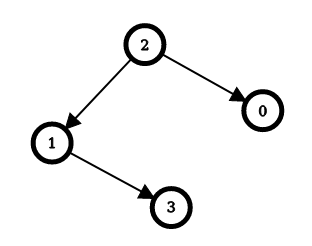
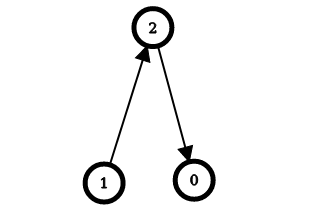
There is a simple directed graph with n nodes labeled from 0 to n - 1. The graph would form a tree if its edges were bi-directional.
You are given an integer n and a 2D integer array edges, where edges[i] = [ui, vi] represents a directed edge going from node ui to node vi.
An edge reversal changes the direction of an edge, i.e., a directed edge going from node ui to node vi becomes a directed edge going from node vi to node ui.
For every node i in the range [0, n - 1], your task is to independently calculate the minimum number of edge reversals required so it is possible to reach any other node starting from node i through a sequence of directed edges.
Return an integer array answer, where answer[i] is theminimum number of edge reversals required so it is possible to reach any other node starting from node i through a sequence of directed edges.
Example 1:
Input: n = 4, edges = [[2,0],[2,1],[1,3]]
Output: [1,1,0,2]
Explanation: The image above shows the graph formed by the edges.
For node 0: after reversing the edge [2,0], it is possible to reach any other node starting from node 0.
So, answer[0] = 1.
For node 1: after reversing the edge [2,1], it is possible to reach any other node starting from node 1.
So, answer[1] = 1.
For node 2: it is already possible to reach any other node starting from node 2.
So, answer[2] = 0.
For node 3: after reversing the edges [1,3] and [2,1], it is possible to reach any other node starting from node 3.
So, answer[3] = 2.
Example 2:
Input: n = 3, edges = [[1,2],[2,0]]
Output: [2,0,1]
Explanation: The image above shows the graph formed by the edges.
For node 0: after reversing the edges [2,0] and [1,2], it is possible to reach any other node starting from node 0.
So, answer[0] = 2.
For node 1: it is already possible to reach any other node starting from node 1.
So, answer[1] = 0.
For node 2: after reversing the edge [1, 2], it is possible to reach any other node starting from node 2.
So, answer[2] = 1.
Constraints:
2 <= n <= 105
edges.length == n - 1
edges[i].length == 2
0 <= ui == edges[i][0] < n
0 <= vi == edges[i][1] < n
ui != vi
The input is generated such that if the edges were bi-directional, the graph would be a tree.
Solutions
Solution 1
Thinking
For every root we want the fewest reversals that make the whole tree reachable. A first DFS from \(0\) counts backward edges as \(ans[0]\). Rerooting along an edge changes the answer by \(\pm 1\), so a second DFS fills every root.
For every node as root we want the fewest reversals that make the whole tree reachable from that node. With \(n \le 10^5\), searching once per root is \(O(n^2)\), and recursing from \(0\) to count backward edges is too deep: a chain makes the call depth \(n\).
Store a directed edge \(x \to y\) as weight \(1\) when walking from \(x\) to \(y\) and weight \(-1\) when walking back. While the root is \(0\), a negative weight on the step to a child means the edge points away from the child and must be reversed. Moving the root to child \(j\) changes the answer to \(ans[i] + k\): weight \(1\) was already correct and now needs a reversal, weight \(-1\) was a reversal and is no longer needed.
Both walks use an explicit stack and go from a parent to its children. The first walk only adds the backward edges into \(ans[0]\). The second writes each new root with that increment. A frame is \((node, parent)\), and a child is processed only after its parent's answer is known.