Skip to content

606. Construct String from Binary Tree

DifficultyMedium

Description

Given the root node of a binary tree, your task is to create a string representation of the tree following a specific set of formatting rules. The representation should be based on a preorder traversal of the binary tree and must adhere to the following guidelines:

  • Node Representation: Each node in the tree should be represented by its integer value.

  • Parentheses for Children: If a node has at least one child (either left or right), its children should be represented inside parentheses. Specifically:

    • If a node has a left child, the value of the left child should be enclosed in parentheses immediately following the node's value.
    • If a node has a right child, the value of the right child should also be enclosed in parentheses. The parentheses for the right child should follow those of the left child.
  • Omitting Empty Parentheses: Any empty parentheses pairs (i.e., ()) should be omitted from the final string representation of the tree, with one specific exception: when a node has a right child but no left child. In such cases, you must include an empty pair of parentheses to indicate the absence of the left child. This ensures that the one-to-one mapping between the string representation and the original binary tree structure is maintained.

    In summary, empty parentheses pairs should be omitted when a node has only a left child or no children. However, when a node has a right child but no left child, an empty pair of parentheses must precede the representation of the right child to reflect the tree's structure accurately.


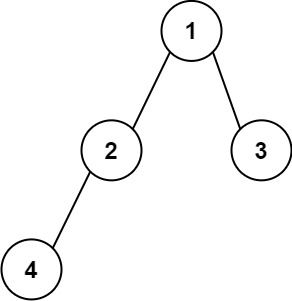
Example 1:

Input: root = [1,2,3,4]
Output: "1(2(4))(3)"
Explanation: Originally, it needs to be "1(2(4)())(3()())", but you need to omit all the empty parenthesis pairs. And it will be "1(2(4))(3)".

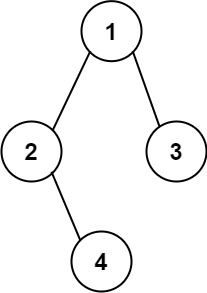
Example 2:

Input: root = [1,2,3,null,4]
Output: "1(2()(4))(3)"
Explanation: Almost the same as the first example, except the () after 2 is necessary to indicate the absence of a left child for 2 and the presence of a right child.


Constraints:

  • The number of nodes in the tree is in the range [1, 104].
  • -1000 <= Node.val <= 1000

Solutions

Solution 1

Thinking

A preorder walk with parentheses can recover the tree, but the empty-parenthesis rule is asymmetric: a missing right child may omit (), a missing left child may not.

Recurse in three cases: a leaf is just the value; no right child wraps only the left; otherwise wrap both. That matches the required omission rule.

 1
 2
 3
 4
 5
 6
 7
 8
 9
10
11
12
13
14
15
16
17
18
# Definition for a binary tree node.
# class TreeNode:
#     def __init__(self, val=0, left=None, right=None):
#         self.val = val
#         self.left = left
#         self.right = right
class Solution:
    def tree2str(self, root: Optional[TreeNode]) -> str:
        def dfs(root):
            if root is None:
                return ''
            if root.left is None and root.right is None:
                return str(root.val)
            if root.right is None:
                return f'{root.val}({dfs(root.left)})'
            return f'{root.val}({dfs(root.left)})({dfs(root.right)})'

        return dfs(root)
 1
 2
 3
 4
 5
 6
 7
 8
 9
10
11
12
13
14
15
16
17
18
19
20
21
22
23
24
25
26
27
28
29
/**
 * Definition for a binary tree node.
 * public class TreeNode {
 *     int val;
 *     TreeNode left;
 *     TreeNode right;
 *     TreeNode() {}
 *     TreeNode(int val) { this.val = val; }
 *     TreeNode(int val, TreeNode left, TreeNode right) {
 *         this.val = val;
 *         this.left = left;
 *         this.right = right;
 *     }
 * }
 */
class Solution {
    public String tree2str(TreeNode root) {
        if (root == null) {
            return "";
        }
        if (root.left == null && root.right == null) {
            return root.val + "";
        }
        if (root.right == null) {
            return root.val + "(" + tree2str(root.left) + ")";
        }
        return root.val + "(" + tree2str(root.left) + ")(" + tree2str(root.right) + ")";
    }
}
 1
 2
 3
 4
 5
 6
 7
 8
 9
10
11
12
13
14
15
16
17
18
19
20
/**
 * Definition for a binary tree node.
 * struct TreeNode {
 *     int val;
 *     TreeNode *left;
 *     TreeNode *right;
 *     TreeNode() : val(0), left(nullptr), right(nullptr) {}
 *     TreeNode(int x) : val(x), left(nullptr), right(nullptr) {}
 *     TreeNode(int x, TreeNode *left, TreeNode *right) : val(x), left(left), right(right) {}
 * };
 */
class Solution {
public:
    string tree2str(TreeNode* root) {
        if (!root) return "";
        if (!root->left && !root->right) return to_string(root->val);
        if (!root->right) return to_string(root->val) + "(" + tree2str(root->left) + ")";
        return to_string(root->val) + "(" + tree2str(root->left) + ")(" + tree2str(root->right) + ")";
    }
};
 1
 2
 3
 4
 5
 6
 7
 8
 9
10
11
12
13
14
15
16
17
18
19
20
/**
 * Definition for a binary tree node.
 * type TreeNode struct {
 *     Val int
 *     Left *TreeNode
 *     Right *TreeNode
 * }
 */
func tree2str(root *TreeNode) string {
    if root == nil {
        return ""
    }
    if root.Left == nil && root.Right == nil {
        return strconv.Itoa(root.Val)
    }
    if root.Right == nil {
        return strconv.Itoa(root.Val) + "(" + tree2str(root.Left) + ")"
    }
    return strconv.Itoa(root.Val) + "(" + tree2str(root.Left) + ")(" + tree2str(root.Right) + ")"
}
 1
 2
 3
 4
 5
 6
 7
 8
 9
10
11
12
13
14
15
16
17
18
19
20
21
22
23
24
25
/**
 * Definition for a binary tree node.
 * class TreeNode {
 *     val: number
 *     left: TreeNode | null
 *     right: TreeNode | null
 *     constructor(val?: number, left?: TreeNode | null, right?: TreeNode | null) {
 *         this.val = (val===undefined ? 0 : val)
 *         this.left = (left===undefined ? null : left)
 *         this.right = (right===undefined ? null : right)
 *     }
 * }
 */

function tree2str(root: TreeNode | null): string {
    if (root == null) {
        return '';
    }
    if (root.left == null && root.right == null) {
        return `${root.val}`;
    }
    return `${root.val}(${root.left ? tree2str(root.left) : ''})${
        root.right ? `(${tree2str(root.right)})` : ''
    }`;
}
 1
 2
 3
 4
 5
 6
 7
 8
 9
10
11
12
13
14
15
16
17
18
19
20
21
22
23
24
25
26
27
28
29
30
31
32
33
34
35
36
37
38
39
40
41
42
43
44
45
46
47
48
// Definition for a binary tree node.
// #[derive(Debug, PartialEq, Eq)]
// pub struct TreeNode {
//   pub val: i32,
//   pub left: Option<Rc<RefCell<TreeNode>>>,
//   pub right: Option<Rc<RefCell<TreeNode>>>,
// }
//
// impl TreeNode {
//   #[inline]
//   pub fn new(val: i32) -> Self {
//     TreeNode {
//       val,
//       left: None,
//       right: None
//     }
//   }
// }
use std::cell::RefCell;
use std::rc::Rc;
impl Solution {
    fn dfs(root: &Option<Rc<RefCell<TreeNode>>>, res: &mut String) {
        if let Some(node) = root {
            let node = node.borrow();
            res.push_str(node.val.to_string().as_str());

            if node.left.is_none() && node.right.is_none() {
                return;
            }
            res.push('(');
            if node.left.is_some() {
                Self::dfs(&node.left, res);
            }
            res.push(')');
            if node.right.is_some() {
                res.push('(');
                Self::dfs(&node.right, res);
                res.push(')');
            }
        }
    }

    pub fn tree2str(root: Option<Rc<RefCell<TreeNode>>>) -> String {
        let mut res = String::new();
        Self::dfs(&root, &mut res);
        res
    }
}

Solution 2: Explicit-Stack Preorder

Thinking

A preorder string with parentheses can be built by recursion: a leaf is just the value, a missing right child wraps only the left, and otherwise both children are wrapped. That is correct on a short tree.

The tree can contain \(10^4\) nodes. A left chain makes this walk recurse once per node and overflow the call stack. Returning each subtree as a new string also copies the same characters many times.

The characters are already ordered by the preorder walk and the empty-parenthesis rule, so a subtree does not need to return a finished string.

One buffer and an explicit stack follow that order. On entry the walk writes the current value; if the node is not a leaf it writes (, then pushes an exit marker and the left child. After the left subtree it writes ), and wraps the right child the same way when one exists. A leaf leaves only its value, and a missing left child leaves an empty pair.

An explicit stack writes the preorder string into one buffer. On entry we write the node value. A leaf stops there. Otherwise we write (, push a marker meaning the left subtree is finished, and push the left child. When that marker pops we write ). If a right child exists, we write ( and push that child with its own closing marker.

The time complexity is \(O(n)\), and the space complexity is \(O(n)\), where \(n\) is the number of nodes in the binary tree.

 1
 2
 3
 4
 5
 6
 7
 8
 9
10
11
12
13
14
15
16
17
18
19
20
21
22
23
24
25
26
27
28
29
30
31
# Definition for a binary tree node.
# class TreeNode:
#     def __init__(self, val=0, left=None, right=None):
#         self.val = val
#         self.left = left
#         self.right = right
class Solution:
    def tree2str(self, root: Optional[TreeNode]) -> str:
        parts = []
        stk = [(root, 0)]
        while stk:
            node, state = stk.pop()
            if state == 0:
                if node is None:
                    continue
                parts.append(str(node.val))
                if node.left is None and node.right is None:
                    continue
                parts.append('(')
                stk.append((node, 1))
                stk.append((node.left, 0))
                continue
            if state == 1:
                parts.append(')')
                if node.right is not None:
                    parts.append('(')
                    stk.append((node, 2))
                    stk.append((node.right, 0))
                continue
            parts.append(')')
        return ''.join(parts)
 1
 2
 3
 4
 5
 6
 7
 8
 9
10
11
12
13
14
15
16
17
18
19
20
21
22
23
24
25
26
27
28
29
30
31
32
33
34
35
36
37
38
39
40
41
42
43
44
45
46
47
48
49
50
51
52
53
54
55
56
57
58
59
60
61
62
/**
 * Definition for a binary tree node.
 * public class TreeNode {
 *     int val;
 *     TreeNode left;
 *     TreeNode right;
 *     TreeNode() {}
 *     TreeNode(int val) { this.val = val; }
 *     TreeNode(int val, TreeNode left, TreeNode right) {
 *         this.val = val;
 *         this.left = left;
 *         this.right = right;
 *     }
 * }
 */
class Solution {
    private static class Frame {
        TreeNode node;
        int state;

        Frame(TreeNode node, int state) {
            this.node = node;
            this.state = state;
        }
    }

    public String tree2str(TreeNode root) {
        StringBuilder sb = new StringBuilder();
        Deque<Frame> stk = new ArrayDeque<>();
        stk.push(new Frame(root, 0));
        while (!stk.isEmpty()) {
            Frame cur = stk.pop();
            TreeNode node = cur.node;
            if (cur.state == 0) {
                if (node == null) {
                    continue;
                }
                sb.append(node.val);
                if (node.left == null && node.right == null) {
                    continue;
                }
                sb.append('(');
                stk.push(new Frame(node, 1));
                if (node.left != null) {
                    stk.push(new Frame(node.left, 0));
                }
                continue;
            }
            if (cur.state == 1) {
                sb.append(')');
                if (node.right != null) {
                    sb.append('(');
                    stk.push(new Frame(node, 2));
                    stk.push(new Frame(node.right, 0));
                }
                continue;
            }
            sb.append(')');
        }
        return sb.toString();
    }
}
 1
 2
 3
 4
 5
 6
 7
 8
 9
10
11
12
13
14
15
16
17
18
19
20
21
22
23
24
25
26
27
28
29
30
31
32
33
34
35
36
37
38
39
40
41
42
43
44
45
46
/**
 * Definition for a binary tree node.
 * struct TreeNode {
 *     int val;
 *     TreeNode *left;
 *     TreeNode *right;
 *     TreeNode() : val(0), left(nullptr), right(nullptr) {}
 *     TreeNode(int x) : val(x), left(nullptr), right(nullptr) {}
 *     TreeNode(int x, TreeNode *left, TreeNode *right) : val(x), left(left), right(right) {}
 * };
 */
class Solution {
public:
    string tree2str(TreeNode* root) {
        string res;
        vector<pair<TreeNode*, int>> stk{{root, 0}};
        while (!stk.empty()) {
            auto [node, state] = stk.back();
            stk.pop_back();
            if (state == 0) {
                if (!node) {
                    continue;
                }
                res += to_string(node->val);
                if (!node->left && !node->right) {
                    continue;
                }
                res.push_back('(');
                stk.emplace_back(node, 1);
                stk.emplace_back(node->left, 0);
                continue;
            }
            if (state == 1) {
                res.push_back(')');
                if (node->right) {
                    res.push_back('(');
                    stk.emplace_back(node, 2);
                    stk.emplace_back(node->right, 0);
                }
                continue;
            }
            res.push_back(')');
        }
        return res;
    }
};
 1
 2
 3
 4
 5
 6
 7
 8
 9
10
11
12
13
14
15
16
17
18
19
20
21
22
23
24
25
26
27
28
29
30
31
32
33
34
35
36
37
38
39
40
41
42
43
/**
 * Definition for a binary tree node.
 * type TreeNode struct {
 *     Val int
 *     Left *TreeNode
 *     Right *TreeNode
 * }
 */
func tree2str(root *TreeNode) string {
    var b strings.Builder
    type frame struct {
        node  *TreeNode
        state int
    }
    stk := []frame{{root, 0}}
    for len(stk) > 0 {
        cur := stk[len(stk)-1]
        stk = stk[:len(stk)-1]
        node, state := cur.node, cur.state
        if state == 0 {
            if node == nil {
                continue
            }
            b.WriteString(strconv.Itoa(node.Val))
            if node.Left == nil && node.Right == nil {
                continue
            }
            b.WriteByte('(')
            stk = append(stk, frame{node, 1}, frame{node.Left, 0})
            continue
        }
        if state == 1 {
            b.WriteByte(')')
            if node.Right != nil {
                b.WriteByte('(')
                stk = append(stk, frame{node, 2}, frame{node.Right, 0})
            }
            continue
        }
        b.WriteByte(')')
    }
    return b.String()
}
 1
 2
 3
 4
 5
 6
 7
 8
 9
10
11
12
13
14
15
16
17
18
19
20
21
22
23
24
25
26
27
28
29
30
31
32
33
34
35
36
37
38
39
40
41
42
43
44
45
/**
 * Definition for a binary tree node.
 * class TreeNode {
 *     val: number
 *     left: TreeNode | null
 *     right: TreeNode | null
 *     constructor(val?: number, left?: TreeNode | null, right?: TreeNode | null) {
 *         this.val = (val===undefined ? 0 : val)
 *         this.left = (left===undefined ? null : left)
 *         this.right = (right===undefined ? null : right)
 *     }
 * }
 */

function tree2str(root: TreeNode | null): string {
    const parts: string[] = [];
    const stk: [TreeNode | null, number][] = [[root, 0]];
    while (stk.length) {
        const [node, state] = stk.pop()!;
        if (state === 0) {
            if (!node) {
                continue;
            }
            parts.push(`${node.val}`);
            if (!node.left && !node.right) {
                continue;
            }
            parts.push('(');
            stk.push([node, 1]);
            stk.push([node.left, 0]);
            continue;
        }
        if (state === 1) {
            parts.push(')');
            if (node && node.right) {
                parts.push('(');
                stk.push([node, 2]);
                stk.push([node.right, 0]);
            }
            continue;
        }
        parts.push(')');
    }
    return parts.join('');
}
 1
 2
 3
 4
 5
 6
 7
 8
 9
10
11
12
13
14
15
16
17
18
19
20
21
22
23
24
25
26
27
28
29
30
31
32
33
34
35
36
37
38
39
40
41
42
43
44
45
46
47
48
49
50
51
52
53
54
55
56
57
58
59
// Definition for a binary tree node.
// #[derive(Debug, PartialEq, Eq)]
// pub struct TreeNode {
//   pub val: i32,
//   pub left: Option<Rc<RefCell<TreeNode>>>,
//   pub right: Option<Rc<RefCell<TreeNode>>>,
// }
//
// impl TreeNode {
//   #[inline]
//   pub fn new(val: i32) -> Self {
//     TreeNode {
//       val,
//       left: None,
//       right: None
//     }
//   }
// }
use std::cell::RefCell;
use std::rc::Rc;

impl Solution {
    pub fn tree2str(root: Option<Rc<RefCell<TreeNode>>>) -> String {
        let mut res = String::new();
        let mut stk = vec![(root, 0)];
        while let Some((node, state)) = stk.pop() {
            if state == 0 {
                if let Some(node) = node {
                    let (val, left, leaf) = {
                        let b = node.borrow();
                        (b.val, b.left.clone(), b.left.is_none() && b.right.is_none())
                    };
                    res.push_str(&val.to_string());
                    if leaf {
                        continue;
                    }
                    res.push('(');
                    stk.push((Some(node), 1));
                    if left.is_some() {
                        stk.push((left, 0));
                    }
                }
            } else if state == 1 {
                if let Some(node) = node {
                    res.push(')');
                    let right = node.borrow().right.clone();
                    if right.is_some() {
                        res.push('(');
                        stk.push((Some(node), 2));
                        stk.push((right, 0));
                    }
                }
            } else {
                res.push(')');
            }
        }
        res
    }
}

Comments