1902. Depth of BST Given Insertion Order 🔒
DifficultyMedium
Description
You are given a 0-indexed integer array order of length n, a permutation of integers from 1 to n representing the order of insertion into a binary search tree.
A binary search tree is defined as follows:
- The left subtree of a node contains only nodes with keys less than the node's key.
- The right subtree of a node contains only nodes with keys greater than the node's key.
- Both the left and right subtrees must also be binary search trees.
The binary search tree is constructed as follows:
order[0]will be the root of the binary search tree.- All subsequent elements are inserted as the child of any existing node such that the binary search tree properties hold.
Return the depth of the binary search tree.
A binary tree's depth is the number of nodes along the longest path from the root node down to the farthest leaf node.
Example 1:
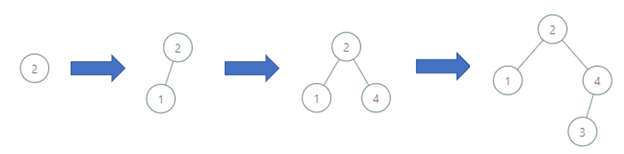
Input: order = [2,1,4,3]
Output: 3
Explanation: The binary search tree has a depth of 3 with path 2->3->4.
Example 2:
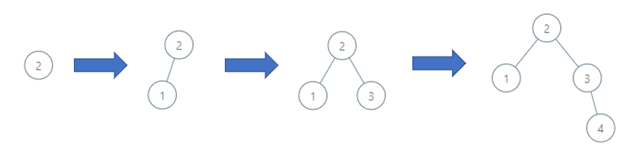
Input: order = [2,1,3,4]
Output: 3
Explanation: The binary search tree has a depth of 3 with path 2->3->4.
Example 3:
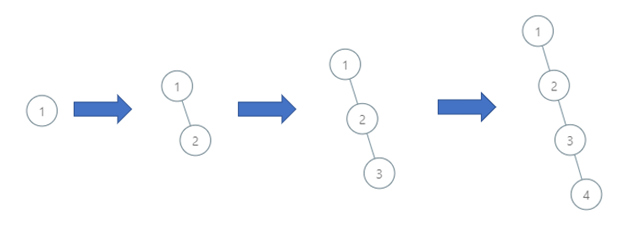
Input: order = [1,2,3,4]
Output: 4
Explanation: The binary search tree has a depth of 4 with path 1->2->3->4.
Constraints:
n == order.length1 <= n <= 105orderis a permutation of integers between1andn.
Solutions
Solution 1
Thinking
Inserting from the root each time costs \(O(n)\) per value and \(O(n^2)\) overall. That fails for \(n\le 10^5\).
A new key attaches under the nearest already-inserted predecessor or successor, so its depth is one plus the larger of those two depths. Pointers are unnecessary if neighbor depths can be queried in a sorted set.
A sorted map stores inserted values and depths, with sentinels \(0\) and \(+\infty\). Each \(v\) looks up its two neighbors, records the new depth, and updates the answer.
1 2 3 4 5 6 7 8 9 10 11 | |
1 2 3 4 5 6 7 8 9 10 11 12 13 14 15 16 17 18 | |