3161. Block Placement Queries
SourceBiweekly Contest 131 Q4DifficultyHardRating2513
Description
There exists an infinite number line, with its origin at 0 and extending towards the positive x-axis.
You are given a 2D array queries, which contains two types of queries:
- For a query of type 1,
queries[i] = [1, x]. Build an obstacle at distancexfrom the origin. It is guaranteed that there is no obstacle at distancexwhen the query is asked. - For a query of type 2,
queries[i] = [2, x, sz]. Check if it is possible to place a block of sizeszanywhere in the range[0, x]on the line, such that the block entirely lies in the range[0, x]. A block cannot be placed if it intersects with any obstacle, but it may touch it. Note that you do not actually place the block. Queries are separate.
Return a boolean array results, where results[i] is true if you can place the block specified in the ith query of type 2, and false otherwise.
Example 1:
Input: queries = [[1,2],[2,3,3],[2,3,1],[2,2,2]]
Output: [false,true,true]
Explanation:
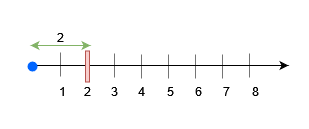
For query 0, place an obstacle at x = 2. A block of size at most 2 can be placed before x = 3.
Example 2:
Input: queries = [[1,7],[2,7,6],[1,2],[2,7,5],[2,7,6]]
Output: [true,true,false]
Explanation:
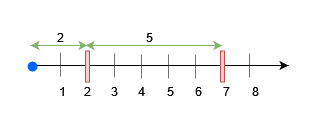
- Place an obstacle at
x = 7for query 0. A block of size at most 7 can be placed beforex = 7. - Place an obstacle at
x = 2for query 2. Now, a block of size at most 5 can be placed beforex = 7, and a block of size at most 2 beforex = 2.
Constraints:
1 <= queries.length <= 15 * 1042 <= queries[i].length <= 31 <= queries[i][0] <= 21 <= x, sz <= min(5 * 104, 3 * queries.length)- The input is generated such that for queries of type 1, no obstacle exists at distance
xwhen the query is asked. - The input is generated such that there is at least one query of type 2.
Solutions
Solution 1: Binary Indexed Tree + Ordered Set
Thinking
Obstacles are inserted only, and a query asks whether a block of size \(sz\) fits in \([0,x]\). Scanning gaps online is \(O(q^2)\).
Reversed time turns insertions into deletions, which only enlarge gaps. A Fenwick tree can store prefix maxima of gap lengths keyed by the right endpoint.
Load every obstacle plus sentinels, write gaps, then go backward: a query checks the prefix maximum up to \(\textit{pre}\) and the tail \(x-\textit{pre}\); a deletion updates the successor gap to \(\textit{nxt}-\textit{pre}\). Reverse the collected answers.
Obstacles are only inserted, so we can process the queries offline in reverse and turn "insert an obstacle" into "delete an obstacle". After a deletion the adjacent gap only grows, and a Fenwick tree can maintain prefix maxima.
Put all obstacles into an ordered set, and add sentinels \(0\) and \(m+1\), where \(m\) is the maximum coordinate. For every pair of neighboring obstacles \(x_1, x_2\), update index \(x_2\) in the Fenwick tree with the gap \(x_2 - x_1\).
Then scan the queries from back to front:
- Type \(2\): find the last obstacle \(\textit{pre} \le x\). The block can be placed if the maximum gap in \([0, \textit{pre}]\) or the tail gap \((\textit{pre}, x]\) is at least \(sz\).
- Type \(1\): delete obstacle \(x\), and update the gap at its successor \(\textit{nxt}\) to \(\textit{nxt} - \textit{pre}\).
The time complexity is \(O(q \log m)\), and the space complexity is \(O(m)\), where \(q\) is the number of queries and \(m\) is the maximum coordinate.
1 2 3 4 5 6 7 8 9 10 11 12 13 14 15 16 17 18 19 20 21 22 23 24 25 26 27 28 29 30 31 32 33 34 35 36 37 38 39 40 | |
1 2 3 4 5 6 7 8 9 10 11 12 13 14 15 16 17 18 19 20 21 22 23 24 25 26 27 28 29 30 31 32 33 34 35 36 37 38 39 40 41 42 43 44 45 46 47 48 49 50 51 52 53 54 55 56 57 58 59 60 61 62 63 64 65 | |
1 2 3 4 5 6 7 8 9 10 11 12 13 14 15 16 17 18 19 20 21 22 23 24 25 26 27 28 29 30 31 32 33 34 35 36 37 38 39 40 41 42 43 44 45 46 47 48 49 50 51 52 53 54 55 56 57 58 59 60 61 62 63 64 65 | |
1 2 3 4 5 6 7 8 9 10 11 12 13 14 15 16 17 18 19 20 21 22 23 24 25 26 27 28 29 30 31 32 33 34 35 36 37 38 39 40 41 42 43 44 45 46 47 48 49 50 51 52 53 54 55 56 57 58 59 60 61 62 63 64 65 | |