You are given a tree (i.e. a connected, undirected graph that has no cycles) consisting of n nodes numbered from 0 to n - 1 and exactly n - 1edges. The root of the tree is the node 0, and each node of the tree has a label which is a lower-case character given in the string labels (i.e. The node with the number i has the label labels[i]).
The edges array is given on the form edges[i] = [ai, bi], which means there is an edge between nodes ai and bi in the tree.
Return an array of size n where ans[i] is the number of nodes in the subtree of the ith node which have the same label as node i.
A subtree of a tree T is the tree consisting of a node in T and all of its descendant nodes.
Example 1:
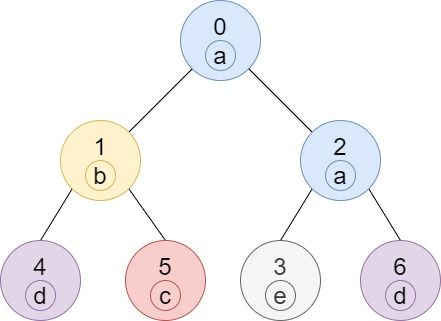
Input: n = 7, edges = [[0,1],[0,2],[1,4],[1,5],[2,3],[2,6]], labels = "abaedcd"
Output: [2,1,1,1,1,1,1]
Explanation: Node 0 has label 'a' and its sub-tree has node 2 with label 'a' as well, thus the answer is 2. Notice that any node is part of its sub-tree.
Node 1 has a label 'b'. The sub-tree of node 1 contains nodes 1,4 and 5, as nodes 4 and 5 have different labels than node 1, the answer is just 1 (the node itself).
Example 2:
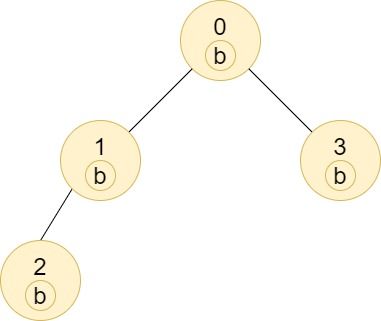
Input: n = 4, edges = [[0,1],[1,2],[0,3]], labels = "bbbb"
Output: [4,2,1,1]
Explanation: The sub-tree of node 2 contains only node 2, so the answer is 1.
The sub-tree of node 3 contains only node 3, so the answer is 1.
The sub-tree of node 1 contains nodes 1 and 2, both have label 'b', thus the answer is 2.
The sub-tree of node 0 contains nodes 0, 1, 2 and 3, all with label 'b', thus the answer is 4.
labels is consisting of only of lowercase English letters.
Solutions
Solution 1
Thinking
For every node we need how many nodes in its subtree share its label. \(n\le 10^5\), so a fresh walk from each node is quadratic. There are only \(26\) labels, which a single DFS can count globally.
Before entering \(i\), remember the current frequency of \(\textit{labels}[i]\); after leaving, read it again. The difference is the count inside that subtree. Storing the entry snapshot in \(\textit{ans}[i]\) (subtract first, add later) avoids an extra array; extra memory is just the alphabet.
For every node we need how many nodes in its subtree share its label. \(n\le 10^5\), so a fresh walk from each node is quadratic. On a chain the first recursive call always follows the only child, so the depth is \(n\) and exceeds the default recursion limit.
There are only \(26\) labels. The increase in a label's count between entering a node and leaving it is exactly the count inside that subtree.
An explicit stack walks the tree in postorder. On entry, subtract the current count from \(\textit{ans}[i]\), increment the count, then push the exit marker and the children. On exit, add the new count back to \(\textit{ans}[i]\). The difference is the number of matching labels in the subtree.