1819. Number of Different Subsequences GCDs
SourceWeekly Contest 235 Q4DifficultyHardRating2539
Description
You are given an array nums that consists of positive integers.
The GCD of a sequence of numbers is defined as the greatest integer that divides all the numbers in the sequence evenly.
- For example, the GCD of the sequence
[4,6,16]is2.
A subsequence of an array is a sequence that can be formed by removing some elements (possibly none) of the array.
- For example,
[2,5,10]is a subsequence of[1,2,1,2,4,1,5,10].
Return the number of different GCDs among all non-empty subsequences of nums.
Example 1:
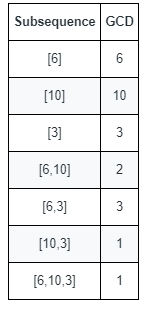
Input: nums = [6,10,3]
Output: 5
Explanation: The figure shows all the non-empty subsequences and their GCDs.
The different GCDs are 6, 10, 3, 2, and 1.
Example 2:
Input: nums = [5,15,40,5,6]
Output: 7
Constraints:
1 <= nums.length <= 1051 <= nums[i] <= 2 * 105
Solutions
Solution 1: Enumeration + Mathematics
Thinking
Every subsequence GCD is at most the array maximum \(mx\), yet there are \(2^n\) subsequences and \(n\le 10^5\), so we cannot enumerate them.
A value \(x\) is some subsequence GCD iff the GCD of the multiples of \(x\) that appear in the array is exactly \(x\). For each \(x\in[1,mx]\) walk those multiples, updating a running gcd, and count \(x\) as soon as the gcd becomes \(x\). The harmonic sum of multiples is \(O(mx \log mx)\).
For all sub-sequences of the array \(\textit{nums}\), their greatest common divisor (GCD) will not exceed the maximum value \(mx\) in the array.
Therefore, we can enumerate each number \(x\) in \([1,.. mx]\), and determine whether \(x\) is the GCD of a sub-sequence of the array \(\textit{nums}\). If it is, then we increment the answer by one.
So the problem is transformed into: determining whether \(x\) is the GCD of a sub-sequence of the array \(\textit{nums}\). We can do this by enumerating the multiples \(y\) of \(x\), and checking whether \(y\) exists in the array \(\textit{nums}\). If \(y\) exists in the array \(\textit{nums}\), then we calculate the GCD \(g\) of \(y\). If \(g = x\) occurs, then \(x\) is the GCD of a sub-sequence of the array \(\textit{nums}\).
The time complexity is \(O(n + M \log M)\), and the space complexity is \(O(M)\), where \(n\) and \(M\) are the length of the array \(\textit{nums}\) and the maximum value in the array \(\textit{nums}\), respectively.
1 2 3 4 5 6 7 8 9 10 11 12 13 14 | |
1 2 3 4 5 6 7 8 9 10 11 12 13 14 15 16 17 18 19 20 21 22 23 24 25 26 27 | |
1 2 3 4 5 6 7 8 9 10 11 12 13 14 15 16 17 18 19 20 21 22 23 24 | |
1 2 3 4 5 6 7 8 9 10 11 12 13 14 15 16 17 18 19 20 21 22 23 24 25 26 27 | |