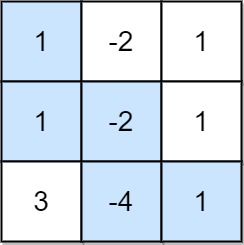
You are given a m x n matrix grid. Initially, you are located at the top-left corner (0, 0), and in each step, you can only move right or down in the matrix.
Among all possible paths starting from the top-left corner (0, 0) and ending in the bottom-right corner (m - 1, n - 1), find the path with the maximum non-negative product. The product of a path is the product of all integers in the grid cells visited along the path.
Return the maximum non-negative product modulo109 + 7. If the maximum product is negative, return -1.
Notice that the modulo is performed after getting the maximum product.
Example 1:
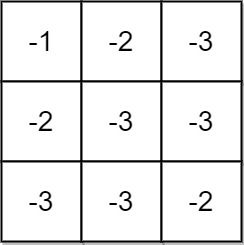
Input: grid = [[-1,-2,-3],[-2,-3,-3],[-3,-3,-2]]
Output: -1
Explanation: It is not possible to get non-negative product in the path from (0, 0) to (2, 2), so return -1.
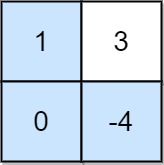
Input: grid = [[1,3],[0,-4]]
Output: 0
Explanation: Maximum non-negative product is shown (1 * 0 * -4 = 0).
Constraints:
m == grid.length
n == grid[i].length
1 <= m, n <= 15
-4 <= grid[i][j] <= 4
Solutions
Solution 1: Dynamic Programming
Thinking
Paths may only go right or down; we want the largest nonnegative product. Negatives mean the best product can come from the most negative product times another negative. Keeping only a maximum misses that path.
Store both the min and max product reaching each cell, updating from the two extrema above and to the left. If the final maximum is negative return \(-1\); otherwise reduce modulo \(10^9+7\).
We define a 3D array \(f\), where \(f[i][j][0]\) and \(f[i][j][1]\) represent the minimum and maximum product of all paths from the top-left corner \((0, 0)\) to position \((i, j)\), respectively. For each position \((i, j)\), we can transition from above \((i - 1, j)\) or from the left \((i, j - 1)\), so we need to consider the results of multiplying the minimum and maximum products of these two paths by the value of the current cell.
Finally, we need to return \(f[m - 1][n - 1][1]\) modulo \(10^9 + 7\). If \(f[m - 1][n - 1][1]\) is less than \(0\), return \(-1\).
The time complexity is \(O(m \times n)\) and the space complexity is \(O(m \times n)\), where \(m\) and \(n\) are the number of rows and columns of the matrix, respectively.