You are given a directed acyclic graph of n nodes numbered from 0 to n − 1. This is represented by a 2D array edges of length m, where edges[i] = [ui, vi, costi] indicates a one‑way communication from node ui to node vi with a recovery cost of costi.
Some nodes may be offline. You are given a boolean array online where online[i] = true means node i is online. Nodes 0 and n − 1 are always online.
A path from 0 to n − 1 is valid if:
All intermediate nodes on the path are online.
The total recovery cost of all edges on the path does not exceed k.
For each valid path, define its score as the minimum edge‑cost along that path.
Return the maximum path score (i.e., the largest minimum-edge cost) among all valid paths. If no valid path exists, return -1.
Example 1:
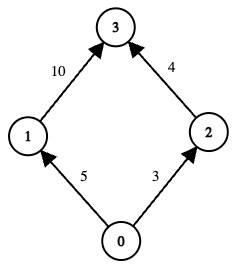
Input:edges = [[0,1,5],[1,3,10],[0,2,3],[2,3,4]], online = [true,true,true,true], k = 10
Output:3
Explanation:
The graph has two possible routes from node 0 to node 3:
Path 0 → 1 → 3
Total cost = 5 + 10 = 15, which exceeds k (15 > 10), so this path is invalid.
Path 0 → 2 → 3
Total cost = 3 + 4 = 7 <= k, so this path is valid.
The minimum edge‐cost along this path is min(3, 4) = 3.
There are no other valid paths. Hence, the maximum among all valid path‐scores is 3.
Example 2:
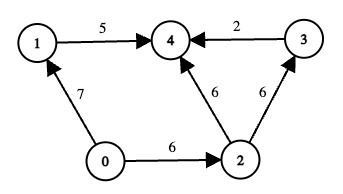
Input:edges = [[0,1,7],[1,4,5],[0,2,6],[2,3,6],[3,4,2],[2,4,6]], online = [true,true,true,false,true], k = 12
Output:6
Explanation:
Node 3 is offline, so any path passing through 3 is invalid.
Consider the remaining routes from 0 to 4:
Path 0 → 1 → 4
Total cost = 7 + 5 = 12 <= k, so this path is valid.
The minimum edge‐cost along this path is min(7, 5) = 5.
Path 0 → 2 → 3 → 4
Node 3 is offline, so this path is invalid regardless of cost.
Path 0 → 2 → 4
Total cost = 6 + 6 = 12 <= k, so this path is valid.
The minimum edge‐cost along this path is min(6, 6) = 6.
Among the two valid paths, their scores are 5 and 6. Therefore, the answer is 6.
Constraints:
n == online.length
2 <= n <= 5 * 104
0 <= m == edges.length <= min(105, n * (n - 1) / 2)
edges[i] = [ui, vi, costi]
0 <= ui, vi < n
ui != vi
0 <= costi <= 109
0 <= k <= 5 * 1013
online[i] is either true or false, and both online[0] and online[n − 1] are true.
A path's score is its lightest edge. We maximize that minimum under a total-cost cap \(k\) and online vertices only. Enumerating paths is impossible.
A larger threshold leaves fewer edges and feasibility is monotone, so binary-search the minimum edge weight. For \(\textit{mid}\), drop edges lighter than \(\textit{mid}\) and run heap Dijkstra from \(0\) to \(n-1\), comparing the distance with \(k\).
Skip any edge whose endpoint is offline. If even the smallest candidate fails, return \(-1\).
The path score is defined as the minimum edge cost along the path. We seek the maximum score among all valid paths.
For a candidate minimum edge weight \(mid\), we only keep edges with cost at least \(mid\), then check whether there exists a path from node \(0\) to node \(n - 1\) with total cost at most \(k\). This reduces to running heap-optimized Dijkstra on the filtered graph.
As \(mid\) increases, fewer edges remain and feasibility becomes harder to satisfy, so we can binary search on \(mid\). We preprocess by removing edges incident to offline nodes, and set \(l\) and \(r\) to the minimum and maximum edge costs. If \(check(l)\) is true, return \(l\); otherwise return \(-1\).
The time complexity is \(O((n + m) \log n \log W)\), and the space complexity is \(O(n + m)\), where \(n\) and \(m\) are the numbers of nodes and edges, and \(W\) is the maximum edge cost.