Binary Search Tree Binary Tree Depth-First Search Sorting Tree Source Weekly Contest 169 Q2 Difficulty Medium Rating 1260
Description Given two binary search trees root1 and root2, return a list containing all the integers from both trees sorted in ascending order .
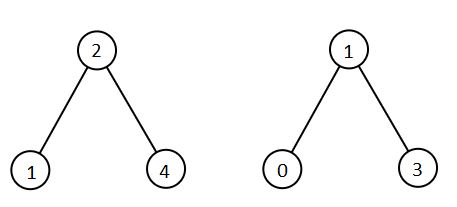
Example 1:
Input: root1 = [2,1,4], root2 = [1,0,3]
Output: [0,1,1,2,3,4]
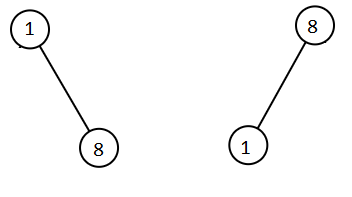
Example 2:
Input: root1 = [1,null,8], root2 = [8,1]
Output: [1,1,8,8]
Constraints:
The number of nodes in each tree is in the range [0, 5000]. -105 <= Node.val <= 105 Solutions Solution 1: DFS + Merge Thinking
All values from two BSTs must be returned in nondecreasing order. Collecting them and sorting costs \(O((n+m) \log(n+m))\) and ignores the trees' order. An in-order walk of a BST is already sorted, so we produce \(a\) and \(b\) separately and merge the two sorted lists in linear time.
Since both trees are binary search trees, we can obtain the node value sequences \(a\) and \(b\) of the two trees through in-order traversal. Then, we use two pointers to merge the two sorted arrays to get the final answer.
The time complexity is \(O(n+m)\) , and the space complexity is \(O(n+m)\) , where \(n\) and \(m\) are the number of nodes in the two trees, respectively.
Python3 Java C++ Go TypeScript Rust
 1
 2
 3
 4
 5
 6
 7
 8
 9
10
11
12
13
14
15
16
17
18
19
20
21
22
23
24
25
26
27
28
29
30
31
32
33
34
35
36
37
# Definition for a binary tree node.
# class TreeNode:
# def __init__(self, val=0, left=None, right=None):
# self.val = val
# self.left = left
# self.right = right
class Solution :
def getAllElements (
self , root1 : Optional [ TreeNode ], root2 : Optional [ TreeNode ]
) -> List [ int ]:
def dfs ( root : Optional [ TreeNode ], nums : List [ int ]) -> int :
if root is None :
return
dfs ( root . left , nums )
nums . append ( root . val )
dfs ( root . right , nums )
a , b = [], []
dfs ( root1 , a )
dfs ( root2 , b )
m , n = len ( a ), len ( b )
i = j = 0
ans = []
while i < m and j < n :
if a [ i ] <= b [ j ]:
ans . append ( a [ i ])
i += 1
else :
ans . append ( b [ j ])
j += 1
while i < m :
ans . append ( a [ i ])
i += 1
while j < n :
ans . append ( b [ j ])
j += 1
return ans
 1
 2
 3
 4
 5
 6
 7
 8
 9
10
11
12
13
14
15
16
17
18
19
20
21
22
23
24
25
26
27
28
29
30
31
32
33
34
35
36
37
38
39
40
41
42
43
44
45
46
47
48
49
/**
* Definition for a binary tree node.
* public class TreeNode {
* int val;
* TreeNode left;
* TreeNode right;
* TreeNode() {}
* TreeNode(int val) { this.val = val; }
* TreeNode(int val, TreeNode left, TreeNode right) {
* this.val = val;
* this.left = left;
* this.right = right;
* }
* }
*/
class Solution {
public List < Integer > getAllElements ( TreeNode root1 , TreeNode root2 ) {
List < Integer > a = new ArrayList <> ();
List < Integer > b = new ArrayList <> ();
dfs ( root1 , a );
dfs ( root2 , b );
int m = a . size (), n = b . size ();
int i = 0 , j = 0 ;
List < Integer > ans = new ArrayList <> ();
while ( i < m && j < n ) {
if ( a . get ( i ) <= b . get ( j )) {
ans . add ( a . get ( i ++ ));
} else {
ans . add ( b . get ( j ++ ));
}
}
while ( i < m ) {
ans . add ( a . get ( i ++ ));
}
while ( j < n ) {
ans . add ( b . get ( j ++ ));
}
return ans ;
}
private void dfs ( TreeNode root , List < Integer > nums ) {
if ( root == null ) {
return ;
}
dfs ( root . left , nums );
nums . add ( root . val );
dfs ( root . right , nums );
}
}
 1
 2
 3
 4
 5
 6
 7
 8
 9
10
11
12
13
14
15
16
17
18
19
20
21
22
23
24
25
26
27
28
29
30
31
32
33
34
35
36
37
38
39
40
41
42
43
44
45
/**
* Definition for a binary tree node.
* struct TreeNode {
* int val;
* TreeNode *left;
* TreeNode *right;
* TreeNode() : val(0), left(nullptr), right(nullptr) {}
* TreeNode(int x) : val(x), left(nullptr), right(nullptr) {}
* TreeNode(int x, TreeNode *left, TreeNode *right) : val(x), left(left), right(right) {}
* };
*/
class Solution {
public :
vector < int > getAllElements ( TreeNode * root1 , TreeNode * root2 ) {
vector < int > a , b , ans ;
dfs ( root1 , a );
dfs ( root2 , b );
int i = 0 , j = 0 ;
while ( i < a . size () && j < b . size ()) {
if ( a [ i ] <= b [ j ]) {
ans . push_back ( a [ i ++ ]);
} else {
ans . push_back ( b [ j ++ ]);
}
}
while ( i < a . size ()) {
ans . push_back ( a [ i ++ ]);
}
while ( j < b . size ()) {
ans . push_back ( b [ j ++ ]);
}
return ans ;
}
private :
void dfs ( TreeNode * root , vector < int >& nums ) {
if ( root == nullptr ) {
return ;
}
dfs ( root -> left , nums );
nums . push_back ( root -> val );
dfs ( root -> right , nums );
}
};
 1
 2
 3
 4
 5
 6
 7
 8
 9
10
11
12
13
14
15
16
17
18
19
20
21
22
23
24
25
26
27
28
29
30
31
32
33
34
35
36
37
38
39
40
/**
* Definition for a binary tree node.
* type TreeNode struct {
* Val int
* Left *TreeNode
* Right *TreeNode
* }
*/
func getAllElements ( root1 * TreeNode , root2 * TreeNode ) ( ans [] int ) {
var dfs func ( * TreeNode , * [] int )
dfs = func ( root * TreeNode , nums * [] int ) {
if root == nil {
return
}
dfs ( root . Left , nums )
* nums = append ( * nums , root . Val )
dfs ( root . Right , nums )
}
a , b := [] int {}, [] int {}
dfs ( root1 , & a )
dfs ( root2 , & b )
i , j := 0 , 0
m , n := len ( a ), len ( b )
for i < m && j < n {
if a [ i ] < b [ j ] {
ans = append ( ans , a [ i ])
i ++
} else {
ans = append ( ans , b [ j ])
j ++
}
}
for ; i < m ; i ++ {
ans = append ( ans , a [ i ])
}
for ; j < n ; j ++ {
ans = append ( ans , b [ j ])
}
return
}
 1
 2
 3
 4
 5
 6
 7
 8
 9
10
11
12
13
14
15
16
17
18
19
20
21
22
23
24
25
26
27
28
29
30
31
32
33
34
35
36
37
38
39
40
41
42
43
44
45
/**
* Definition for a binary tree node.
* class TreeNode {
* val: number
* left: TreeNode | null
* right: TreeNode | null
* constructor(val?: number, left?: TreeNode | null, right?: TreeNode | null) {
* this.val = (val===undefined ? 0 : val)
* this.left = (left===undefined ? null : left)
* this.right = (right===undefined ? null : right)
* }
* }
*/
function getAllElements ( root1 : TreeNode | null , root2 : TreeNode | null ) : number [] {
const dfs = ( root : TreeNode | null , nums : number []) => {
if ( ! root ) {
return ;
}
dfs ( root . left , nums );
nums . push ( root . val );
dfs ( root . right , nums );
};
const a : number [] = [];
const b : number [] = [];
dfs ( root1 , a );
dfs ( root2 , b );
const [ m , n ] = [ a . length , b . length ];
const ans : number [] = [];
let [ i , j ] = [ 0 , 0 ];
while ( i < m && j < n ) {
if ( a [ i ] < b [ j ]) {
ans . push ( a [ i ++ ]);
} else {
ans . push ( b [ j ++ ]);
}
}
while ( i < m ) {
ans . push ( a [ i ++ ]);
}
while ( j < n ) {
ans . push ( b [ j ++ ]);
}
return ans ;
}
 1
 2
 3
 4
 5
 6
 7
 8
 9
10
11
12
13
14
15
16
17
18
19
20
21
22
23
24
25
26
27
28
29
30
31
32
33
34
35
36
37
38
39
40
41
42
43
44
45
46
47
48
49
50
51
52
53
54
55
56
57
58
59
60
61
62
63
64
65
66
// Definition for a binary tree node.
// #[derive(Debug, PartialEq, Eq)]
// pub struct TreeNode {
// pub val: i32,
// pub left: Option<Rc<RefCell<TreeNode>>>,
// pub right: Option<Rc<RefCell<TreeNode>>>,
// }
//
// impl TreeNode {
// #[inline]
// pub fn new(val: i32) -> Self {
// TreeNode {
// val,
// left: None,
// right: None
// }
// }
// }
use std :: cell :: RefCell ;
use std :: rc :: Rc ;
impl Solution {
pub fn get_all_elements (
root1 : Option < Rc < RefCell < TreeNode >>> ,
root2 : Option < Rc < RefCell < TreeNode >>> ,
) -> Vec < i32 > {
let mut a = Vec :: new ();
let mut b = Vec :: new ();
Solution :: dfs ( & root1 , & mut a );
Solution :: dfs ( & root2 , & mut b );
let mut ans = Vec :: new ();
let ( mut i , mut j ) = ( 0 , 0 );
while i < a . len () && j < b . len () {
if a [ i ] <= b [ j ] {
ans . push ( a [ i ]);
i += 1 ;
} else {
ans . push ( b [ j ]);
j += 1 ;
}
}
while i < a . len () {
ans . push ( a [ i ]);
i += 1 ;
}
while j < b . len () {
ans . push ( b [ j ]);
j += 1 ;
}
ans
}
fn dfs ( root : & Option < Rc < RefCell < TreeNode >>> , nums : & mut Vec < i32 > ) {
if let Some ( node ) = root {
let node = node . borrow ();
Solution :: dfs ( & node . left , nums );
nums . push ( node . val );
Solution :: dfs ( & node . right , nums );
}
}
}