Skip to content

2096. Step-By-Step Directions From a Binary Tree Node to Another

SourceWeekly Contest 270 Q3DifficultyMediumRating1804

Description

You are given the root of a binary tree with n nodes. Each node is uniquely assigned a value from 1 to n. You are also given an integer startValue representing the value of the start node s, and a different integer destValue representing the value of the destination node t.

Find the shortest path starting from node s and ending at node t. Generate step-by-step directions of such path as a string consisting of only the uppercase letters 'L', 'R', and 'U'. Each letter indicates a specific direction:

  • 'L' means to go from a node to its left child node.
  • 'R' means to go from a node to its right child node.
  • 'U' means to go from a node to its parent node.

Return the step-by-step directions of the shortest path from node s to node t.


Example 1:

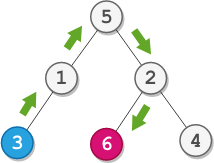
Input: root = [5,1,2,3,null,6,4], startValue = 3, destValue = 6
Output: "UURL"
Explanation: The shortest path is: 3 → 1 → 5 → 2 → 6.

Example 2:

Input: root = [2,1], startValue = 2, destValue = 1
Output: "L"
Explanation: The shortest path is: 2 → 1.


Constraints:

  • The number of nodes in the tree is n.
  • 2 <= n <= 105
  • 1 <= Node.val <= n
  • All the values in the tree are unique.
  • 1 <= startValue, destValue <= n
  • startValue != destValue

Solutions

Solution 1: Lowest Common Ancestor + DFS

Thinking

The unique path goes through the LCA. Upward edges become U; the descent uses L/R. Three tree walks are fine for \(n \le 10^5\).

Find the LCA, DFS both directions from it, replace the start path by Us, and concatenate.

We can first find the lowest common ancestor of nodes \(\textit{startValue}\) and \(\textit{destValue}\), denoted as \(\textit{node}\). Then, starting from \(\textit{node}\), we find the paths to \(\textit{startValue}\) and \(\textit{destValue}\) respectively. The path from \(\textit{startValue}\) to \(\textit{node}\) will consist of a number of \(U\)s, and the path from \(\textit{node}\) to \(\textit{destValue}\) will be the \(\textit{path}\). Finally, we concatenate these two paths.

The time complexity is \(O(n)\), and the space complexity is \(O(n)\), where \(n\) is the number of nodes in the binary tree.

 1
 2
 3
 4
 5
 6
 7
 8
 9
10
11
12
13
14
15
16
17
18
19
20
21
22
23
24
25
26
27
28
29
30
31
32
33
34
35
36
37
38
39
40
41
42
43
44
# Definition for a binary tree node.
# class TreeNode:
#     def __init__(self, val=0, left=None, right=None):
#         self.val = val
#         self.left = left
#         self.right = right


class Solution:
    def getDirections(
        self, root: Optional[TreeNode], startValue: int, destValue: int
    ) -> str:
        def lca(node: Optional[TreeNode], p: int, q: int):
            if node is None or node.val in (p, q):
                return node
            left = lca(node.left, p, q)
            right = lca(node.right, p, q)
            if left and right:
                return node
            return left or right

        def dfs(node: Optional[TreeNode], x: int, path: list[str]):
            if node is None:
                return False
            if node.val == x:
                return True
            path.append("L")
            if dfs(node.left, x, path):
                return True
            path[-1] = "R"
            if dfs(node.right, x, path):
                return True
            path.pop()
            return False

        node = lca(root, startValue, destValue)

        path_to_start = []
        path_to_dest = []

        dfs(node, startValue, path_to_start)
        dfs(node, destValue, path_to_dest)

        return "U" * len(path_to_start) + "".join(path_to_dest)
 1
 2
 3
 4
 5
 6
 7
 8
 9
10
11
12
13
14
15
16
17
18
19
20
21
22
23
24
25
26
27
28
29
30
31
32
33
34
35
36
37
38
39
40
41
class Solution {
    public String getDirections(TreeNode root, int startValue, int destValue) {
        TreeNode node = lca(root, startValue, destValue);
        StringBuilder pathToStart = new StringBuilder();
        StringBuilder pathToDest = new StringBuilder();
        dfs(node, startValue, pathToStart);
        dfs(node, destValue, pathToDest);
        return "U".repeat(pathToStart.length()) + pathToDest.toString();
    }

    private TreeNode lca(TreeNode node, int p, int q) {
        if (node == null || node.val == p || node.val == q) {
            return node;
        }
        TreeNode left = lca(node.left, p, q);
        TreeNode right = lca(node.right, p, q);
        if (left != null && right != null) {
            return node;
        }
        return left != null ? left : right;
    }

    private boolean dfs(TreeNode node, int x, StringBuilder path) {
        if (node == null) {
            return false;
        }
        if (node.val == x) {
            return true;
        }
        path.append('L');
        if (dfs(node.left, x, path)) {
            return true;
        }
        path.setCharAt(path.length() - 1, 'R');
        if (dfs(node.right, x, path)) {
            return true;
        }
        path.deleteCharAt(path.length() - 1);
        return false;
    }
}
 1
 2
 3
 4
 5
 6
 7
 8
 9
10
11
12
13
14
15
16
17
18
19
20
21
22
23
24
25
26
27
28
29
30
31
32
33
34
35
36
37
38
39
40
41
42
43
44
45
46
47
48
49
50
51
52
53
/**
 * Definition for a binary tree node.
 * struct TreeNode {
 *     int val;
 *     TreeNode *left;
 *     TreeNode *right;
 *     TreeNode() : val(0), left(nullptr), right(nullptr) {}
 *     TreeNode(int x) : val(x), left(nullptr), right(nullptr) {}
 *     TreeNode(int x, TreeNode *left, TreeNode *right) : val(x), left(left), right(right) {}
 * };
 */
class Solution {
public:
    string getDirections(TreeNode* root, int startValue, int destValue) {
        TreeNode* node = lca(root, startValue, destValue);
        string pathToStart, pathToDest;
        dfs(node, startValue, pathToStart);
        dfs(node, destValue, pathToDest);
        return string(pathToStart.size(), 'U') + pathToDest;
    }

private:
    TreeNode* lca(TreeNode* node, int p, int q) {
        if (node == nullptr || node->val == p || node->val == q) {
            return node;
        }
        TreeNode* left = lca(node->left, p, q);
        TreeNode* right = lca(node->right, p, q);
        if (left != nullptr && right != nullptr) {
            return node;
        }
        return left != nullptr ? left : right;
    }

    bool dfs(TreeNode* node, int x, string& path) {
        if (node == nullptr) {
            return false;
        }
        if (node->val == x) {
            return true;
        }
        path.push_back('L');
        if (dfs(node->left, x, path)) {
            return true;
        }
        path.back() = 'R';
        if (dfs(node->right, x, path)) {
            return true;
        }
        path.pop_back();
        return false;
    }
};
 1
 2
 3
 4
 5
 6
 7
 8
 9
10
11
12
13
14
15
16
17
18
19
20
21
22
23
24
25
26
27
28
29
30
31
32
33
34
35
36
37
38
39
40
41
42
43
44
45
46
47
48
49
50
51
/**
 * Definition for a binary tree node.
 * type TreeNode struct {
 *     Val int
 *     Left *TreeNode
 *     Right *TreeNode
 * }
 */
func getDirections(root *TreeNode, startValue int, destValue int) string {
    var lca func(node *TreeNode, p, q int) *TreeNode
    lca = func(node *TreeNode, p, q int) *TreeNode {
        if node == nil || node.Val == p || node.Val == q {
            return node
        }
        left := lca(node.Left, p, q)
        right := lca(node.Right, p, q)
        if left != nil && right != nil {
            return node
        }
        if left != nil {
            return left
        }
        return right
    }
    var dfs func(node *TreeNode, x int, path *[]byte) bool
    dfs = func(node *TreeNode, x int, path *[]byte) bool {
        if node == nil {
            return false
        }
        if node.Val == x {
            return true
        }
        *path = append(*path, 'L')
        if dfs(node.Left, x, path) {
            return true
        }
        (*path)[len(*path)-1] = 'R'
        if dfs(node.Right, x, path) {
            return true
        }
        *path = (*path)[:len(*path)-1]
        return false
    }

    node := lca(root, startValue, destValue)
    pathToStart := []byte{}
    pathToDest := []byte{}
    dfs(node, startValue, &pathToStart)
    dfs(node, destValue, &pathToDest)
    return string(bytes.Repeat([]byte{'U'}, len(pathToStart))) + string(pathToDest)
}
 1
 2
 3
 4
 5
 6
 7
 8
 9
10
11
12
13
14
15
16
17
18
19
20
21
22
23
24
25
26
27
28
29
30
31
32
33
34
35
36
37
38
39
40
41
42
43
44
45
46
47
48
49
50
51
/**
 * Definition for a binary tree node.
 * class TreeNode {
 *     val: number
 *     left: TreeNode | null
 *     right: TreeNode | null
 *     constructor(val?: number, left?: TreeNode | null, right?: TreeNode | null) {
 *         this.val = (val===undefined ? 0 : val)
 *         this.left = (left===undefined ? null : left)
 *         this.right = (right===undefined ? null : right)
 *     }
 * }
 */

function getDirections(root: TreeNode | null, startValue: number, destValue: number): string {
    const lca = (node: TreeNode | null, p: number, q: number): TreeNode | null => {
        if (node === null || [p, q].includes(node.val)) {
            return node;
        }
        const left = lca(node.left, p, q);
        const right = lca(node.right, p, q);

        return left && right ? node : (left ?? right);
    };

    const dfs = (node: TreeNode | null, x: number, path: string[]): boolean => {
        if (node === null) {
            return false;
        }
        if (node.val === x) {
            return true;
        }
        path.push('L');
        if (dfs(node.left, x, path)) {
            return true;
        }
        path[path.length - 1] = 'R';
        if (dfs(node.right, x, path)) {
            return true;
        }
        path.pop();
        return false;
    };

    const node = lca(root, startValue, destValue);
    const pathToStart: string[] = [];
    const pathToDest: string[] = [];
    dfs(node, startValue, pathToStart);
    dfs(node, destValue, pathToDest);
    return 'U'.repeat(pathToStart.length) + pathToDest.join('');
}
 1
 2
 3
 4
 5
 6
 7
 8
 9
10
11
12
13
14
15
16
17
18
19
20
21
22
23
24
25
26
27
28
29
30
31
32
33
34
35
36
37
38
39
40
41
42
43
44
45
46
47
48
49
50
51
/**
 * Definition for a binary tree node.
 * function TreeNode(val, left, right) {
 *     this.val = (val===undefined ? 0 : val)
 *     this.left = (left===undefined ? null : left)
 *     this.right = (right===undefined ? null : right)
 * }
 */
/**
 * @param {TreeNode} root
 * @param {number} startValue
 * @param {number} destValue
 * @return {string}
 */
var getDirections = function (root, startValue, destValue) {
    const lca = (node, p, q) => {
        if (node === null || [p, q].includes(node.val)) {
            return node;
        }
        const left = lca(node.left, p, q);
        const right = lca(node.right, p, q);

        return left && right ? node : (left ?? right);
    };

    const dfs = (node, x, path) => {
        if (node === null) {
            return false;
        }
        if (node.val === x) {
            return true;
        }
        path.push('L');
        if (dfs(node.left, x, path)) {
            return true;
        }
        path[path.length - 1] = 'R';
        if (dfs(node.right, x, path)) {
            return true;
        }
        path.pop();
        return false;
    };

    const node = lca(root, startValue, destValue);
    const pathToStart = [];
    const pathToDest = [];
    dfs(node, startValue, pathToStart);
    dfs(node, destValue, pathToDest);
    return 'U'.repeat(pathToStart.length) + pathToDest.join('');
};

Solution 2: Lowest Common Ancestor + DFS (Optimized)

Thinking

Solution 1 finds the LCA then walks twice more. Paths from the root share a prefix; stripping it is exactly “up to the LCA then down.” The extra LCA search disappears.

Two DFS strings, skip the common prefix of length \(i\), emit \((|\textit{start}|-i)\) Us plus the destination suffix.

We can start from \(\textit{root}\), find the paths to \(\textit{startValue}\) and \(\textit{destValue}\), denoted as \(\textit{pathToStart}\) and \(\textit{pathToDest}\), respectively. Then, remove the longest common prefix of \(\textit{pathToStart}\) and \(\textit{pathToDest}\). At this point, the length of \(\textit{pathToStart}\) is the number of \(U\)s in the answer, and the path of \(\textit{pathToDest}\) is the path in the answer. We just need to concatenate these two paths.

The time complexity is \(O(n)\), and the space complexity is \(O(n)\), where \(n\) is the number of nodes in the binary tree.

 1
 2
 3
 4
 5
 6
 7
 8
 9
10
11
12
13
14
15
16
17
18
19
20
21
22
23
24
25
26
27
28
29
30
31
32
33
34
35
36
37
38
39
# Definition for a binary tree node.
# class TreeNode:
#     def __init__(self, val=0, left=None, right=None):
#         self.val = val
#         self.left = left
#         self.right = right


class Solution:
    def getDirections(
        self, root: Optional[TreeNode], startValue: int, destValue: int
    ) -> str:
        def dfs(node: Optional[TreeNode], x: int, path: list[str]):
            if node is None:
                return False
            if node.val == x:
                return True
            path.append("L")
            if dfs(node.left, x, path):
                return True
            path[-1] = "R"
            if dfs(node.right, x, path):
                return True
            path.pop()
            return False

        path_to_start = []
        path_to_dest = []

        dfs(root, startValue, path_to_start)
        dfs(root, destValue, path_to_dest)
        i = 0
        while (
            i < len(path_to_start)
            and i < len(path_to_dest)
            and path_to_start[i] == path_to_dest[i]
        ):
            i += 1
        return "U" * (len(path_to_start) - i) + "".join(path_to_dest[i:])
 1
 2
 3
 4
 5
 6
 7
 8
 9
10
11
12
13
14
15
16
17
18
19
20
21
22
23
24
25
26
27
28
29
30
31
32
33
class Solution {
    public String getDirections(TreeNode root, int startValue, int destValue) {
        StringBuilder pathToStart = new StringBuilder();
        StringBuilder pathToDest = new StringBuilder();
        dfs(root, startValue, pathToStart);
        dfs(root, destValue, pathToDest);
        int i = 0;
        while (i < pathToStart.length() && i < pathToDest.length()
            && pathToStart.charAt(i) == pathToDest.charAt(i)) {
            ++i;
        }
        return "U".repeat(pathToStart.length() - i) + pathToDest.substring(i);
    }

    private boolean dfs(TreeNode node, int x, StringBuilder path) {
        if (node == null) {
            return false;
        }
        if (node.val == x) {
            return true;
        }
        path.append('L');
        if (dfs(node.left, x, path)) {
            return true;
        }
        path.setCharAt(path.length() - 1, 'R');
        if (dfs(node.right, x, path)) {
            return true;
        }
        path.deleteCharAt(path.length() - 1);
        return false;
    }
}
 1
 2
 3
 4
 5
 6
 7
 8
 9
10
11
12
13
14
15
16
17
18
19
20
21
22
23
24
25
26
27
28
29
30
31
32
33
34
35
36
37
38
39
40
41
42
43
44
/**
 * Definition for a binary tree node.
 * struct TreeNode {
 *     int val;
 *     TreeNode *left;
 *     TreeNode *right;
 *     TreeNode() : val(0), left(nullptr), right(nullptr) {}
 *     TreeNode(int x) : val(x), left(nullptr), right(nullptr) {}
 *     TreeNode(int x, TreeNode *left, TreeNode *right) : val(x), left(left), right(right) {}
 * };
 */
class Solution {
public:
    string getDirections(TreeNode* root, int startValue, int destValue) {
        string pathToStart, pathToDest;
        dfs(root, startValue, pathToStart);
        dfs(root, destValue, pathToDest);
        int i = 0;
        while (i < pathToStart.size() && i < pathToDest.size() && pathToStart[i] == pathToDest[i]) {
            i++;
        }
        return string(pathToStart.size() - i, 'U') + pathToDest.substr(i);
    }

private:
    bool dfs(TreeNode* node, int x, string& path) {
        if (node == nullptr) {
            return false;
        }
        if (node->val == x) {
            return true;
        }
        path.push_back('L');
        if (dfs(node->left, x, path)) {
            return true;
        }
        path.back() = 'R';
        if (dfs(node->right, x, path)) {
            return true;
        }
        path.pop_back();
        return false;
    }
};
 1
 2
 3
 4
 5
 6
 7
 8
 9
10
11
12
13
14
15
16
17
18
19
20
21
22
23
24
25
26
27
28
29
30
31
32
33
34
35
36
37
38
39
/**
 * Definition for a binary tree node.
 * type TreeNode struct {
 *     Val int
 *     Left *TreeNode
 *     Right *TreeNode
 * }
 */
func getDirections(root *TreeNode, startValue int, destValue int) string {
    var dfs func(node *TreeNode, x int, path *[]byte) bool
    dfs = func(node *TreeNode, x int, path *[]byte) bool {
        if node == nil {
            return false
        }
        if node.Val == x {
            return true
        }
        *path = append(*path, 'L')
        if dfs(node.Left, x, path) {
            return true
        }
        (*path)[len(*path)-1] = 'R'
        if dfs(node.Right, x, path) {
            return true
        }
        *path = (*path)[:len(*path)-1]
        return false
    }

    pathToStart := []byte{}
    pathToDest := []byte{}
    dfs(root, startValue, &pathToStart)
    dfs(root, destValue, &pathToDest)
    i := 0
    for i < len(pathToStart) && i < len(pathToDest) && pathToStart[i] == pathToDest[i] {
        i++
    }
    return string(bytes.Repeat([]byte{'U'}, len(pathToStart)-i)) + string(pathToDest[i:])
}
 1
 2
 3
 4
 5
 6
 7
 8
 9
10
11
12
13
14
15
16
17
18
19
20
21
22
23
24
25
26
27
28
29
30
31
32
33
34
35
36
37
38
39
40
41
42
43
/**
 * Definition for a binary tree node.
 * class TreeNode {
 *     val: number
 *     left: TreeNode | null
 *     right: TreeNode | null
 *     constructor(val?: number, left?: TreeNode | null, right?: TreeNode | null) {
 *         this.val = (val===undefined ? 0 : val)
 *         this.left = (left===undefined ? null : left)
 *         this.right = (right===undefined ? null : right)
 *     }
 * }
 */

function getDirections(root: TreeNode | null, startValue: number, destValue: number): string {
    const dfs = (node: TreeNode | null, x: number, path: string[]): boolean => {
        if (node === null) {
            return false;
        }
        if (node.val === x) {
            return true;
        }
        path.push('L');
        if (dfs(node.left, x, path)) {
            return true;
        }
        path[path.length - 1] = 'R';
        if (dfs(node.right, x, path)) {
            return true;
        }
        path.pop();
        return false;
    };
    const pathToStart: string[] = [];
    const pathToDest: string[] = [];
    dfs(root, startValue, pathToStart);
    dfs(root, destValue, pathToDest);
    let i = 0;
    while (pathToStart[i] === pathToDest[i]) {
        ++i;
    }
    return 'U'.repeat(pathToStart.length - i) + pathToDest.slice(i).join('');
}
 1
 2
 3
 4
 5
 6
 7
 8
 9
10
11
12
13
14
15
16
17
18
19
20
21
22
23
24
25
26
27
28
29
30
31
32
33
34
35
36
37
38
39
40
41
42
43
/**
 * Definition for a binary tree node.
 * function TreeNode(val, left, right) {
 *     this.val = (val===undefined ? 0 : val)
 *     this.left = (left===undefined ? null : left)
 *     this.right = (right===undefined ? null : right)
 * }
 */
/**
 * @param {TreeNode} root
 * @param {number} startValue
 * @param {number} destValue
 * @return {string}
 */
var getDirections = function (root, startValue, destValue) {
    const dfs = (node, x, path) => {
        if (node === null) {
            return false;
        }
        if (node.val === x) {
            return true;
        }
        path.push('L');
        if (dfs(node.left, x, path)) {
            return true;
        }
        path[path.length - 1] = 'R';
        if (dfs(node.right, x, path)) {
            return true;
        }
        path.pop();
        return false;
    };
    const pathToStart = [];
    const pathToDest = [];
    dfs(root, startValue, pathToStart);
    dfs(root, destValue, pathToDest);
    let i = 0;
    while (pathToStart[i] === pathToDest[i]) {
        ++i;
    }
    return 'U'.repeat(pathToStart.length - i) + pathToDest.slice(i).join('');
};

Solution 3: Explicit-Stack Lowest Common Ancestor

Thinking

The shortest path goes through the lowest common ancestor. Every step above that ancestor is U, and the descent from the ancestor to the destination is L or R. Three linear walks fit \(n \le 10^5\).

Both the ancestor search and the direction search enter the left child first. A left chain can be \(n\) nodes long, so recursion overflows before the direction string is finished.

The ancestor is known only after both subtrees return: the current node is the ancestor when both sides found a target, otherwise the non-empty side is passed upward. An explicit stack separates “expand both children” from “both children have returned,” and the direction search pushes a backtrack marker before the left child. A failed left subtree rewrites the last step to R and searches the right child, stopping when the target is found.

The length of the start path is the number of Us, concatenated with the path from the ancestor to the destination.

An explicit stack finds the lowest common ancestor of \(\textit{startValue}\) and \(\textit{destValue}\), denoted as \(\textit{node}\). State \(0\) expands the two children, and state \(1\) decides the ancestor after both sides return: the current node when both sides are non-empty, otherwise the non-empty side. The same stack then walks from \(\textit{node}\), recording L to the left and rewriting that step to R when the left subtree misses the target. The number of steps from \(\textit{startValue}\) back to \(\textit{node}\) is the number of Us, followed by the direction string from \(\textit{node}\) to \(\textit{destValue}\).

The time complexity is \(O(n)\), and the space complexity is \(O(n)\), where \(n\) is the number of nodes in the binary tree.

 1
 2
 3
 4
 5
 6
 7
 8
 9
10
11
12
13
14
15
16
17
18
19
20
21
22
23
24
25
26
27
28
29
30
31
32
33
34
35
36
37
38
39
40
41
42
43
44
45
46
47
48
49
50
51
52
53
54
55
56
57
58
59
60
61
# Definition for a binary tree node.
# class TreeNode:
#     def __init__(self, val=0, left=None, right=None):
#         self.val = val
#         self.left = left
#         self.right = right


class Solution:
    def getDirections(
        self, root: Optional[TreeNode], startValue: int, destValue: int
    ) -> str:
        def lca(root: Optional[TreeNode], p: int, q: int):
            ret = {}
            stk = [(root, 0)]
            while stk:
                node, state = stk.pop()
                if state == 0:
                    if node is None:
                        continue
                    if node.val in (p, q):
                        ret[id(node)] = node
                        continue
                    stk.append((node, 1))
                    stk.append((node.right, 0))
                    stk.append((node.left, 0))
                else:
                    left = ret.get(id(node.left)) if node.left is not None else None
                    right = ret.get(id(node.right)) if node.right is not None else None
                    if left and right:
                        ret[id(node)] = node
                    else:
                        ret[id(node)] = left or right
            return ret.get(id(root))

        def dfs(start: Optional[TreeNode], x: int, path: list[str]) -> bool:
            stk = [(start, 0)]
            while stk:
                node, state = stk.pop()
                if state == 0:
                    if node is None:
                        continue
                    if node.val == x:
                        return True
                    path.append('L')
                    stk.append((node, 1))
                    stk.append((node.left, 0))
                elif state == 1:
                    path[-1] = 'R'
                    stk.append((node, 2))
                    stk.append((node.right, 0))
                else:
                    path.pop()
            return False

        node = lca(root, startValue, destValue)
        path_to_start: list[str] = []
        path_to_dest: list[str] = []
        dfs(node, startValue, path_to_start)
        dfs(node, destValue, path_to_dest)
        return 'U' * len(path_to_start) + ''.join(path_to_dest)
 1
 2
 3
 4
 5
 6
 7
 8
 9
10
11
12
13
14
15
16
17
18
19
20
21
22
23
24
25
26
27
28
29
30
31
32
33
34
35
36
37
38
39
40
41
42
43
44
45
46
47
48
49
50
51
52
53
54
55
56
57
58
59
60
61
62
63
64
65
66
67
68
69
70
71
72
73
74
75
76
77
78
class Solution {
    private static class Frame {
        TreeNode node;
        int state;

        Frame(TreeNode node, int state) {
            this.node = node;
            this.state = state;
        }
    }

    public String getDirections(TreeNode root, int startValue, int destValue) {
        TreeNode node = lca(root, startValue, destValue);
        StringBuilder pathToStart = new StringBuilder();
        StringBuilder pathToDest = new StringBuilder();
        dfs(node, startValue, pathToStart);
        dfs(node, destValue, pathToDest);
        return "U".repeat(pathToStart.length()) + pathToDest.toString();
    }

    private TreeNode lca(TreeNode root, int p, int q) {
        Map<TreeNode, TreeNode> ret = new IdentityHashMap<>();
        Deque<Frame> stk = new ArrayDeque<>();
        stk.push(new Frame(root, 0));
        while (!stk.isEmpty()) {
            Frame cur = stk.pop();
            TreeNode node = cur.node;
            if (cur.state == 0) {
                if (node == null) {
                    continue;
                }
                if (node.val == p || node.val == q) {
                    ret.put(node, node);
                    continue;
                }
                stk.push(new Frame(node, 1));
                stk.push(new Frame(node.right, 0));
                stk.push(new Frame(node.left, 0));
            } else {
                TreeNode left = node.left == null ? null : ret.get(node.left);
                TreeNode right = node.right == null ? null : ret.get(node.right);
                if (left != null && right != null) {
                    ret.put(node, node);
                } else {
                    ret.put(node, left != null ? left : right);
                }
            }
        }
        return ret.get(root);
    }

    private boolean dfs(TreeNode start, int x, StringBuilder path) {
        Deque<Frame> stk = new ArrayDeque<>();
        stk.push(new Frame(start, 0));
        while (!stk.isEmpty()) {
            Frame cur = stk.pop();
            TreeNode node = cur.node;
            if (cur.state == 0) {
                if (node == null) {
                    continue;
                }
                if (node.val == x) {
                    return true;
                }
                path.append('L');
                stk.push(new Frame(node, 1));
                stk.push(new Frame(node.left, 0));
            } else if (cur.state == 1) {
                path.setCharAt(path.length() - 1, 'R');
                stk.push(new Frame(node, 2));
                stk.push(new Frame(node.right, 0));
            } else {
                path.deleteCharAt(path.length() - 1);
            }
        }
        return false;
    }
}
 1
 2
 3
 4
 5
 6
 7
 8
 9
10
11
12
13
14
15
16
17
18
19
20
21
22
23
24
25
26
27
28
29
30
31
32
33
34
35
36
37
38
39
40
41
42
43
44
45
46
47
48
49
50
51
52
53
54
55
56
57
58
59
60
61
62
63
64
65
66
67
68
69
70
71
72
73
74
75
76
77
78
79
80
/**
 * Definition for a binary tree node.
 * struct TreeNode {
 *     int val;
 *     TreeNode *left;
 *     TreeNode *right;
 *     TreeNode() : val(0), left(nullptr), right(nullptr) {}
 *     TreeNode(int x) : val(x), left(nullptr), right(nullptr) {}
 *     TreeNode(int x, TreeNode *left, TreeNode *right) : val(x), left(left), right(right) {}
 * };
 */
class Solution {
public:
    string getDirections(TreeNode* root, int startValue, int destValue) {
        TreeNode* node = lca(root, startValue, destValue);
        string pathToStart, pathToDest;
        dfs(node, startValue, pathToStart);
        dfs(node, destValue, pathToDest);
        return string(pathToStart.size(), 'U') + pathToDest;
    }

private:
    TreeNode* lca(TreeNode* root, int p, int q) {
        unordered_map<TreeNode*, TreeNode*> ret;
        vector<pair<TreeNode*, int>> stk;
        stk.emplace_back(root, 0);
        while (!stk.empty()) {
            auto [node, state] = stk.back();
            stk.pop_back();
            if (state == 0) {
                if (node == nullptr) {
                    continue;
                }
                if (node->val == p || node->val == q) {
                    ret[node] = node;
                    continue;
                }
                stk.emplace_back(node, 1);
                stk.emplace_back(node->right, 0);
                stk.emplace_back(node->left, 0);
            } else {
                TreeNode* left = node->left && ret.count(node->left) ? ret[node->left] : nullptr;
                TreeNode* right = node->right && ret.count(node->right) ? ret[node->right] : nullptr;
                if (left != nullptr && right != nullptr) {
                    ret[node] = node;
                } else {
                    ret[node] = left != nullptr ? left : right;
                }
            }
        }
        return ret.count(root) ? ret[root] : nullptr;
    }

    bool dfs(TreeNode* start, int x, string& path) {
        vector<pair<TreeNode*, int>> stk;
        stk.emplace_back(start, 0);
        while (!stk.empty()) {
            auto [node, state] = stk.back();
            stk.pop_back();
            if (state == 0) {
                if (node == nullptr) {
                    continue;
                }
                if (node->val == x) {
                    return true;
                }
                path.push_back('L');
                stk.emplace_back(node, 1);
                stk.emplace_back(node->left, 0);
            } else if (state == 1) {
                path.back() = 'R';
                stk.emplace_back(node, 2);
                stk.emplace_back(node->right, 0);
            } else {
                path.pop_back();
            }
        }
        return false;
    }
};
 1
 2
 3
 4
 5
 6
 7
 8
 9
10
11
12
13
14
15
16
17
18
19
20
21
22
23
24
25
26
27
28
29
30
31
32
33
34
35
36
37
38
39
40
41
42
43
44
45
46
47
48
49
50
51
52
53
54
55
56
57
58
59
60
61
62
63
64
65
66
67
68
69
70
71
72
73
74
75
76
77
78
/**
 * Definition for a binary tree node.
 * type TreeNode struct {
 *     Val int
 *     Left *TreeNode
 *     Right *TreeNode
 * }
 */
func getDirections(root *TreeNode, startValue int, destValue int) string {
    lca := func(root *TreeNode, p, q int) *TreeNode {
        ret := map[*TreeNode]*TreeNode{}
        stk := [][2]interface{}{{root, 0}}
        for len(stk) > 0 {
            cur := stk[len(stk)-1]
            stk = stk[:len(stk)-1]
            node, _ := cur[0].(*TreeNode)
            state := cur[1].(int)
            if state == 0 {
                if node == nil {
                    continue
                }
                if node.Val == p || node.Val == q {
                    ret[node] = node
                    continue
                }
                stk = append(stk, [2]interface{}{node, 1}, [2]interface{}{node.Right, 0}, [2]interface{}{node.Left, 0})
            } else {
                var left, right *TreeNode
                if node.Left != nil {
                    left = ret[node.Left]
                }
                if node.Right != nil {
                    right = ret[node.Right]
                }
                if left != nil && right != nil {
                    ret[node] = node
                } else if left != nil {
                    ret[node] = left
                } else {
                    ret[node] = right
                }
            }
        }
        return ret[root]
    }
    dfs := func(start *TreeNode, x int, path *[]byte) bool {
        stk := [][2]interface{}{{start, 0}}
        for len(stk) > 0 {
            cur := stk[len(stk)-1]
            stk = stk[:len(stk)-1]
            node, _ := cur[0].(*TreeNode)
            state := cur[1].(int)
            if state == 0 {
                if node == nil {
                    continue
                }
                if node.Val == x {
                    return true
                }
                *path = append(*path, 'L')
                stk = append(stk, [2]interface{}{node, 1}, [2]interface{}{node.Left, 0})
            } else if state == 1 {
                (*path)[len(*path)-1] = 'R'
                stk = append(stk, [2]interface{}{node, 2}, [2]interface{}{node.Right, 0})
            } else {
                *path = (*path)[:len(*path)-1]
            }
        }
        return false
    }

    node := lca(root, startValue, destValue)
    pathToStart := []byte{}
    pathToDest := []byte{}
    dfs(node, startValue, &pathToStart)
    dfs(node, destValue, &pathToDest)
    return string(bytes.Repeat([]byte{'U'}, len(pathToStart))) + string(pathToDest)
}
 1
 2
 3
 4
 5
 6
 7
 8
 9
10
11
12
13
14
15
16
17
18
19
20
21
22
23
24
25
26
27
28
29
30
31
32
33
34
35
36
37
38
39
40
41
42
43
44
45
46
47
48
49
50
51
52
53
54
55
56
57
58
59
60
61
62
63
64
65
66
67
68
69
70
71
72
/**
 * Definition for a binary tree node.
 * class TreeNode {
 *     val: number
 *     left: TreeNode | null
 *     right: TreeNode | null
 *     constructor(val?: number, left?: TreeNode | null, right?: TreeNode | null) {
 *         this.val = (val===undefined ? 0 : val)
 *         this.left = (left===undefined ? null : left)
 *         this.right = (right===undefined ? null : right)
 *     }
 * }
 */

function getDirections(root: TreeNode | null, startValue: number, destValue: number): string {
    const lca = (root: TreeNode | null, p: number, q: number): TreeNode | null => {
        const ret = new Map<TreeNode, TreeNode | null>();
        const stk: [TreeNode | null, number][] = [[root, 0]];
        while (stk.length) {
            const [node, state] = stk.pop()!;
            if (state === 0) {
                if (node === null) {
                    continue;
                }
                if (node.val === p || node.val === q) {
                    ret.set(node, node);
                    continue;
                }
                stk.push([node, 1]);
                stk.push([node.right, 0]);
                stk.push([node.left, 0]);
            } else {
                const left = node!.left ? ret.get(node!.left) : null;
                const right = node!.right ? ret.get(node!.right) : null;
                ret.set(node!, left && right ? node : (left ?? right));
            }
        }
        return ret.get(root!) ?? null;
    };

    const dfs = (start: TreeNode | null, x: number, path: string[]): boolean => {
        const stk: [TreeNode | null, number][] = [[start, 0]];
        while (stk.length) {
            const [node, state] = stk.pop()!;
            if (state === 0) {
                if (node === null) {
                    continue;
                }
                if (node.val === x) {
                    return true;
                }
                path.push('L');
                stk.push([node, 1]);
                stk.push([node.left, 0]);
            } else if (state === 1) {
                path[path.length - 1] = 'R';
                stk.push([node, 2]);
                stk.push([node!.right, 0]);
            } else {
                path.pop();
            }
        }
        return false;
    };

    const node = lca(root, startValue, destValue);
    const pathToStart: string[] = [];
    const pathToDest: string[] = [];
    dfs(node, startValue, pathToStart);
    dfs(node, destValue, pathToDest);
    return 'U'.repeat(pathToStart.length) + pathToDest.join('');
}
 1
 2
 3
 4
 5
 6
 7
 8
 9
10
11
12
13
14
15
16
17
18
19
20
21
22
23
24
25
26
27
28
29
30
31
32
33
34
35
36
37
38
39
40
41
42
43
44
45
46
47
48
49
50
51
52
53
54
55
56
57
58
59
60
61
62
63
64
65
66
67
68
69
70
71
72
/**
 * Definition for a binary tree node.
 * function TreeNode(val, left, right) {
 *     this.val = (val===undefined ? 0 : val)
 *     this.left = (left===undefined ? null : left)
 *     this.right = (right===undefined ? null : right)
 * }
 */
/**
 * @param {TreeNode} root
 * @param {number} startValue
 * @param {number} destValue
 * @return {string}
 */
var getDirections = function (root, startValue, destValue) {
    const lca = (root, p, q) => {
        const ret = new Map();
        const stk = [[root, 0]];
        while (stk.length) {
            const [node, state] = stk.pop();
            if (state === 0) {
                if (node === null) {
                    continue;
                }
                if (node.val === p || node.val === q) {
                    ret.set(node, node);
                    continue;
                }
                stk.push([node, 1]);
                stk.push([node.right, 0]);
                stk.push([node.left, 0]);
            } else {
                const left = node.left ? ret.get(node.left) : null;
                const right = node.right ? ret.get(node.right) : null;
                ret.set(node, left && right ? node : (left ?? right));
            }
        }
        return ret.get(root) ?? null;
    };

    const dfs = (start, x, path) => {
        const stk = [[start, 0]];
        while (stk.length) {
            const [node, state] = stk.pop();
            if (state === 0) {
                if (node === null) {
                    continue;
                }
                if (node.val === x) {
                    return true;
                }
                path.push('L');
                stk.push([node, 1]);
                stk.push([node.left, 0]);
            } else if (state === 1) {
                path[path.length - 1] = 'R';
                stk.push([node, 2]);
                stk.push([node.right, 0]);
            } else {
                path.pop();
            }
        }
        return false;
    };

    const node = lca(root, startValue, destValue);
    const pathToStart = [];
    const pathToDest = [];
    dfs(node, startValue, pathToStart);
    dfs(node, destValue, pathToDest);
    return 'U'.repeat(pathToStart.length) + pathToDest.join('');
};

Solution 4: Explicit-Stack Root Paths

Thinking

Solution 1 still runs a separate ancestor search and then walks twice from that ancestor. Paths from the root share a prefix, and stripping it is the same as climbing back to the ancestor and then descending, so the dedicated ancestor search can be dropped.

The two direction searches can still follow a chain of length \(n\), so they use the same explicit stack: push a backtrack marker, then the left child, and rewrite the last step to R when the left subtree fails.

After the common prefix of length \(i\) is removed, the answer is \((|\textit{start}|-i)\) Us plus the destination suffix.

An explicit stack walks from \(\textit{root}\) to \(\textit{startValue}\) and to \(\textit{destValue}\), producing \(\textit{pathToStart}\) and \(\textit{pathToDest}\). A failed left subtree rewrites the last step to R before the right child is searched, so the strings match the previous depth-first order. After the longest common prefix is removed, the remaining length of \(\textit{pathToStart}\) is the number of Us, and the remaining part of \(\textit{pathToDest}\) is the downward path. Concatenate the two pieces.

The time complexity is \(O(n)\), and the space complexity is \(O(n)\), where \(n\) is the number of nodes in the binary tree.

 1
 2
 3
 4
 5
 6
 7
 8
 9
10
11
12
13
14
15
16
17
18
19
20
21
22
23
24
25
26
27
28
29
30
31
32
33
34
35
36
37
38
39
40
41
42
43
44
# Definition for a binary tree node.
# class TreeNode:
#     def __init__(self, val=0, left=None, right=None):
#         self.val = val
#         self.left = left
#         self.right = right


class Solution:
    def getDirections(
        self, root: Optional[TreeNode], startValue: int, destValue: int
    ) -> str:
        def dfs(start: Optional[TreeNode], x: int, path: list[str]) -> bool:
            stk = [(start, 0)]
            while stk:
                node, state = stk.pop()
                if state == 0:
                    if node is None:
                        continue
                    if node.val == x:
                        return True
                    path.append('L')
                    stk.append((node, 1))
                    stk.append((node.left, 0))
                elif state == 1:
                    path[-1] = 'R'
                    stk.append((node, 2))
                    stk.append((node.right, 0))
                else:
                    path.pop()
            return False

        path_to_start: list[str] = []
        path_to_dest: list[str] = []
        dfs(root, startValue, path_to_start)
        dfs(root, destValue, path_to_dest)
        i = 0
        while (
            i < len(path_to_start)
            and i < len(path_to_dest)
            and path_to_start[i] == path_to_dest[i]
        ):
            i += 1
        return 'U' * (len(path_to_start) - i) + ''.join(path_to_dest[i:])
 1
 2
 3
 4
 5
 6
 7
 8
 9
10
11
12
13
14
15
16
17
18
19
20
21
22
23
24
25
26
27
28
29
30
31
32
33
34
35
36
37
38
39
40
41
42
43
44
45
46
47
48
49
50
51
class Solution {
    private static class Frame {
        TreeNode node;
        int state;

        Frame(TreeNode node, int state) {
            this.node = node;
            this.state = state;
        }
    }

    public String getDirections(TreeNode root, int startValue, int destValue) {
        StringBuilder pathToStart = new StringBuilder();
        StringBuilder pathToDest = new StringBuilder();
        dfs(root, startValue, pathToStart);
        dfs(root, destValue, pathToDest);
        int i = 0;
        while (i < pathToStart.length() && i < pathToDest.length()
            && pathToStart.charAt(i) == pathToDest.charAt(i)) {
            ++i;
        }
        return "U".repeat(pathToStart.length() - i) + pathToDest.substring(i);
    }

    private boolean dfs(TreeNode start, int x, StringBuilder path) {
        Deque<Frame> stk = new ArrayDeque<>();
        stk.push(new Frame(start, 0));
        while (!stk.isEmpty()) {
            Frame cur = stk.pop();
            TreeNode node = cur.node;
            if (cur.state == 0) {
                if (node == null) {
                    continue;
                }
                if (node.val == x) {
                    return true;
                }
                path.append('L');
                stk.push(new Frame(node, 1));
                stk.push(new Frame(node.left, 0));
            } else if (cur.state == 1) {
                path.setCharAt(path.length() - 1, 'R');
                stk.push(new Frame(node, 2));
                stk.push(new Frame(node.right, 0));
            } else {
                path.deleteCharAt(path.length() - 1);
            }
        }
        return false;
    }
}
 1
 2
 3
 4
 5
 6
 7
 8
 9
10
11
12
13
14
15
16
17
18
19
20
21
22
23
24
25
26
27
28
29
30
31
32
33
34
35
36
37
38
39
40
41
42
43
44
45
46
47
48
49
50
51
52
/**
 * Definition for a binary tree node.
 * struct TreeNode {
 *     int val;
 *     TreeNode *left;
 *     TreeNode *right;
 *     TreeNode() : val(0), left(nullptr), right(nullptr) {}
 *     TreeNode(int x) : val(x), left(nullptr), right(nullptr) {}
 *     TreeNode(int x, TreeNode *left, TreeNode *right) : val(x), left(left), right(right) {}
 * };
 */
class Solution {
public:
    string getDirections(TreeNode* root, int startValue, int destValue) {
        string pathToStart, pathToDest;
        dfs(root, startValue, pathToStart);
        dfs(root, destValue, pathToDest);
        int i = 0;
        while (i < pathToStart.size() && i < pathToDest.size() && pathToStart[i] == pathToDest[i]) {
            i++;
        }
        return string(pathToStart.size() - i, 'U') + pathToDest.substr(i);
    }

private:
    bool dfs(TreeNode* start, int x, string& path) {
        vector<pair<TreeNode*, int>> stk;
        stk.emplace_back(start, 0);
        while (!stk.empty()) {
            auto [node, state] = stk.back();
            stk.pop_back();
            if (state == 0) {
                if (node == nullptr) {
                    continue;
                }
                if (node->val == x) {
                    return true;
                }
                path.push_back('L');
                stk.emplace_back(node, 1);
                stk.emplace_back(node->left, 0);
            } else if (state == 1) {
                path.back() = 'R';
                stk.emplace_back(node, 2);
                stk.emplace_back(node->right, 0);
            } else {
                path.pop_back();
            }
        }
        return false;
    }
};
 1
 2
 3
 4
 5
 6
 7
 8
 9
10
11
12
13
14
15
16
17
18
19
20
21
22
23
24
25
26
27
28
29
30
31
32
33
34
35
36
37
38
39
40
41
42
43
44
45
/**
 * Definition for a binary tree node.
 * type TreeNode struct {
 *     Val int
 *     Left *TreeNode
 *     Right *TreeNode
 * }
 */
func getDirections(root *TreeNode, startValue int, destValue int) string {
    dfs := func(start *TreeNode, x int, path *[]byte) bool {
        stk := [][2]interface{}{{start, 0}}
        for len(stk) > 0 {
            cur := stk[len(stk)-1]
            stk = stk[:len(stk)-1]
            node, _ := cur[0].(*TreeNode)
            state := cur[1].(int)
            if state == 0 {
                if node == nil {
                    continue
                }
                if node.Val == x {
                    return true
                }
                *path = append(*path, 'L')
                stk = append(stk, [2]interface{}{node, 1}, [2]interface{}{node.Left, 0})
            } else if state == 1 {
                (*path)[len(*path)-1] = 'R'
                stk = append(stk, [2]interface{}{node, 2}, [2]interface{}{node.Right, 0})
            } else {
                *path = (*path)[:len(*path)-1]
            }
        }
        return false
    }

    pathToStart := []byte{}
    pathToDest := []byte{}
    dfs(root, startValue, &pathToStart)
    dfs(root, destValue, &pathToDest)
    i := 0
    for i < len(pathToStart) && i < len(pathToDest) && pathToStart[i] == pathToDest[i] {
        i++
    }
    return string(bytes.Repeat([]byte{'U'}, len(pathToStart)-i)) + string(pathToDest[i:])
}
 1
 2
 3
 4
 5
 6
 7
 8
 9
10
11
12
13
14
15
16
17
18
19
20
21
22
23
24
25
26
27
28
29
30
31
32
33
34
35
36
37
38
39
40
41
42
43
44
45
46
47
48
49
/**
 * Definition for a binary tree node.
 * class TreeNode {
 *     val: number
 *     left: TreeNode | null
 *     right: TreeNode | null
 *     constructor(val?: number, left?: TreeNode | null, right?: TreeNode | null) {
 *         this.val = (val===undefined ? 0 : val)
 *         this.left = (left===undefined ? null : left)
 *         this.right = (right===undefined ? null : right)
 *     }
 * }
 */

function getDirections(root: TreeNode | null, startValue: number, destValue: number): string {
    const dfs = (start: TreeNode | null, x: number, path: string[]): boolean => {
        const stk: [TreeNode | null, number][] = [[start, 0]];
        while (stk.length) {
            const [node, state] = stk.pop()!;
            if (state === 0) {
                if (node === null) {
                    continue;
                }
                if (node.val === x) {
                    return true;
                }
                path.push('L');
                stk.push([node, 1]);
                stk.push([node.left, 0]);
            } else if (state === 1) {
                path[path.length - 1] = 'R';
                stk.push([node, 2]);
                stk.push([node!.right, 0]);
            } else {
                path.pop();
            }
        }
        return false;
    };
    const pathToStart: string[] = [];
    const pathToDest: string[] = [];
    dfs(root, startValue, pathToStart);
    dfs(root, destValue, pathToDest);
    let i = 0;
    while (i < pathToStart.length && i < pathToDest.length && pathToStart[i] === pathToDest[i]) {
        ++i;
    }
    return 'U'.repeat(pathToStart.length - i) + pathToDest.slice(i).join('');
}
 1
 2
 3
 4
 5
 6
 7
 8
 9
10
11
12
13
14
15
16
17
18
19
20
21
22
23
24
25
26
27
28
29
30
31
32
33
34
35
36
37
38
39
40
41
42
43
44
45
46
47
48
49
/**
 * Definition for a binary tree node.
 * function TreeNode(val, left, right) {
 *     this.val = (val===undefined ? 0 : val)
 *     this.left = (left===undefined ? null : left)
 *     this.right = (right===undefined ? null : right)
 * }
 */
/**
 * @param {TreeNode} root
 * @param {number} startValue
 * @param {number} destValue
 * @return {string}
 */
var getDirections = function (root, startValue, destValue) {
    const dfs = (start, x, path) => {
        const stk = [[start, 0]];
        while (stk.length) {
            const [node, state] = stk.pop();
            if (state === 0) {
                if (node === null) {
                    continue;
                }
                if (node.val === x) {
                    return true;
                }
                path.push('L');
                stk.push([node, 1]);
                stk.push([node.left, 0]);
            } else if (state === 1) {
                path[path.length - 1] = 'R';
                stk.push([node, 2]);
                stk.push([node.right, 0]);
            } else {
                path.pop();
            }
        }
        return false;
    };
    const pathToStart = [];
    const pathToDest = [];
    dfs(root, startValue, pathToStart);
    dfs(root, destValue, pathToDest);
    let i = 0;
    while (i < pathToStart.length && i < pathToDest.length && pathToStart[i] === pathToDest[i]) {
        ++i;
    }
    return 'U'.repeat(pathToStart.length - i) + pathToDest.slice(i).join('');
};

Comments