2737. Find the Closest Marked Node 🔒
DifficultyMedium
Description
You are given a positive integer n which is the number of nodes of a 0-indexed directed weighted graph and a 0-indexed 2D array edges where edges[i] = [ui, vi, wi] indicates that there is an edge from node ui to node vi with weight wi.
You are also given a node s and a node array marked; your task is to find the minimum distance from s to any of the nodes in marked.
Return an integer denoting the minimum distance from s to any node in marked or -1 if there are no paths from s to any of the marked nodes.
Example 1:
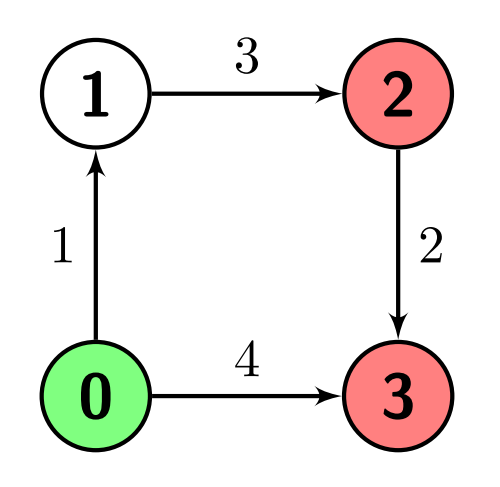
Input: n = 4, edges = [[0,1,1],[1,2,3],[2,3,2],[0,3,4]], s = 0, marked = [2,3]
Output: 4
Explanation: There is one path from node 0 (the green node) to node 2 (a red node), which is 0->1->2, and has a distance of 1 + 3 = 4.
There are two paths from node 0 to node 3 (a red node), which are 0->1->2->3 and 0->3, the first one has a distance of 1 + 3 + 2 = 6 and the second one has a distance of 4.
The minimum of them is 4.
Example 2:
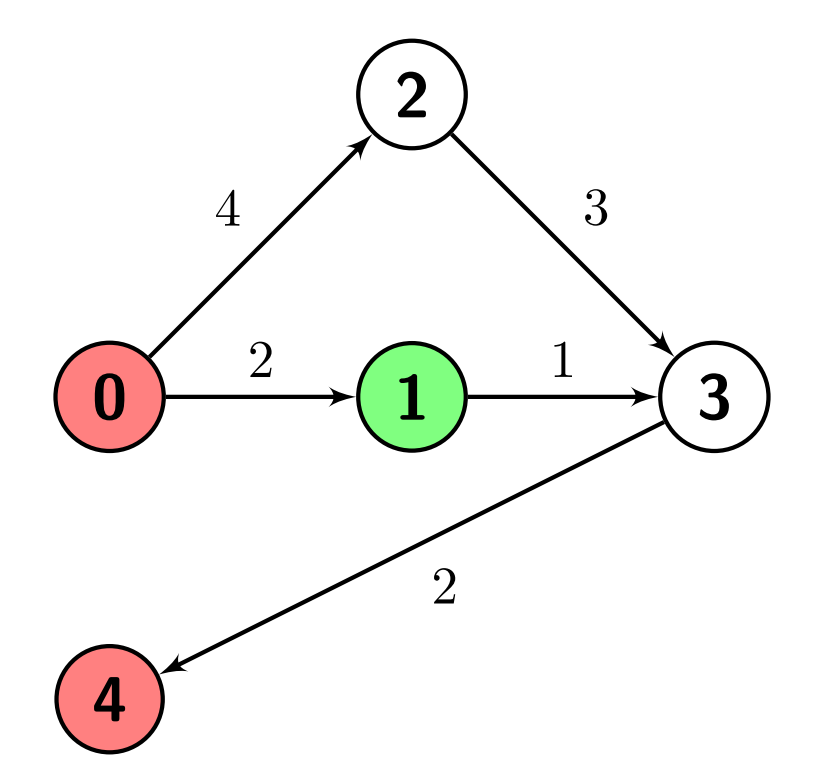
Input: n = 5, edges = [[0,1,2],[0,2,4],[1,3,1],[2,3,3],[3,4,2]], s = 1, marked = [0,4]
Output: 3
Explanation: There are no paths from node 1 (the green node) to node 0 (a red node).
There is one path from node 1 to node 4 (a red node), which is 1->3->4, and has a distance of 1 + 2 = 3.
So the answer is 3.
Example 3:
Input: n = 4, edges = [[0,1,1],[1,2,3],[2,3,2]], s = 3, marked = [0,1]
Output: -1
Explanation: There are no paths from node 3 (the green node) to any of the marked nodes (the red nodes), so the answer is -1.

Constraints:
2 <= n <= 5001 <= edges.length <= 104edges[i].length = 30 <= edges[i][0], edges[i][1] <= n - 11 <= edges[i][2] <= 1061 <= marked.length <= n - 10 <= s, marked[i] <= n - 1s != marked[i]marked[i] != marked[j]for everyi != j- The graph might have repeated edges.
- The graph is generated such that it has no self-loops.
Solutions
Solution 1: Dijkstra's Algorithm
Thinking
Find the shortest path from \(s\) to any marked vertex in a directed weighted graph. \(n\) is small enough for Dijkstra on an adjacency matrix without a heap.
Repeatedly pick the closest unused vertex and relax its outgoing edges, then take the minimum \(\textit{dist}\) among marked vertices, or \(-1\) if it stays infinite.
First, we construct an adjacency matrix \(g\) based on the edge information provided in the problem, where \(g[i][j]\) represents the distance from node \(i\) to node \(j\). If such an edge does not exist, then \(g[i][j]\) is positive infinity.
Then, we can use Dijkstra's algorithm to find the shortest distance from the starting point \(s\) to all nodes, denoted as \(\textit{dist}\).
Finally, we traverse all the marked nodes and find the marked node with the smallest distance. If the distance is positive infinity, we return \(-1\).
The time complexity is \(O(n^2)\), and the space complexity is \(O(n^2)\), where \(n\) is the number of nodes.
1 2 3 4 5 6 7 8 9 10 11 12 13 14 15 16 17 18 19 20 | |
1 2 3 4 5 6 7 8 9 10 11 12 13 14 15 16 17 18 19 20 21 22 23 24 25 26 27 28 29 30 31 32 33 34 | |
1 2 3 4 5 6 7 8 9 10 11 12 13 14 15 16 17 18 19 20 21 22 23 24 25 26 27 28 29 30 31 | |
1 2 3 4 5 6 7 8 9 10 11 12 13 14 15 16 17 18 19 20 21 22 23 24 25 26 27 28 29 30 31 32 33 34 35 36 37 38 | |
1 2 3 4 5 6 7 8 9 10 11 12 13 14 15 16 17 18 19 20 21 22 23 24 25 26 27 28 29 | |