Skip to content

1861. Rotating the Box

Description

You are given an m x n matrix of characters boxGrid representing a side-view of a box. Each cell of the box is one of the following:

  • A stone '#'
  • A stationary obstacle '*'
  • Empty '.'

The box is rotated 90 degrees clockwise, causing some of the stones to fall due to gravity. Each stone falls down until it lands on an obstacle, another stone, or the bottom of the box. Gravity does not affect the obstacles' positions, and the inertia from the box's rotation does not affect the stones' horizontal positions.

It is guaranteed that each stone in boxGrid rests on an obstacle, another stone, or the bottom of the box.

Return an n x m matrix representing the box after the rotation described above.

Β 

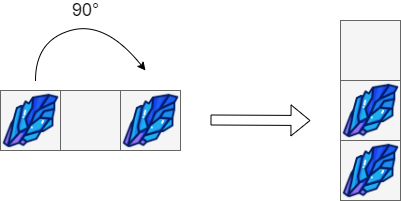
Example 1:

Input: boxGrid = [["#",".","#"]]
Output: [["."],
Β         ["#"],
Β         ["#"]]

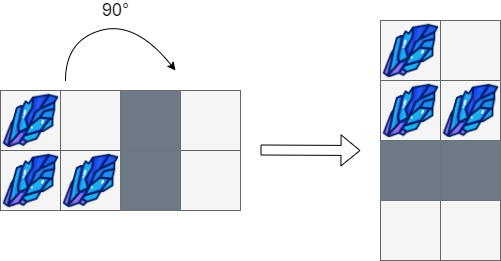
Example 2:

Input: boxGrid = [["#",".","*","."],
Β              ["#","#","*","."]]
Output: [["#","."],
Β         ["#","#"],
Β         ["*","*"],
Β         [".","."]]

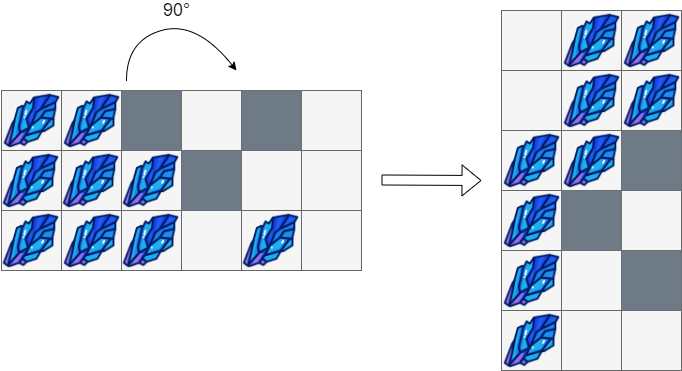
Example 3:

Input: boxGrid = [["#","#","*",".","*","."],
Β              ["#","#","#","*",".","."],
Β              ["#","#","#",".","#","."]]
Output: [[".","#","#"],
Β         [".","#","#"],
Β         ["#","#","*"],
Β         ["#","*","."],
Β         ["#",".","*"],
Β         ["#",".","."]]

Β 

Constraints:

  • m == boxGrid.length
  • n == boxGrid[i].length
  • 1 <= m, n <= 500
  • boxGrid[i][j] is either '#', '*', or '.'.

Solutions

Solution 1: Queue Simulation

We first rotate the matrix 90 degrees clockwise, then simulate the falling process of stones in each column.

Specifically, we use a queue \(q\) to store the row indices of empty positions in the current column. When traversing each column, we scan from bottom to top. If we encounter a stone, we drop it to the first empty position in \(q\), remove that empty position from \(q\), and add the current position's row index to \(q\) since it becomes empty. If we encounter an obstacle, we clear \(q\) because stones cannot pass through obstacles. If we encounter an empty position, we add its row index to \(q\).

The time complexity is \(O(m \times n)\), and the space complexity is \(O(m \times n)\), where \(m\) and \(n\) are the number of rows and columns of the matrix respectively.


 1
 2
 3
 4
 5
 6
 7
 8
 9
10
11
12
13
14
15
16
17
18
19
class Solution:
    def rotateTheBox(self, boxGrid: List[List[str]]) -> List[List[str]]:
        m, n = len(boxGrid), len(boxGrid[0])
        ans = [[None] * m for _ in range(n)]
        for i in range(m):
            for j in range(n):
                ans[j][m - i - 1] = boxGrid[i][j]
        for j in range(m):
            q = deque()
            for i in range(n - 1, -1, -1):
                if ans[i][j] == "*":
                    q.clear()
                elif ans[i][j] == ".":
                    q.append(i)
                elif q:
                    ans[q.popleft()][j] = "#"
                    ans[i][j] = "."
                    q.append(i)
        return ans
 1
 2
 3
 4
 5
 6
 7
 8
 9
10
11
12
13
14
15
16
17
18
19
20
21
22
23
24
25
26
class Solution {
    public char[][] rotateTheBox(char[][] boxGrid) {
        int m = boxGrid.length, n = boxGrid[0].length;
        char[][] ans = new char[n][m];
        for (int i = 0; i < m; ++i) {
            for (int j = 0; j < n; ++j) {
                ans[j][m - i - 1] = boxGrid[i][j];
            }
        }
        for (int j = 0; j < m; ++j) {
            Deque<Integer> q = new ArrayDeque<>();
            for (int i = n - 1; i >= 0; --i) {
                if (ans[i][j] == '*') {
                    q.clear();
                } else if (ans[i][j] == '.') {
                    q.offer(i);
                } else if (!q.isEmpty()) {
                    ans[q.pollFirst()][j] = '#';
                    ans[i][j] = '.';
                    q.offer(i);
                }
            }
        }
        return ans;
    }
}
 1
 2
 3
 4
 5
 6
 7
 8
 9
10
11
12
13
14
15
16
17
18
19
20
21
22
23
24
25
26
27
28
29
class Solution {
public:
    vector<vector<char>> rotateTheBox(vector<vector<char>>& boxGrid) {
        int m = boxGrid.size(), n = boxGrid[0].size();
        vector<vector<char>> ans(n, vector<char>(m));
        for (int i = 0; i < m; ++i) {
            for (int j = 0; j < n; ++j) {
                ans[j][m - i - 1] = boxGrid[i][j];
            }
        }
        for (int j = 0; j < m; ++j) {
            queue<int> q;
            for (int i = n - 1; ~i; --i) {
                if (ans[i][j] == '*') {
                    queue<int> t;
                    swap(t, q);
                } else if (ans[i][j] == '.') {
                    q.push(i);
                } else if (!q.empty()) {
                    ans[q.front()][j] = '#';
                    q.pop();
                    ans[i][j] = '.';
                    q.push(i);
                }
            }
        }
        return ans;
    }
};
 1
 2
 3
 4
 5
 6
 7
 8
 9
10
11
12
13
14
15
16
17
18
19
20
21
22
23
24
25
26
27
28
func rotateTheBox(boxGrid [][]byte) [][]byte {
    m, n := len(boxGrid), len(boxGrid[0])
    ans := make([][]byte, n)
    for i := range ans {
        ans[i] = make([]byte, m)
    }
    for i := 0; i < m; i++ {
        for j := 0; j < n; j++ {
            ans[j][m-i-1] = boxGrid[i][j]
        }
    }
    for j := 0; j < m; j++ {
        q := []int{}
        for i := n - 1; i >= 0; i-- {
            if ans[i][j] == '*' {
                q = []int{}
            } else if ans[i][j] == '.' {
                q = append(q, i)
            } else if len(q) > 0 {
                ans[q[0]][j] = '#'
                q = q[1:]
                ans[i][j] = '.'
                q = append(q, i)
            }
        }
    }
    return ans
}
 1
 2
 3
 4
 5
 6
 7
 8
 9
10
11
12
13
14
15
16
17
18
19
20
21
22
23
24
25
26
27
28
29
function rotateTheBox(boxGrid: string[][]): string[][] {
    const m = boxGrid.length;
    const n = boxGrid[0].length;
    const ans: string[][] = Array.from({ length: n }, () => Array(m));

    for (let i = 0; i < m; i++) {
        for (let j = 0; j < n; j++) {
            ans[j][m - i - 1] = boxGrid[i][j];
        }
    }

    for (let j = 0; j < m; j++) {
        const q: number[] = [];
        for (let i = n - 1; i >= 0; i--) {
            if (ans[i][j] === '*') {
                q.length = 0;
            } else if (ans[i][j] === '.') {
                q.push(i);
            } else if (q.length > 0) {
                const t = q.shift()!;
                ans[t][j] = '#';
                ans[i][j] = '.';
                q.push(i);
            }
        }
    }

    return ans;
}
 1
 2
 3
 4
 5
 6
 7
 8
 9
10
11
12
13
14
15
16
17
18
19
20
21
22
23
24
25
26
27
28
29
30
31
32
33
use std::collections::VecDeque;

impl Solution {
    pub fn rotate_the_box(box_grid: Vec<Vec<char>>) -> Vec<Vec<char>> {
        let m: usize = box_grid.len();
        let n: usize = box_grid[0].len();
        let mut ans: Vec<Vec<char>> = vec![vec![' '; m]; n];

        for i in 0..m {
            for j in 0..n {
                ans[j][m - i - 1] = box_grid[i][j];
            }
        }

        for j in 0..m {
            let mut q: VecDeque<usize> = VecDeque::new();
            for i in (0..n).rev() {
                if ans[i][j] == '*' {
                    q.clear();
                } else if ans[i][j] == '.' {
                    q.push_back(i);
                } else if !q.is_empty() {
                    let t = q.pop_front().unwrap();
                    ans[t][j] = '#';
                    ans[i][j] = '.';
                    q.push_back(i);
                }
            }
        }

        ans
    }
}

Comments