2768. Number of Black Blocks
SourceBiweekly Contest 108 Q4DifficultyMediumRating2175
Description
You are given two integers m and n representing the dimensions of a 0-indexed m x n grid.
You are also given a 0-indexed 2D integer matrix coordinates, where coordinates[i] = [x, y] indicates that the cell with coordinates [x, y] is colored black. All cells in the grid that do not appear in coordinates are white.
A block is defined as a 2 x 2 submatrix of the grid. More formally, a block with cell [x, y] as its top-left corner where 0 <= x < m - 1 and 0 <= y < n - 1 contains the coordinates [x, y], [x + 1, y], [x, y + 1], and [x + 1, y + 1].
Return a 0-indexed integer array arr of size 5 such that arr[i] is the number of blocks that contains exactly i black cells.
Example 1:
Input: m = 3, n = 3, coordinates = [[0,0]]
Output: [3,1,0,0,0]
Explanation: The grid looks like this:
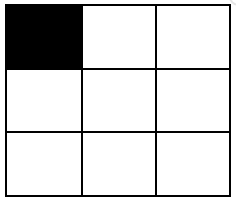 There is only 1 block with one black cell, and it is the block starting with cell [0,0].
The other 3 blocks start with cells [0,1], [1,0] and [1,1]. They all have zero black cells.
Thus, we return [3,1,0,0,0].
Example 2:
Input: m = 3, n = 3, coordinates = [[0,0],[1,1],[0,2]]
Output: [0,2,2,0,0]
Explanation: The grid looks like this:
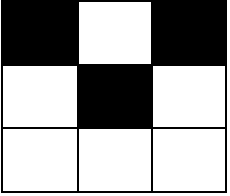 There are 2 blocks with two black cells (the ones starting with cell coordinates [0,0] and [0,1]).
The other 2 blocks have starting cell coordinates of [1,0] and [1,1]. They both have 1 black cell.
Therefore, we return [0,2,2,0,0].
Constraints:
2 <= m <= 1052 <= n <= 1050 <= coordinates.length <= 104coordinates[i].length == 20 <= coordinates[i][0] < m0 <= coordinates[i][1] < n- It is guaranteed that
coordinatescontains pairwise distinct coordinates.
Solutions
Solution 1: Hash Table
Thinking
Count how many \(2\times 2\) blocks contain \(0\) through \(4\) black cells. There are \((m-1)(n-1)\) blocks and the grid can be \(10^5\) on a side, so the blocks cannot all be visited.
A black cell touches at most four blocks. Increment those blocks in a hash map, fill \(\textit{ans}[1..4]\) from the map values, and set \(\textit{ans}[0]\) to the number of blocks minus the map size.
For each \(2 \times 2\) submatrix, we can use its upper-left corner coordinate \((x, y)\) to represent it.
For each black cell \((x, y)\), its contribution to the 4 submatrices is \(1\), namely the matrices \((x - 1, y - 1)\), \((x - 1, y)\), \((x, y - 1)\), \((x, y)\).
Therefore, we traverse all the black cells, and then accumulate the number of black cells in each submatrix, recorded in the hash table \(\textit{cnt}\).
Finally, we traverse all the values in \(\textit{cnt}\) (greater than \(0\)), count the number of times they appear, and record them in the answer array \(\textit{ans}\), while \(\textit{ans}[0]\) represents the number of submatrices without black cells, the value is \((m - 1) \times (n - 1) - \sum_{i = 1}^4 \textit{ans}[i]\).
The time complexity is \(O(l)\), and the space complexity is \(O(l)\), where \(l\) is the length of \(\textit{coordinates}\).
1 2 3 4 5 6 7 8 9 10 11 12 13 14 15 | |
1 2 3 4 5 6 7 8 9 10 11 12 13 14 15 16 17 18 19 20 21 22 | |
1 2 3 4 5 6 7 8 9 10 11 12 13 14 15 16 17 18 19 20 21 22 23 | |
1 2 3 4 5 6 7 8 9 10 11 12 13 14 15 16 17 18 19 20 | |
1 2 3 4 5 6 7 8 9 10 11 12 13 14 15 16 17 18 19 20 | |