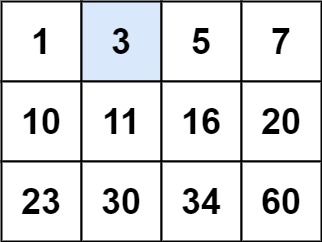
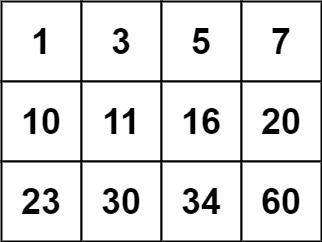
A full scan is \(O(mn)\). \(m,n \le 100\) would pass, but the problem asks for \(O(\log(mn))\).
Two dimensions hide a single binary search. Each row increases, and the last of row \(i\) is less than the first of row \(i+1\), so concatenating rows is a sorted array of length \(mn\). Logical index \(\textit{mid}\) maps to \(\textit{matrix}[\lfloor \textit{mid}/n\rfloor][\textit{mid} \bmod n]\), so we binary-search \([0,mn-1]\) without materializing the flatten.
We can logically unfold the two-dimensional matrix and then perform binary search.
The time complexity is \(O(\log(mn))\), and the space complexity is \(O(1)\), where \(m\) and \(n\) are the number of rows and columns of the matrix, respectively.
Solution 2: Search from the Bottom Left or Top Right
Thinking
Method 1 flattens the matrix and binary-searches, which is \(O(\log(mn))\), but it maps \(\textit{mid}\) to coordinates and needs the last of one row to be less than the first of the next. Without that index map, row/column monotonicity lets a corner walk drop a whole row or column per comparison. The code is simpler; the cost is \(O(m+n)\) time.
Here, we start searching from the bottom left corner and move towards the top right direction. We compare the current element \(\textit{matrix}[i][j]\) with \(\textit{target}\):
If \(\textit{matrix}[i][j] = \textit{target}\), we have found the target value and return true.
If \(\textit{matrix}[i][j] > \textit{target}\), all elements to the right of the current position in this row are greater than target, so we should move the pointer \(i\) upwards, i.e., \(i = i - 1\).
If \(\textit{matrix}[i][j] < \textit{target}\), all elements above the current position in this column are less than target, so we should move the pointer \(j\) to the right, i.e., \(j = j + 1\).
If we still can't find \(\textit{target}\) after the search, return false.
The time complexity is \(O(m + n)\), and the space complexity is \(O(1)\), where \(m\) and \(n\) are the number of rows and columns of the matrix, respectively.