3319. K-th Largest Perfect Subtree Size in Binary Tree
SourceWeekly Contest 419 Q2DifficultyMediumRating1603
Description
You are given the root of a binary tree and an integer k.
Return an integer denoting the size of the kth largest perfect binary subtree, or -1 if it doesn't exist.
A perfect binary tree is a tree where all leaves are on the same level, and every parent has two children.
Example 1:
Input: root = [5,3,6,5,2,5,7,1,8,null,null,6,8], k = 2
Output: 3
Explanation:
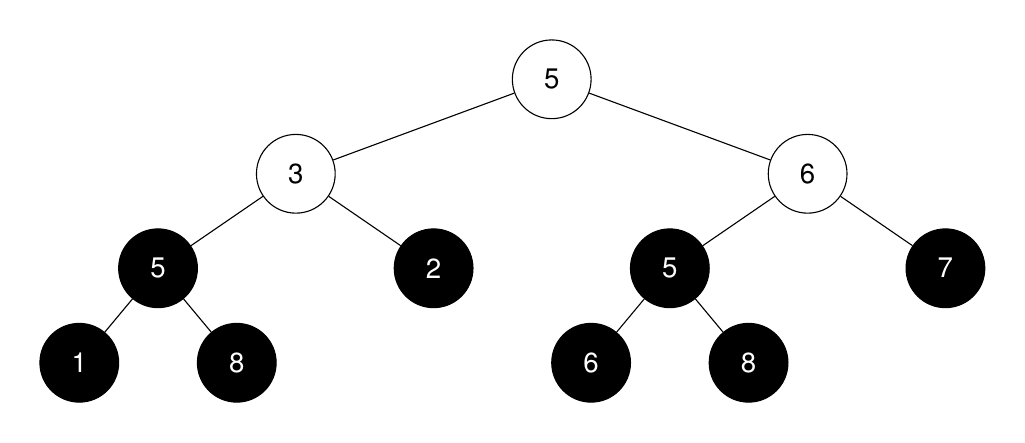
The roots of the perfect binary subtrees are highlighted in black. Their sizes, in non-increasing order are [3, 3, 1, 1, 1, 1, 1, 1].
The 2nd largest size is 3.
Example 2:
Input: root = [1,2,3,4,5,6,7], k = 1
Output: 7
Explanation:
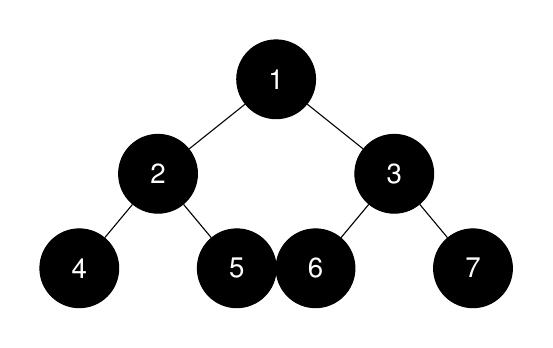
The sizes of the perfect binary subtrees in non-increasing order are [7, 3, 3, 1, 1, 1, 1]. The size of the largest perfect binary subtree is 7.
Example 3:
Input: root = [1,2,3,null,4], k = 3
Output: -1
Explanation:
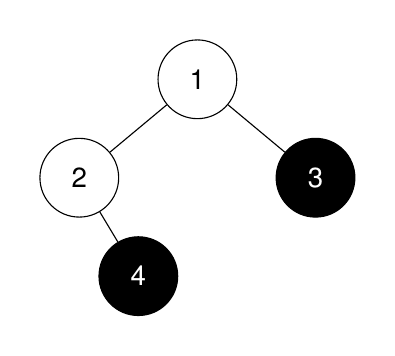
The sizes of the perfect binary subtrees in non-increasing order are [1, 1]. There are fewer than 3 perfect binary subtrees.
Constraints:
- The number of nodes in the tree is in the range
[1, 2000]. 1 <= Node.val <= 20001 <= k <= 1024
Solutions
Solution 1: DFS + Sorting
Thinking
A perfect binary subtree needs two perfect children of equal size. With \(n \le 2000\), one post-order walk can collect every valid size.
An empty tree has size \(0\). If both children return the same non-negative size, the current tree is perfect and we record \(l+r+1\); otherwise we return \(-1\).
After sorting the sizes descending, we return the \(k\)-th or \(-1\) if fewer than \(k\) exist.
We define a function \(\textit{dfs}\) to calculate the size of the perfect binary subtree rooted at the current node, using an array \(\textit{nums}\) to record the sizes of all perfect binary subtrees. If the subtree rooted at the current node is not a perfect binary subtree, it returns \(-1\).
The execution process of the function \(\textit{dfs}\) is as follows:
- If the current node is null, return \(0\);
- Recursively calculate the sizes of the perfect binary subtrees of the left and right subtrees, denoted as \(l\) and \(r\) respectively;
- If the sizes of the left and right subtrees are not equal, or if the sizes of the left and right subtrees are less than \(0\), return \(-1\);
- Calculate the size of the perfect binary subtree rooted at the current node \(\textit{cnt} = l + r + 1\), and add \(\textit{cnt}\) to the array \(\textit{nums}\);
- Return \(\textit{cnt}\).
We call the \(\textit{dfs}\) function to calculate the sizes of all perfect binary subtrees. If the length of the array \(\textit{nums}\) is less than \(k\), return \(-1\). Otherwise, sort the array \(\textit{nums}\) in descending order and return the \(k\)-th largest perfect binary subtree size.
The time complexity is \(O(n \times \log n)\), and the space complexity is \(O(n)\). Here, \(n\) is the number of nodes in the binary tree.
1 2 3 4 5 6 7 8 9 10 11 12 13 14 15 16 17 18 19 20 21 22 23 24 | |
1 2 3 4 5 6 7 8 9 10 11 12 13 14 15 16 17 18 19 20 21 22 23 24 25 26 27 28 29 30 31 32 33 34 35 36 37 38 39 40 41 | |
1 2 3 4 5 6 7 8 9 10 11 12 13 14 15 16 17 18 19 20 21 22 23 24 25 26 27 28 29 30 31 32 33 34 35 36 | |
1 2 3 4 5 6 7 8 9 10 11 12 13 14 15 16 17 18 19 20 21 22 23 24 25 26 27 28 29 30 | |
1 2 3 4 5 6 7 8 9 10 11 12 13 14 15 16 17 18 19 20 21 22 23 24 25 26 27 28 29 30 31 32 33 34 35 | |