1275. Find Winner on a Tic Tac Toe Game
SourceWeekly Contest 165 Q1DifficultyEasyRating1336
Description
Tic-tac-toe is played by two players A and B on a 3 x 3 grid. The rules of Tic-Tac-Toe are:
- Players take turns placing characters into empty squares
' '. - The first player
Aalways places'X'characters, while the second playerBalways places'O'characters. 'X'and'O'characters are always placed into empty squares, never on filled ones.- The game ends when there are three of the same (non-empty) character filling any row, column, or diagonal.
- The game also ends if all squares are non-empty.
- No more moves can be played if the game is over.
Given a 2D integer array moves where moves[i] = [rowi, coli] indicates that the ith move will be played on grid[rowi][coli]. return the winner of the game if it exists (A or B). In case the game ends in a draw return "Draw". If there are still movements to play return "Pending".
You can assume that moves is valid (i.e., it follows the rules of Tic-Tac-Toe), the grid is initially empty, and A will play first.
Example 1:
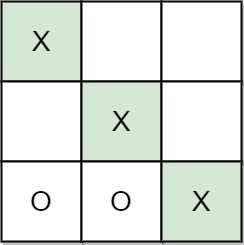
Input: moves = [[0,0],[2,0],[1,1],[2,1],[2,2]]
Output: "A"
Explanation: A wins, they always play first.
Example 2:
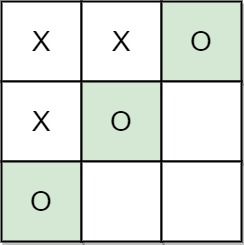
Input: moves = [[0,0],[1,1],[0,1],[0,2],[1,0],[2,0]]
Output: "B"
Explanation: B wins.
Example 3:
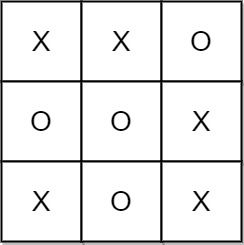
Input: moves = [[0,0],[1,1],[2,0],[1,0],[1,2],[2,1],[0,1],[0,2],[2,2]]
Output: "Draw"
Explanation: The game ends in a draw since there are no moves to make.
Constraints:
1 <= moves.length <= 9moves[i].length == 20 <= rowi, coli <= 2- There are no repeated elements on
moves. movesfollow the rules of tic tac toe.
Solutions
Solution 1: Determine if the last player to move can win
Thinking
Moves are legal and play stops at a win, so we only test whether the last player already has three in a row. Walking backward every other move, we tally that player's rows, columns, and diagonals; a \(3\) is a win. Otherwise nine moves is a draw, fewer is pending.
Since all moves are valid, that is, there is no situation where a person continues to play after someone has won. Therefore, we only need to determine whether the last player to move can win.
We use an array \(\textit{cnt}\) of length \(8\) to record the number of moves in rows, columns, and diagonals. Where \(\textit{cnt}[0, 1, 2]\) represent the number of moves in the \(0, 1, 2\) rows respectively, and \(\textit{cnt}[3, 4, 5]\) represent the number of moves in the \(0, 1, 2\) columns respectively. Additionally, \(\textit{cnt}[6]\) and \(\textit{cnt}[7]\) represent the number of moves on the two diagonals respectively. During the game, if a player makes \(3\) moves in a row, column, or diagonal, that player wins.
If the last player to move does not win, then we determine whether the board is full. If it is full, it is a draw; otherwise, the game is not over yet.
The time complexity is \(O(n)\), and the space complexity is \(O(n)\), where \(n\) is the length of \(\textit{moves}\).
1 2 3 4 5 6 7 8 9 10 11 12 13 14 15 | |
1 2 3 4 5 6 7 8 9 10 11 12 13 14 15 16 17 18 19 20 21 | |
1 2 3 4 5 6 7 8 9 10 11 12 13 14 15 16 17 18 19 20 21 22 | |
1 2 3 4 5 6 7 8 9 10 11 12 13 14 15 16 17 18 19 20 21 22 23 24 25 | |
1 2 3 4 5 6 7 8 9 10 11 12 13 14 15 16 17 18 19 | |