The tree is represented in the same input/output way as normal binary trees where each node is represented as a pair of [val, random_index] where:
val: an integer representing Node.val
random_index: the index of the node (in the input) where the random pointer points to, or null if it does not point to any node.
You will be given the tree in class Node and you should return the cloned tree in class NodeCopy. NodeCopy class is just a clone of Node class with the same attributes and constructors.
Example 1:
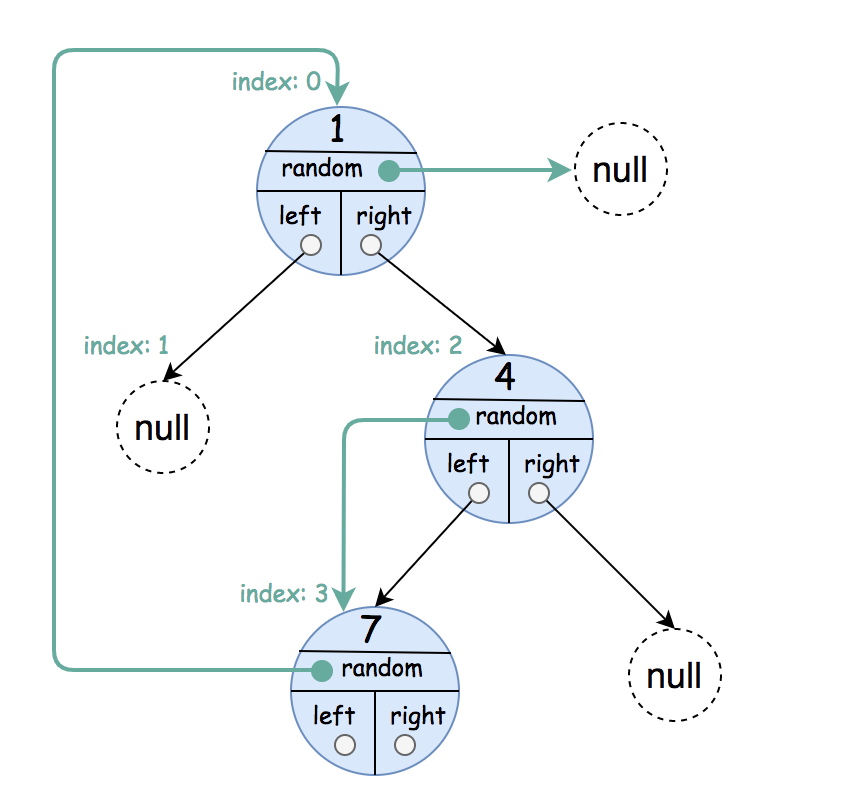
Input: root = [[1,null],null,[4,3],[7,0]]
Output: [[1,null],null,[4,3],[7,0]]
Explanation: The original binary tree is [1,null,4,7].
The random pointer of node one is null, so it is represented as [1, null].
The random pointer of node 4 is node 7, so it is represented as [4, 3] where 3 is the index of node 7 in the array representing the tree.
The random pointer of node 7 is node 1, so it is represented as [7, 0] where 0 is the index of node 1 in the array representing the tree.
Example 2:
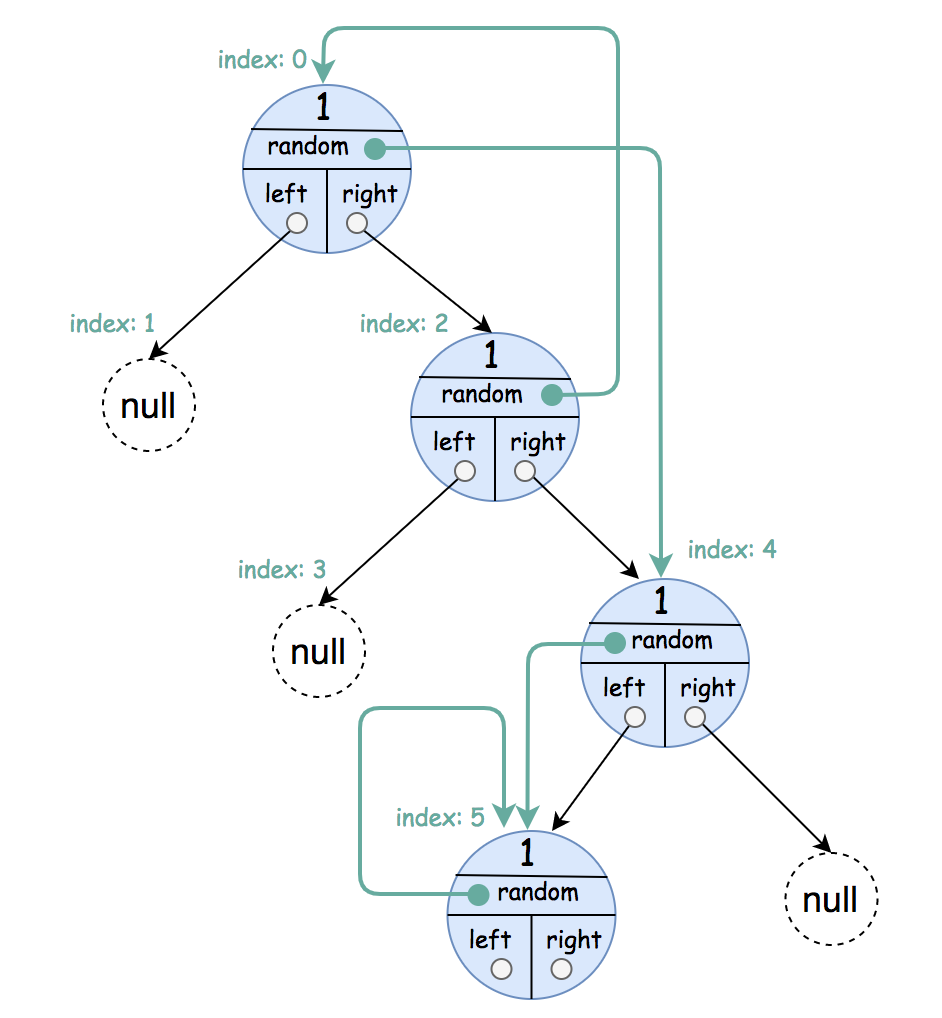
Input: root = [[1,4],null,[1,0],null,[1,5],[1,5]]
Output: [[1,4],null,[1,0],null,[1,5],[1,5]]
Explanation: The random pointer of a node can be the node itself.
The number of nodes in the tree is in the range [0, 1000].
1 <= Node.val <= 106
Solutions
Solution 1
Thinking
Besides left and right there is a \(\textit{random}\) pointer that may form cycles, so a naive recursion can loop or copy a node twice.
Map each original node to its copy: create the copy first, then recurse on left, right, and \(\textit{random}\). A hit in the map returns the existing copy.
/** * Definition for a Node. * type Node struct { * Val int * Left *Node * Right *Node * Random *Node * } */funccopyRandomBinaryTree(root*Node)*NodeCopy{mp:=make(map[*Node]*NodeCopy)vardfsfunc(root*Node)*NodeCopydfs=func(root*Node)*NodeCopy{ifroot==nil{returnnil}ifv,ok:=mp[root];ok{returnv}copy:=&NodeCopy{Val:root.Val}mp[root]=copycopy.Left=dfs(root.Left)copy.Right=dfs(root.Right)copy.Random=dfs(root.Random)returncopy}returndfs(root)}