
题目描述
二进制手表顶部有 4 个 LED 代表 小时(0-11),底部的 6 个 LED 代表 分钟(0-59)。每个 LED 代表一个 0 或 1,最低位在右侧。
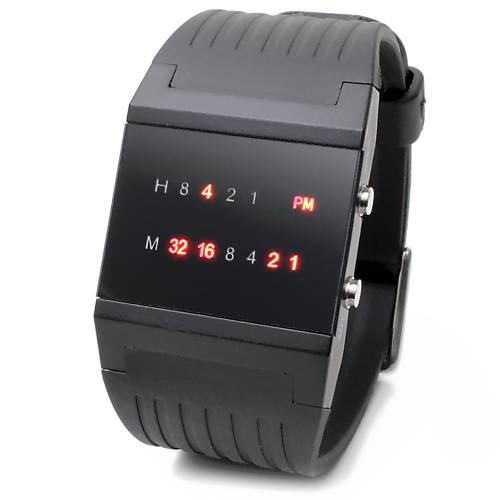
给你一个整数 turnedOn ,表示当前亮着的 LED 的数量,返回二进制手表可以表示的所有可能时间。你可以 按任意顺序 返回答案。
小时不会以零开头:
- 例如,
"01:00" 是无效的时间,正确的写法应该是 "1:00" 。
分钟必须由两位数组成,可能会以零开头:
- 例如,
"10:2" 是无效的时间,正确的写法应该是 "10:02" 。
示例 1:
输入:turnedOn = 1
输出:["0:01","0:02","0:04","0:08","0:16","0:32","1:00","2:00","4:00","8:00"]
示例 2:
输入:turnedOn = 9
输出:[]
提示:
解法
方法一:枚举组合
题目可以转换为求 \(i \in [0, 12)\) 和 \(j \in [0, 60)\) 的所有可能组合。
合法组合需要满足的条件是 \(i\) 的二进制形式中 1 的个数加上 \(j\) 的二进制形式中 1 的个数,结果等于 \(\textit{turnedOn}\)。
时间复杂度 \(O(1)\),空间复杂度 \(O(1)\)。
| class Solution:
def readBinaryWatch(self, turnedOn: int) -> List[str]:
return [
'{:d}:{:02d}'.format(i, j)
for i in range(12)
for j in range(60)
if (bin(i) + bin(j)).count('1') == turnedOn
]
|
1
2
3
4
5
6
7
8
9
10
11
12
13 | class Solution {
public List<String> readBinaryWatch(int turnedOn) {
List<String> ans = new ArrayList<>();
for (int i = 0; i < 12; ++i) {
for (int j = 0; j < 60; ++j) {
if (Integer.bitCount(i) + Integer.bitCount(j) == turnedOn) {
ans.add(String.format("%d:%02d", i, j));
}
}
}
return ans;
}
}
|
 1
 2
 3
 4
 5
 6
 7
 8
 9
10
11
12
13
14 | class Solution {
public:
vector<string> readBinaryWatch(int turnedOn) {
vector<string> ans;
for (int i = 0; i < 12; ++i) {
for (int j = 0; j < 60; ++j) {
if (__builtin_popcount(i) + __builtin_popcount(j) == turnedOn) {
ans.push_back(to_string(i) + ":" + (j < 10 ? "0" : "") + to_string(j));
}
}
}
return ans;
}
};
|
| func readBinaryWatch(turnedOn int) []string {
var ans []string
for i := 0; i < 12; i++ {
for j := 0; j < 60; j++ {
if bits.OnesCount(uint(i))+bits.OnesCount(uint(j)) == turnedOn {
ans = append(ans, fmt.Sprintf("%d:%02d", i, j))
}
}
}
return ans
}
|
 1
 2
 3
 4
 5
 6
 7
 8
 9
10
11
12
13
14
15
16
17
18
19
20
21
22 | function readBinaryWatch(turnedOn: number): string[] {
const ans: string[] = [];
for (let i = 0; i < 12; ++i) {
for (let j = 0; j < 60; ++j) {
if (bitCount(i) + bitCount(j) === turnedOn) {
ans.push(`${i}:${j.toString().padStart(2, '0')}`);
}
}
}
return ans;
}
function bitCount(i: number): number {
i = i - ((i >>> 1) & 0x55555555);
i = (i & 0x33333333) + ((i >>> 2) & 0x33333333);
i = (i + (i >>> 4)) & 0x0f0f0f0f;
i = i + (i >>> 8);
i = i + (i >>> 16);
return i & 0x3f;
}
|
 1
 2
 3
 4
 5
 6
 7
 8
 9
10
11
12
13
14
15 | impl Solution {
pub fn read_binary_watch(turned_on: i32) -> Vec<String> {
let mut ans: Vec<String> = Vec::new();
for i in 0u32..12 {
for j in 0u32..60 {
if (i.count_ones() + j.count_ones()) as i32 == turned_on {
ans.push(format!("{}:{:02}", i, j));
}
}
}
ans
}
}
|
方法二:二进制枚举
我们可以利用 \(10\) 个二进制位表示手表,其中前 \(4\) 位代表小时,后 \(6\) 位代表分钟。枚举 \([0, 2^{10})\) 中的每个数,判断其二进制表示中 1 的个数是否等于 \(\textit{turnedOn}\),如果是,则将其转换为时间格式加入答案中。
时间复杂度 \(O(1)\),空间复杂度 \(O(1)\)。
| class Solution:
def readBinaryWatch(self, turnedOn: int) -> List[str]:
ans = []
for i in range(1 << 10):
h, m = i >> 6, i & 0b111111
if h < 12 and m < 60 and i.bit_count() == turnedOn:
ans.append('{:d}:{:02d}'.format(h, m))
return ans
|
1
2
3
4
5
6
7
8
9
10
11
12 | class Solution {
public List<String> readBinaryWatch(int turnedOn) {
List<String> ans = new ArrayList<>();
for (int i = 0; i < 1 << 10; ++i) {
int h = i >> 6, m = i & 0b111111;
if (h < 12 && m < 60 && Integer.bitCount(i) == turnedOn) {
ans.add(String.format("%d:%02d", h, m));
}
}
return ans;
}
}
|
1
2
3
4
5
6
7
8
9
10
11
12
13 | class Solution {
public:
vector<string> readBinaryWatch(int turnedOn) {
vector<string> ans;
for (int i = 0; i < 1 << 10; ++i) {
int h = i >> 6, m = i & 0b111111;
if (h < 12 && m < 60 && __builtin_popcount(i) == turnedOn) {
ans.push_back(to_string(h) + ":" + (m < 10 ? "0" : "") + to_string(m));
}
}
return ans;
}
};
|
| func readBinaryWatch(turnedOn int) []string {
var ans []string
for i := 0; i < 1<<10; i++ {
h, m := i>>6, i&0b111111
if h < 12 && m < 60 && bits.OnesCount(uint(i)) == turnedOn {
ans = append(ans, fmt.Sprintf("%d:%02d", h, m))
}
}
return ans
}
|
 1
 2
 3
 4
 5
 6
 7
 8
 9
10
11
12
13
14
15
16
17
18
19
20
21
22
23 | function readBinaryWatch(turnedOn: number): string[] {
const ans: string[] = [];
for (let i = 0; i < 1 << 10; ++i) {
const h = i >> 6;
const m = i & 0b111111;
if (h < 12 && m < 60 && bitCount(i) === turnedOn) {
ans.push(`${h}:${m < 10 ? '0' : ''}${m}`);
}
}
return ans;
}
function bitCount(i: number): number {
i = i - ((i >>> 1) & 0x55555555);
i = (i & 0x33333333) + ((i >>> 2) & 0x33333333);
i = (i + (i >>> 4)) & 0x0f0f0f0f;
i = i + (i >>> 8);
i = i + (i >>> 16);
return i & 0x3f;
}
|
 1
 2
 3
 4
 5
 6
 7
 8
 9
10
11
12
13
14
15
16 | impl Solution {
pub fn read_binary_watch(turned_on: i32) -> Vec<String> {
let mut ans: Vec<String> = Vec::new();
for i in 0u32..(1 << 10) {
let h = i >> 6;
let m = i & 0b111111;
if h < 12 && m < 60 && i.count_ones() as i32 == turned_on {
ans.push(format!("{}:{:02}", h, m));
}
}
ans
}
}
|