Skip to content

337. House Robber III

Description

The thief has found himself a new place for his thievery again. There is only one entrance to this area, called root.

Besides the root, each house has one and only one parent house. After a tour, the smart thief realized that all houses in this place form a binary tree. It will automatically contact the police if two directly-linked houses were broken into on the same night.

Given the root of the binary tree, return the maximum amount of money the thief can rob without alerting the police.

Β 

Example 1:

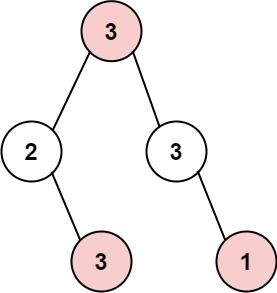
Input: root = [3,2,3,null,3,null,1]
Output: 7
Explanation: Maximum amount of money the thief can rob = 3 + 3 + 1 = 7.

Example 2:

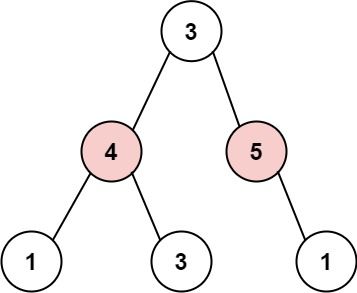
Input: root = [3,4,5,1,3,null,1]
Output: 9
Explanation: Maximum amount of money the thief can rob = 4 + 5 = 9.

Β 

Constraints:

  • The number of nodes in the tree is in the range [1, 104].
  • 0 <= Node.val <= 104

Solutions

Solution 1

 1
 2
 3
 4
 5
 6
 7
 8
 9
10
11
12
13
14
15
16
# Definition for a binary tree node.
# class TreeNode:
#     def __init__(self, val=0, left=None, right=None):
#         self.val = val
#         self.left = left
#         self.right = right
class Solution:
    def rob(self, root: Optional[TreeNode]) -> int:
        def dfs(root: Optional[TreeNode]) -> (int, int):
            if root is None:
                return 0, 0
            la, lb = dfs(root.left)
            ra, rb = dfs(root.right)
            return root.val + lb + rb, max(la, lb) + max(ra, rb)

        return max(dfs(root))
 1
 2
 3
 4
 5
 6
 7
 8
 9
10
11
12
13
14
15
16
17
18
19
20
21
22
23
24
25
26
27
28
29
30
/**
 * Definition for a binary tree node.
 * public class TreeNode {
 *     int val;
 *     TreeNode left;
 *     TreeNode right;
 *     TreeNode() {}
 *     TreeNode(int val) { this.val = val; }
 *     TreeNode(int val, TreeNode left, TreeNode right) {
 *         this.val = val;
 *         this.left = left;
 *         this.right = right;
 *     }
 * }
 */
class Solution {
    public int rob(TreeNode root) {
        int[] ans = dfs(root);
        return Math.max(ans[0], ans[1]);
    }

    private int[] dfs(TreeNode root) {
        if (root == null) {
            return new int[2];
        }
        int[] l = dfs(root.left);
        int[] r = dfs(root.right);
        return new int[] {root.val + l[1] + r[1], Math.max(l[0], l[1]) + Math.max(r[0], r[1])};
    }
}
 1
 2
 3
 4
 5
 6
 7
 8
 9
10
11
12
13
14
15
16
17
18
19
20
21
22
23
24
25
26
/**
 * Definition for a binary tree node.
 * struct TreeNode {
 *     int val;
 *     TreeNode *left;
 *     TreeNode *right;
 *     TreeNode() : val(0), left(nullptr), right(nullptr) {}
 *     TreeNode(int x) : val(x), left(nullptr), right(nullptr) {}
 *     TreeNode(int x, TreeNode *left, TreeNode *right) : val(x), left(left), right(right) {}
 * };
 */
class Solution {
public:
    int rob(TreeNode* root) {
        function<pair<int, int>(TreeNode*)> dfs = [&](TreeNode* root) -> pair<int, int> {
            if (!root) {
                return make_pair(0, 0);
            }
            auto [la, lb] = dfs(root->left);
            auto [ra, rb] = dfs(root->right);
            return make_pair(root->val + lb + rb, max(la, lb) + max(ra, rb));
        };
        auto [a, b] = dfs(root);
        return max(a, b);
    }
};
 1
 2
 3
 4
 5
 6
 7
 8
 9
10
11
12
13
14
15
16
17
18
19
20
21
/**
 * Definition for a binary tree node.
 * type TreeNode struct {
 *     Val int
 *     Left *TreeNode
 *     Right *TreeNode
 * }
 */
func rob(root *TreeNode) int {
    var dfs func(*TreeNode) (int, int)
    dfs = func(root *TreeNode) (int, int) {
        if root == nil {
            return 0, 0
        }
        la, lb := dfs(root.Left)
        ra, rb := dfs(root.Right)
        return root.Val + lb + rb, max(la, lb) + max(ra, rb)
    }
    a, b := dfs(root)
    return max(a, b)
}
 1
 2
 3
 4
 5
 6
 7
 8
 9
10
11
12
13
14
15
16
17
18
19
20
21
22
23
24
25
/**
 * Definition for a binary tree node.
 * class TreeNode {
 *     val: number
 *     left: TreeNode | null
 *     right: TreeNode | null
 *     constructor(val?: number, left?: TreeNode | null, right?: TreeNode | null) {
 *         this.val = (val===undefined ? 0 : val)
 *         this.left = (left===undefined ? null : left)
 *         this.right = (right===undefined ? null : right)
 *     }
 * }
 */

function rob(root: TreeNode | null): number {
    const dfs = (root: TreeNode | null): [number, number] => {
        if (!root) {
            return [0, 0];
        }
        const [la, lb] = dfs(root.left);
        const [ra, rb] = dfs(root.right);
        return [root.val + lb + rb, Math.max(la, lb) + Math.max(ra, rb)];
    };
    return Math.max(...dfs(root));
}

Comments