2872. Maximum Number of K-Divisible Components
SourceBiweekly Contest 114 Q4DifficultyHardRating1967
Description
There is an undirected tree with n nodes labeled from 0 to n - 1. You are given the integer n and a 2D integer array edges of length n - 1, where edges[i] = [ai, bi] indicates that there is an edge between nodes ai and bi in the tree.
You are also given a 0-indexed integer array values of length n, where values[i] is the value associated with the ith node, and an integer k.
A valid split of the tree is obtained by removing any set of edges, possibly empty, from the tree such that the resulting components all have values that are divisible by k, where the value of a connected component is the sum of the values of its nodes.
Return the maximum number of components in any valid split.
Example 1:
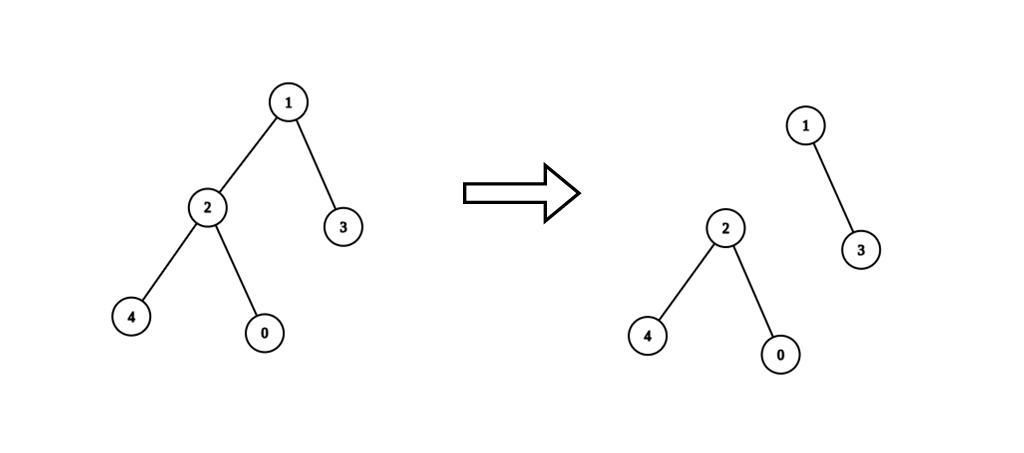
Input: n = 5, edges = [[0,2],[1,2],[1,3],[2,4]], values = [1,8,1,4,4], k = 6
Output: 2
Explanation: We remove the edge connecting node 1 with 2. The resulting split is valid because:
- The value of the component containing nodes 1 and 3 is values[1] + values[3] = 12.
- The value of the component containing nodes 0, 2, and 4 is values[0] + values[2] + values[4] = 6.
It can be shown that no other valid split has more than 2 connected components.
Example 2:
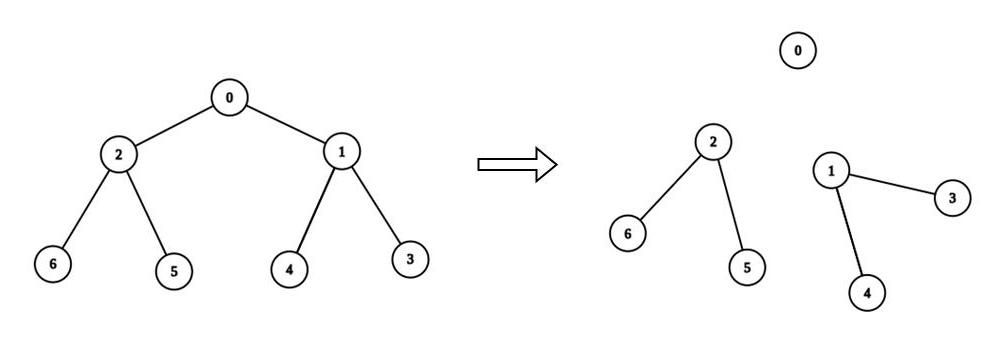
Input: n = 7, edges = [[0,1],[0,2],[1,3],[1,4],[2,5],[2,6]], values = [3,0,6,1,5,2,1], k = 3
Output: 3
Explanation: We remove the edge connecting node 0 with 2, and the edge connecting node 0 with 1. The resulting split is valid because:
- The value of the component containing node 0 is values[0] = 3.
- The value of the component containing nodes 2, 5, and 6 is values[2] + values[5] + values[6] = 9.
- The value of the component containing nodes 1, 3, and 4 is values[1] + values[3] + values[4] = 6.
It can be shown that no other valid split has more than 3 connected components.
Constraints:
1 <= n <= 3 * 104edges.length == n - 1edges[i].length == 20 <= ai, bi < nvalues.length == n0 <= values[i] <= 1091 <= k <= 109- Sum of
valuesis divisible byk. - The input is generated such that
edgesrepresents a valid tree.
Solutions
Solution 1: DFS
Thinking
The whole tree sum is divisible by \(k\), so deleting a subtree whose sum is also divisible by \(k\) leaves valid components. A bottom-up DFS accumulates subtree sums and counts every subtree whose sum is \(0\) modulo \(k\).
We note that the problem guarantees the sum of all node values in the entire tree is divisible by \(k\). Therefore, if we remove a subtree whose sum of elements is divisible by \(k\), the sum of node values in each of the remaining connected components must also be divisible by \(k\).
Thus, we can use a depth-first search approach, starting from the root node to traverse the entire tree. For each node, we calculate the sum of all node values in its subtree. If this sum is divisible by \(k\), we increment the answer by one.
The time complexity is \(O(n)\) and the space complexity is \(O(n)\), where \(n\) is the number of nodes in the tree.
1 2 3 4 5 6 7 8 9 10 11 12 13 14 15 16 17 18 19 20 | |
1 2 3 4 5 6 7 8 9 10 11 12 13 14 15 16 17 18 19 20 21 22 23 24 25 26 27 28 29 30 31 | |
1 2 3 4 5 6 7 8 9 10 11 12 13 14 15 16 17 18 19 20 21 22 23 24 | |
1 2 3 4 5 6 7 8 9 10 11 12 13 14 15 16 17 18 19 20 21 22 23 | |
1 2 3 4 5 6 7 8 9 10 11 12 13 14 15 16 17 18 19 20 21 22 23 24 25 26 27 | |
1 2 3 4 5 6 7 8 9 10 11 12 13 14 15 16 17 18 19 20 21 22 23 24 25 26 27 28 29 30 | |