2756. Query Batching 🔒

Description
Batching multiple small queries into a single large query can be a useful optimization. Write a class QueryBatcher that implements this functionality.
The constructor should accept two parameters:
- An asynchronous function
queryMultiplewhich accepts an array of string keysinput. It will resolve with an array of values that is the same length as the input array. Each index corresponds to the value associated withinput[i]. You can assume the promise will never reject. - A throttle time in milliseconds
t.
The class has a single method.
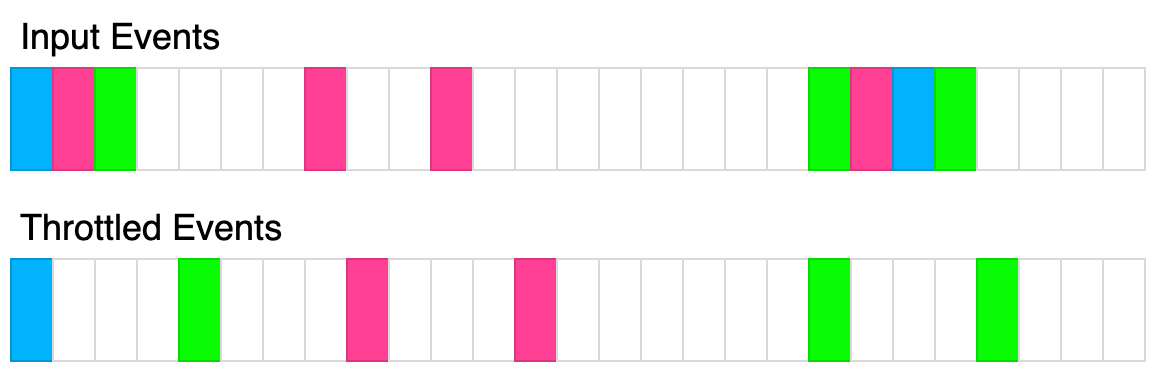
async getValue(key). Accepts a single string key and resolves with a single string value. The keys passed to this function should eventually get passed to thequeryMultiplefunction.queryMultipleshould never be called consecutively withintmilliseconds. The first timegetValueis called,queryMultipleshould immediately be called with that single key. If aftertmilliseconds,getValuehad been called again, all the passed keys should be passed toqueryMultipleand ultimately returned. You can assume every key passed to this method is unique.
The following diagram illustrates how the throttling algorithm works. Each rectangle represents 100ms. The throttle time is 400ms.
Example 1:
Input:
queryMultiple = async function(keys) {
  return keys.map(key => key + '!');
}
t = 100
calls = [
 {"key": "a", "time": 10},
 {"key": "b", "time": 20},
 {"key": "c", "time": 30}
]
Output: [
 {"resolved": "a!", "time": 10},
 {"resolved": "b!", "time": 110},
 {"resolved": "c!", "time": 110}
]
Explanation:
const batcher = new QueryBatcher(queryMultiple, 100);
setTimeout(() => batcher.getValue('a'), 10); // "a!" at t=10ms
setTimeout(() => batcher.getValue('b'), 20); // "b!" at t=110ms
setTimeout(() => batcher.getValue('c'), 30); // "c!" at t=110ms

queryMultiple simply adds an "!" to the key
At t=10ms, getValue('a') is called, queryMultiple(['a']) is immediately called and the result is immediately returned.
At t=20ms, getValue('b') is called but the query is queued
At t=30ms, getValue('c') is called but the query is queued.
At t=110ms, queryMultiple(['a', 'b']) is called and the results are immediately returned.
Example 2:
Input:
queryMultiple = async function(keys) {
  await new Promise(res => setTimeout(res, 100));
  return keys.map(key => key + '!');
}
t = 100
calls = [
 {"key": "a", "time": 10},
 {"key": "b", "time": 20},
 {"key": "c", "time": 30}
]
Output: [
  {"resolved": "a!", "time": 110},
  {"resolved": "b!", "time": 210},
  {"resolved": "c!", "time": 210}
]
Explanation:
This example is the same as example 1 except there is a 100ms delay in queryMultiple. The results are the same except the promises resolve 100ms later.
Example 3:
Input:
queryMultiple = async function(keys) {
  await new Promise(res => setTimeout(res, keys.length * 100));
  return keys.map(key => key + '!');
}
t = 100
calls = [
  {"key": "a", "time": 10},
  {"key": "b", "time": 20},
  {"key": "c", "time": 30},
  {"key": "d", "time": 40},
  {"key": "e", "time": 250}
  {"key": "f", "time": 300}
]
Output: [
  {"resolved":"a!","time":110},
  {"resolved":"e!","time":350},
  {"resolved":"b!","time":410},
  {"resolved":"c!","time":410},
  {"resolved":"d!","time":410},
  {"resolved":"f!","time":450}
]
Explanation:
queryMultiple(['a']) is called at t=10ms, it is resolved at t=110ms
queryMultiple(['b', 'c', 'd']) is called at t=110ms, it is resolved at 410ms
queryMultiple(['e']) is called at t=250ms, it is resolved at 350ms
queryMultiple(['f']) is called at t=350ms, it is resolved at 450ms
Constraints:
0 <= t <= 10000 <= calls.length <= 101 <= key.length <= 100- All keys are unique
Solutions
Solution 1
1 | |