2685. Count the Number of Complete Components
SourceWeekly Contest 345 Q4DifficultyMediumRating1769
Description
You are given an integer n. There is an undirected graph with n vertices, numbered from 0 to n - 1. You are given a 2D integer array edges where edges[i] = [ai, bi] denotes that there exists an undirected edge connecting vertices ai and bi.
Return the number of complete connected components of the graph.
A connected component is a subgraph of a graph in which there exists a path between any two vertices, and no vertex of the subgraph shares an edge with a vertex outside of the subgraph.
A connected component is said to be complete if there exists an edge between every pair of its vertices.
Example 1:
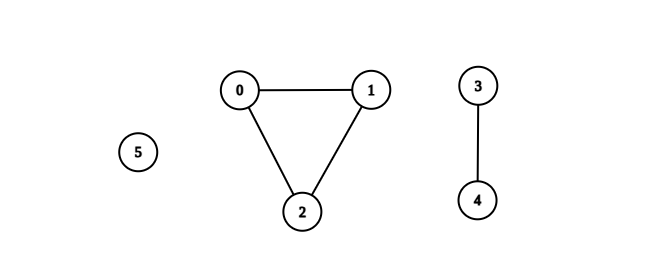
Input: n = 6, edges = [[0,1],[0,2],[1,2],[3,4]]
Output: 3
Explanation: From the picture above, one can see that all of the components of this graph are complete.
Example 2:
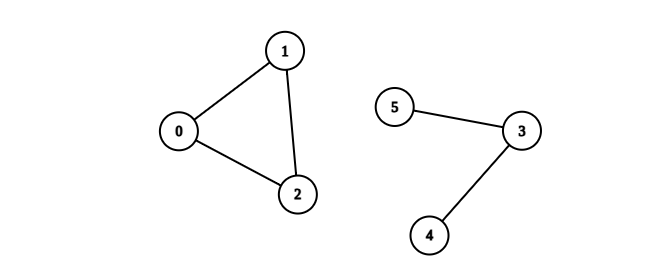
Input: n = 6, edges = [[0,1],[0,2],[1,2],[3,4],[3,5]]
Output: 1
Explanation: The component containing vertices 0, 1, and 2 is complete since there is an edge between every pair of two vertices. On the other hand, the component containing vertices 3, 4, and 5 is not complete since there is no edge between vertices 4 and 5. Thus, the number of complete components in this graph is 1.
Constraints:
1 <= n <= 500 <= edges.length <= n * (n - 1) / 2edges[i].length == 20 <= ai, bi <= n - 1ai != bi- There are no repeated edges.
Solutions
Solution 1
Thinking
A complete component has every pair joined. Checking all pairs after listing a component works for \(n \le 50\), but one DFS already yields the vertex and edge counts.
Each undirected edge is counted twice, so a clique satisfies \(x(x-1)=y\). DFS from every unseen vertex accumulates \((x,y)\) and tests that identity.
1 2 3 4 5 6 7 8 9 10 11 12 13 14 15 16 17 18 19 20 21 22 23 | |
1 2 3 4 5 6 7 8 9 10 11 12 13 14 15 16 17 18 19 20 21 22 23 24 25 26 27 28 29 30 31 32 33 34 35 36 37 38 | |
1 2 3 4 5 6 7 8 9 10 11 12 13 14 15 16 17 18 19 20 21 22 23 24 25 26 27 28 29 30 31 32 33 34 35 | |
1 2 3 4 5 6 7 8 9 10 11 12 13 14 15 16 17 18 19 20 21 22 23 24 25 26 27 28 29 30 31 | |
Solution 2: Simple Method
Thinking
Solution 1 counts edges explicitly. Storing each closed neighborhood instead: in a complete component those sets are identical and the set size equals how often it appears.
Grouping vertices by that set avoids a separate edge check, which suits a small \(n\) and an equality-of-neighborhoods view.
Problems needed to solve:
- How do we maintain the link state between each node and the others? 如
- How can one determine whether multiple points form a connected graph?
For the first one: we can maintain each node's connection set(including itself).
For the second one: After solving the first one, we can see:
- the node itself includes every node in the connected graph(including itself).
- and only connected to the nodes in the connected graph.
Take example 1 to explain:
- Node 5's connected node is itself, so it is a connected graph.
- Node 0's connected 0, 1, 2. Same as nodes 1, 2.
- Nodes 3 and 4 also include themselves and each other.
1 2 3 4 5 6 7 8 9 10 11 12 13 14 15 16 17 18 19 20 21 22 23 24 | |