Skip to content

257. Binary Tree Paths

Description

Given the root of a binary tree, return all root-to-leaf paths in any order.

A leaf is a node with no children.


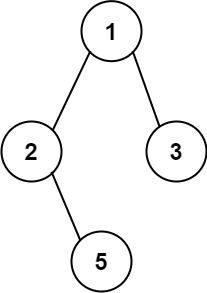
Example 1:

Input: root = [1,2,3,null,5]
Output: ["1->2->5","1->3"]

Example 2:

Input: root = [1]
Output: ["1"]


Constraints:

  • The number of nodes in the tree is in the range [1, 100].
  • -100 <= Node.val <= 100

Solutions

Solution 1: DFS

We can use depth-first search to traverse the entire binary tree. Each time, we add the current node to the path. If the current node is a leaf node, we add the entire path to the answer. Otherwise, we continue to recursively traverse the child nodes of the node. Finally, when the recursion ends and returns to the current node, we need to remove the current node from the path.

The time complexity is \(O(n^2)\), and the space complexity is \(O(n)\). Where \(n\) is the number of nodes in the binary tree.

 1
 2
 3
 4
 5
 6
 7
 8
 9
10
11
12
13
14
15
16
17
18
19
20
21
22
23
# Definition for a binary tree node.
# class TreeNode:
#     def __init__(self, val=0, left=None, right=None):
#         self.val = val
#         self.left = left
#         self.right = right
class Solution:
    def binaryTreePaths(self, root: Optional[TreeNode]) -> List[str]:
        def dfs(root: Optional[TreeNode]):
            if root is None:
                return
            t.append(str(root.val))
            if root.left is None and root.right is None:
                ans.append("->".join(t))
            else:
                dfs(root.left)
                dfs(root.right)
            t.pop()

        ans = []
        t = []
        dfs(root)
        return ans
 1
 2
 3
 4
 5
 6
 7
 8
 9
10
11
12
13
14
15
16
17
18
19
20
21
22
23
24
25
26
27
28
29
30
31
32
33
34
35
36
37
38
/**
 * Definition for a binary tree node.
 * public class TreeNode {
 *     int val;
 *     TreeNode left;
 *     TreeNode right;
 *     TreeNode() {}
 *     TreeNode(int val) { this.val = val; }
 *     TreeNode(int val, TreeNode left, TreeNode right) {
 *         this.val = val;
 *         this.left = left;
 *         this.right = right;
 *     }
 * }
 */
class Solution {
    private List<String> ans = new ArrayList<>();
    private List<String> t = new ArrayList<>();

    public List<String> binaryTreePaths(TreeNode root) {
        dfs(root);
        return ans;
    }

    private void dfs(TreeNode root) {
        if (root == null) {
            return;
        }
        t.add(root.val + "");
        if (root.left == null && root.right == null) {
            ans.add(String.join("->", t));
        } else {
            dfs(root.left);
            dfs(root.right);
        }
        t.remove(t.size() - 1);
    }
}
 1
 2
 3
 4
 5
 6
 7
 8
 9
10
11
12
13
14
15
16
17
18
19
20
21
22
23
24
25
26
27
28
29
30
31
32
33
34
35
36
37
38
39
40
41
42
43
44
/**
 * Definition for a binary tree node.
 * struct TreeNode {
 *     int val;
 *     TreeNode *left;
 *     TreeNode *right;
 *     TreeNode() : val(0), left(nullptr), right(nullptr) {}
 *     TreeNode(int x) : val(x), left(nullptr), right(nullptr) {}
 *     TreeNode(int x, TreeNode *left, TreeNode *right) : val(x), left(left), right(right) {}
 * };
 */
class Solution {
public:
    vector<string> binaryTreePaths(TreeNode* root) {
        vector<string> ans;
        vector<string> t;
        function<void(TreeNode*)> dfs = [&](TreeNode* root) {
            if (!root) {
                return;
            }
            t.push_back(to_string(root->val));
            if (!root->left && !root->right) {
                ans.push_back(join(t));
            } else {
                dfs(root->left);
                dfs(root->right);
            }
            t.pop_back();
        };
        dfs(root);
        return ans;
    }

    string join(vector<string>& t, string sep = "->") {
        string ans;
        for (int i = 0; i < t.size(); ++i) {
            if (i > 0) {
                ans += sep;
            }
            ans += t[i];
        }
        return ans;
    }
};
 1
 2
 3
 4
 5
 6
 7
 8
 9
10
11
12
13
14
15
16
17
18
19
20
21
22
23
24
25
26
27
/**
 * Definition for a binary tree node.
 * type TreeNode struct {
 *     Val int
 *     Left *TreeNode
 *     Right *TreeNode
 * }
 */
func binaryTreePaths(root *TreeNode) (ans []string) {
    t := []string{}
    var dfs func(*TreeNode)
    dfs = func(root *TreeNode) {
        if root == nil {
            return
        }
        t = append(t, strconv.Itoa(root.Val))
        if root.Left == nil && root.Right == nil {
            ans = append(ans, strings.Join(t, "->"))
        } else {
            dfs(root.Left)
            dfs(root.Right)
        }
        t = t[:len(t)-1]
    }
    dfs(root)
    return
}
 1
 2
 3
 4
 5
 6
 7
 8
 9
10
11
12
13
14
15
16
17
18
19
20
21
22
23
24
25
26
27
28
29
30
31
32
33
/**
 * Definition for a binary tree node.
 * class TreeNode {
 *     val: number
 *     left: TreeNode | null
 *     right: TreeNode | null
 *     constructor(val?: number, left?: TreeNode | null, right?: TreeNode | null) {
 *         this.val = (val===undefined ? 0 : val)
 *         this.left = (left===undefined ? null : left)
 *         this.right = (right===undefined ? null : right)
 *     }
 * }
 */

function binaryTreePaths(root: TreeNode | null): string[] {
    const ans: string[] = [];
    const t: number[] = [];
    const dfs = (root: TreeNode | null) => {
        if (!root) {
            return;
        }
        t.push(root.val);
        if (!root.left && !root.right) {
            ans.push(t.join('->'));
        } else {
            dfs(root.left);
            dfs(root.right);
        }
        t.pop();
    };
    dfs(root);
    return ans;
}

Comments