You are given a 0-indexedm x n integer matrix grid and an integer k. You are currently at position (0, 0) and you want to reach position (m - 1, n - 1) moving only down or right.
Return the number of paths where the sum of the elements on the path is divisible by k. Since the answer may be very large, return it modulo109 + 7.
Example 1:
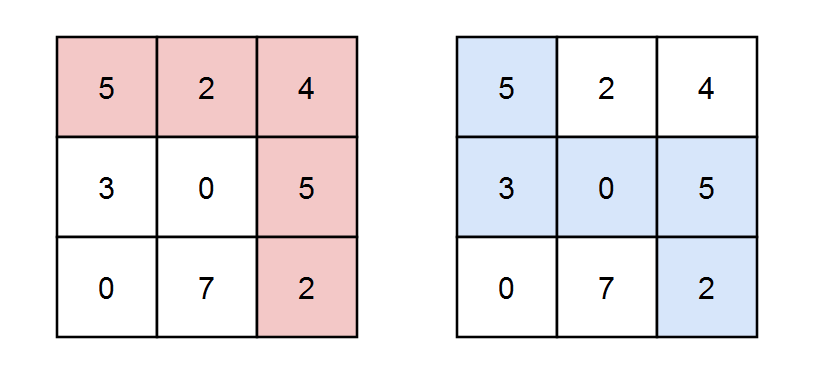
Input: grid = [[5,2,4],[3,0,5],[0,7,2]], k = 3
Output: 2
Explanation: There are two paths where the sum of the elements on the path is divisible by k.
The first path highlighted in red has a sum of 5 + 2 + 4 + 5 + 2 = 18 which is divisible by 3.
The second path highlighted in blue has a sum of 5 + 3 + 0 + 5 + 2 = 15 which is divisible by 3.
Example 2:
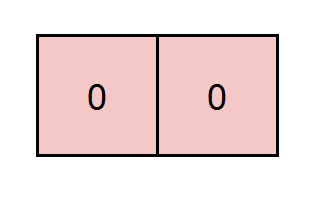
Input: grid = [[0,0]], k = 5
Output: 1
Explanation: The path highlighted in red has a sum of 0 + 0 = 0 which is divisible by 5.
Example 3:
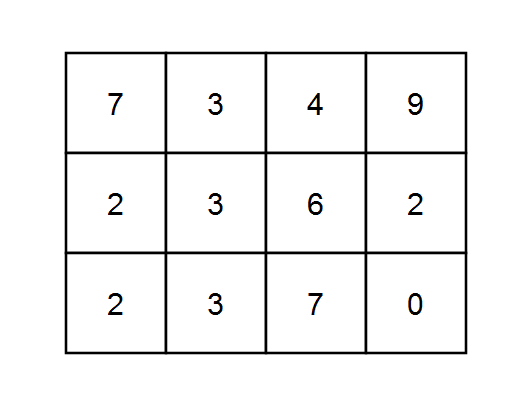
Input: grid = [[7,3,4,9],[2,3,6,2],[2,3,7,0]], k = 1
Output: 10
Explanation: Every integer is divisible by 1 so the sum of the elements on every possible path is divisible by k.
Constraints:
m == grid.length
n == grid[i].length
1 <= m, n <= 5 * 104
1 <= m * n <= 5 * 104
0 <= grid[i][j] <= 100
1 <= k <= 50
Solutions
Solution 1: Dynamic Programming
Thinking
Moves are only right or down. The grid has \(mn\le 5\times 10^4\) and \(k\le 50\). We need the number of paths whose sum is \(0\) modulo \(k\), so the remainder is part of the state.
Let \(f[i][j][r]\) be ways to reach \((i,j)\) with sum \(r\bmod K\), coming from the cell above or to the left with remainder \(r-grid[i][j]\). Seed the start with \(1\).
We denote the \(k\) in the problem as \(K\), and let \(m\) and \(n\) be the number of rows and columns of the matrix \(\textit{grid}\), respectively.
Define \(f[i][j][k]\) as the number of paths starting from \((0, 0)\), reaching position \((i, j)\), where the sum of elements along the path modulo \(K\) equals \(k\). Initially, \(f[0][0][\textit{grid}[0][0] \bmod K] = 1\). The final answer is \(f[m - 1][n - 1][0]\).
To avoid issues with negative modulo operations, we can replace \((k - \textit{grid}[i][j])\bmod K\) in the above equation with \(((k - \textit{grid}[i][j] \bmod K) + K) \bmod K\).
The answer is \(f[m - 1][n - 1][0]\).
The time complexity is \(O(m \times n \times K)\) and the space complexity is \(O(m \times n \times K)\), where \(m\) and \(n\) are the number of rows and columns of the matrix \(\textit{grid}\), respectively, and \(K\) is the integer \(k\) from the problem.