2212. Maximum Points in an Archery Competition
SourceWeekly Contest 285 Q3DifficultyMediumRating1868
Description
Alice and Bob are opponents in an archery competition. The competition has set the following rules:
- Alice first shoots
numArrowsarrows and then Bob shootsnumArrowsarrows. - The points are then calculated as follows:
- The target has integer scoring sections ranging from
0to11inclusive. - For each section of the target with score
k(in between0to11), say Alice and Bob have shotakandbkarrows on that section respectively. Ifak >= bk, then Alice takeskpoints. Ifak < bk, then Bob takeskpoints. - However, if
ak == bk == 0, then nobody takeskpoints.
- The target has integer scoring sections ranging from
-
For example, if Alice and Bob both shot
2arrows on the section with score11, then Alice takes11points. On the other hand, if Alice shot0arrows on the section with score11and Bob shot2arrows on that same section, then Bob takes11points.
You are given the integer numArrows and an integer array aliceArrows of size 12, which represents the number of arrows Alice shot on each scoring section from 0 to 11. Now, Bob wants to maximize the total number of points he can obtain.
Return the array bobArrows which represents the number of arrows Bob shot on each scoring section from 0 to 11. The sum of the values in bobArrows should equal numArrows.
If there are multiple ways for Bob to earn the maximum total points, return any one of them.
Example 1:
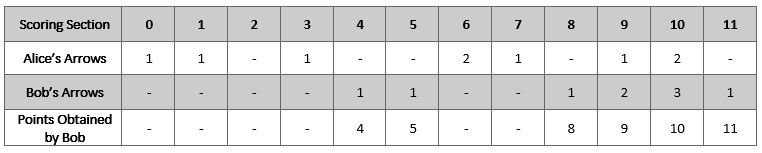
Input: numArrows = 9, aliceArrows = [1,1,0,1,0,0,2,1,0,1,2,0]
Output: [0,0,0,0,1,1,0,0,1,2,3,1]
Explanation: The table above shows how the competition is scored.
Bob earns a total point of 4 + 5 + 8 + 9 + 10 + 11 = 47.
It can be shown that Bob cannot obtain a score higher than 47 points.
Example 2:

Input: numArrows = 3, aliceArrows = [0,0,1,0,0,0,0,0,0,0,0,2]
Output: [0,0,0,0,0,0,0,0,1,1,1,0]
Explanation: The table above shows how the competition is scored.
Bob earns a total point of 8 + 9 + 10 = 27.
It can be shown that Bob cannot obtain a score higher than 27 points.
Constraints:
1 <= numArrows <= 105aliceArrows.length == bobArrows.length == 120 <= aliceArrows[i], bobArrows[i] <= numArrowssum(aliceArrows[i]) == numArrows
Solutions
Solution 1: Binary Enumeration
Thinking
Bob must allocate arrows to \(12\) sections and scores a section only with strictly more arrows than Alice. Searching the exact count per section is hopeless: \(\textit{numArrows}\) can be \(10^5\). Only \(12\) sections exist, so the real choice is which sections to win.
Winning section \(i\) costs \(aliceArrows[i]+1\) arrows and yields \(i\) points. Enumerate a \(12\)-bit mask of winning sections, accumulate cost and score, and keep the best feasible mask.
Rebuild the arrow vector from that mask and dump leftover arrows into section \(0\). \(2^{12}\) masks are cheap.
Since there are only \(12\) regions, we use binary enumeration to determine in which regions \(\textit{Bob}\) scores. We use a variable \(\textit{st}\) to represent the scheme in which \(\textit{Bob}\) obtains the maximum score, and \(\textit{mx}\) to represent the maximum score \(\textit{Bob}\) obtains.
We enumerate \(\textit{Bob}\)'s scoring schemes in the range \([1, 2^m)\), where \(m\) is the length of \(\textit{aliceArrows}\). For each scheme, we calculate \(\textit{Bob}\)'s score \(\textit{s}\) and the number of arrows \(\textit{cnt}\). If \(\textit{cnt} \leq \textit{numArrows}\) and \(\textit{s} > \textit{mx}\), we update \(\textit{mx}\) and \(\textit{st}\).
Then, we calculate \(\textit{Bob}\)'s scoring scheme based on \(\textit{st}\). If there are any remaining arrows, we allocate the remaining arrows to the first region, which is the region with index \(0\).
The time complexity is \(O(2^m \times m)\), where \(m\) is the length of \(\textit{aliceArrows}\). Ignoring the space consumption of the answer array, the space complexity is \(O(1)\).
1 2 3 4 5 6 7 8 9 10 11 12 13 14 15 16 17 18 19 20 | |
1 2 3 4 5 6 7 8 9 10 11 12 13 14 15 16 17 18 19 20 21 22 23 24 25 26 27 28 | |
1 2 3 4 5 6 7 8 9 10 11 12 13 14 15 16 17 18 19 20 21 22 23 24 25 26 27 28 29 | |
1 2 3 4 5 6 7 8 9 10 11 12 13 14 15 16 17 18 19 20 21 22 23 24 25 26 | |
1 2 3 4 5 6 7 8 9 10 11 12 13 14 15 16 17 18 19 20 21 22 23 24 25 26 | |
1 2 3 4 5 6 7 8 9 10 11 12 13 14 15 16 17 18 19 20 21 22 23 24 25 26 27 28 29 30 31 | |
1 2 3 4 5 6 7 8 9 10 11 12 13 14 15 16 17 18 19 20 21 22 23 24 25 26 27 28 29 30 31 | |