1656. Design an Ordered Stream
SourceWeekly Contest 215 Q1DifficultyEasyRating1418
Description
There is a stream of n (idKey, value) pairs arriving in an arbitrary order, where idKey is an integer between 1 and n and value is a string. No two pairs have the same id.
Design a stream that returns the values in increasing order of their IDs by returning a chunk (list) of values after each insertion. The concatenation of all the chunks should result in a list of the sorted values.
Implement the OrderedStream class:
OrderedStream(int n)Constructs the stream to takenvalues.String[] insert(int idKey, String value)Inserts the pair(idKey, value)into the stream, then returns the largest possible chunk of currently inserted values that appear next in the order.
Example:
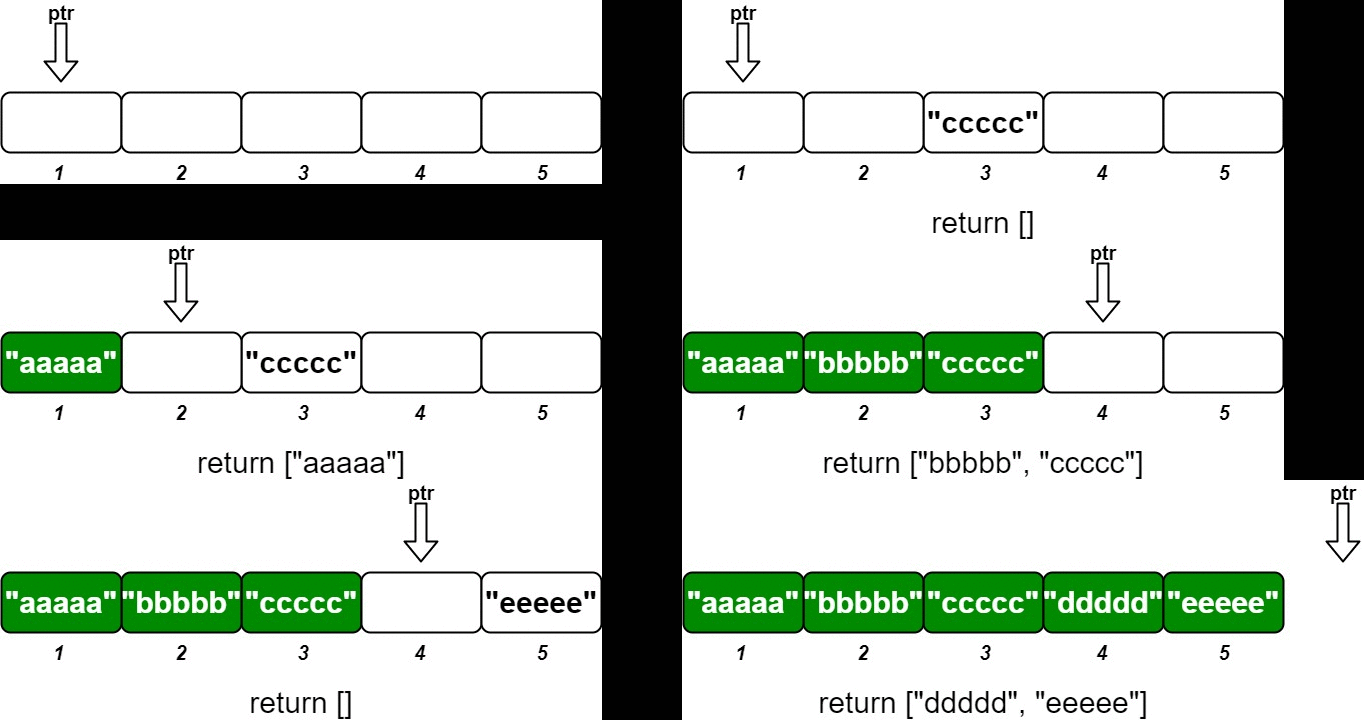
Input
["OrderedStream", "insert", "insert", "insert", "insert", "insert"]
[[5], [3, "ccccc"], [1, "aaaaa"], [2, "bbbbb"], [5, "eeeee"], [4, "ddddd"]]
Output
[null, [], ["aaaaa"], ["bbbbb", "ccccc"], [], ["ddddd", "eeeee"]]

Explanation
// Note that the values ordered by ID is ["aaaaa", "bbbbb", "ccccc", "ddddd", "eeeee"].
OrderedStream os = new OrderedStream(5);
os.insert(3, "ccccc"); // Inserts (3, "ccccc"), returns [].
os.insert(1, "aaaaa"); // Inserts (1, "aaaaa"), returns ["aaaaa"].
os.insert(2, "bbbbb"); // Inserts (2, "bbbbb"), returns ["bbbbb", "ccccc"].
os.insert(5, "eeeee"); // Inserts (5, "eeeee"), returns [].
os.insert(4, "ddddd"); // Inserts (4, "ddddd"), returns ["ddddd", "eeeee"].
// Concatentating all the chunks returned:
// [] + ["aaaaa"] + ["bbbbb", "ccccc"] + [] + ["ddddd", "eeeee"] = ["aaaaa", "bbbbb", "ccccc", "ddddd", "eeeee"]
// The resulting order is the same as the order above.
Constraints:
1 <= n <= 10001 <= id <= nvalue.length == 5valueconsists only of lowercase letters.- Each call to
insertwill have a uniqueid. - Exactly
ncalls will be made toinsert.
Solutions
Solution 1: Array Simulation
Thinking
Inserts carry ids; only the contiguous filled prefix starting at the pointer may be emitted. Each id is used once, so an array indexed by id is enough.
After writing \(\textit{data}[\textit{idKey}]\), emit while \(\textit{ptr}\) is occupied and advance the pointer.
We can use an array \(\textit{data}\) of length \(n + 1\) to simulate this stream, where \(\textit{data}[i]\) represents the value of \(\textit{id} = i\). At the same time, we use a pointer \(\textit{ptr}\) to represent the current position. Initially, \(\textit{ptr} = 1\).
When inserting a new \((\textit{idKey}, \textit{value})\) pair, we update \(\textit{data}[\textit{idKey}]\) to \(\textit{value}\). Then, starting from \(\textit{ptr}\), we sequentially add \(\textit{data}[\textit{ptr}]\) to the answer until \(\textit{data}[\textit{ptr}]\) is empty.
The time complexity is \(O(n)\), and the space complexity is \(O(n)\). Where \(n\) is the length of the data stream.
1 2 3 4 5 6 7 8 9 10 11 12 13 14 15 16 17 18 | |
1 2 3 4 5 6 7 8 9 10 11 12 13 14 15 16 17 18 19 20 21 22 23 | |
1 2 3 4 5 6 7 8 9 10 11 12 13 14 15 16 17 18 19 20 21 22 23 24 25 26 | |
1 2 3 4 5 6 7 8 9 10 11 12 13 14 15 16 17 18 19 20 21 22 23 24 25 26 27 | |
1 2 3 4 5 6 7 8 9 10 11 12 13 14 15 16 17 18 19 20 21 22 23 24 | |
1 2 3 4 5 6 7 8 9 10 11 12 13 14 15 16 17 18 19 20 21 22 23 | |