You are given an undirected weighted graph of n nodes (0-indexed), represented by an edge list where edges[i] = [a, b] is an undirected edge connecting the nodes a and b with a probability of success of traversing that edge succProb[i].
Given two nodes start and end, find the path with the maximum probability of success to go from start to end and return its success probability.
If there is no path from start to end, return 0. Your answer will be accepted if it differs from the correct answer by at most 1e-5.
Example 1:
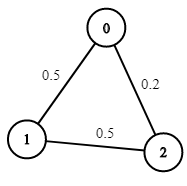
Input: n = 3, edges = [[0,1],[1,2],[0,2]], succProb = [0.5,0.5,0.2], start = 0, end = 2
Output: 0.25000
Explanation: There are two paths from start to end, one having a probability of success = 0.2 and the other has 0.5 * 0.5 = 0.25.
Example 2:
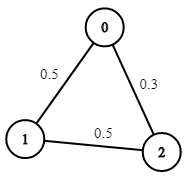
Input: n = 3, edges = [[0,1],[1,2],[0,2]], succProb = [0.5,0.5,0.3], start = 0, end = 2
Output: 0.30000
Example 3:
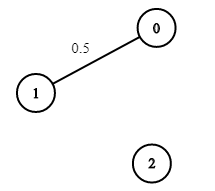
Input: n = 3, edges = [[0,1]], succProb = [0.5], start = 0, end = 2
Output: 0.00000
Explanation: There is no path between 0 and 2.
Constraints:
2 <= n <= 10^4
0 <= start, end < n
start != end
0 <= a, b < n
a != b
0 <= succProb.length == edges.length <= 2*10^4
0 <= succProb[i] <= 1
There is at most one edge between every two nodes.
Solutions
Solution 1: Heap-Optimized Dijkstra Algorithm
We can use Dijkstra's algorithm to find the shortest path, but here we modify it slightly to find the path with the maximum probability.
We use a priority queue (max-heap) \(\textit{pq}\) to store the probability from the starting point to each node and the node's identifier. Initially, we set the probability of the starting point to \(1\) and the probabilities of the other nodes to \(0\), then add the starting point to \(\textit{pq}\).
In each iteration, we take out the node \(a\) with the highest probability from \(\textit{pq}\) and its probability \(w\). If the probability of node \(a\) is already greater than \(w\), we can skip this node. Otherwise, we traverse all adjacent edges \((a, b)\) of \(a\). If the probability of \(b\) is less than the probability of \(a\) multiplied by the probability of \((a, b)\), we update the probability of \(b\) and add \(b\) to \(\textit{pq}\).
Finally, we obtain the maximum probability from the starting point to the endpoint.
The time complexity is \(O(m \times \log m)\), and the space complexity is \(O(m)\). Here, \(m\) is the number of edges.