Skip to content

1489. Find Critical and Pseudo-Critical Edges in Minimum Spanning Tree

Description

Given a weighted undirected connected graph with nΒ vertices numbered from 0 to n - 1,Β and an array edgesΒ where edges[i] = [ai, bi, weighti] represents a bidirectional and weighted edge between nodesΒ aiΒ and bi. A minimum spanning tree (MST) is a subset of the graph's edges that connects all vertices without cyclesΒ and with the minimum possible total edge weight.

Find all the critical and pseudo-critical edges in the given graph's minimum spanning tree (MST). An MST edge whose deletion from the graph would cause the MST weight to increase is called aΒ critical edge. OnΒ the other hand, a pseudo-critical edge is that which can appear in some MSTs but not all.

Note that you can return the indices of the edges in any order.

Β 

Example 1:

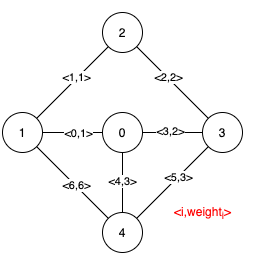
Input: n = 5, edges = [[0,1,1],[1,2,1],[2,3,2],[0,3,2],[0,4,3],[3,4,3],[1,4,6]]
Output: [[0,1],[2,3,4,5]]
Explanation: The figure above describes the graph.
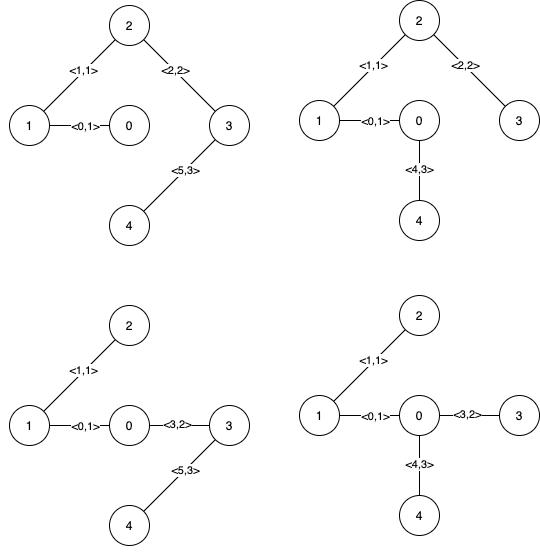
The following figure shows all the possible MSTs:

Notice that the two edges 0 and 1 appear in all MSTs, therefore they are critical edges, so we return them in the first list of the output.
The edges 2, 3, 4, and 5 are only part of some MSTs, therefore they are considered pseudo-critical edges. We add them to the second list of the output.
Example 2:

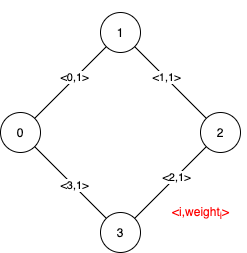
Input: n = 4, edges = [[0,1,1],[1,2,1],[2,3,1],[0,3,1]]
Output: [[],[0,1,2,3]]
Explanation: We can observe that since all 4 edges have equal weight, choosing any 3 edges from the given 4 will yield an MST. Therefore all 4 edges are pseudo-critical.

Β 

Constraints:

  • 2 <= n <= 100
  • 1 <= edges.length <= min(200, n * (n - 1) / 2)
  • edges[i].length == 3
  • 0 <= ai < bi < n
  • 1 <= weightiΒ <= 1000
  • All pairs (ai, bi) are distinct.

Solutions

Solution 1

 1
 2
 3
 4
 5
 6
 7
 8
 9
10
11
12
13
14
15
16
17
18
19
20
21
22
23
24
25
26
27
28
29
30
31
32
33
34
35
36
37
38
39
40
41
class UnionFind:
    def __init__(self, n):
        self.p = list(range(n))
        self.n = n

    def union(self, a, b):
        if self.find(a) == self.find(b):
            return False
        self.p[self.find(a)] = self.find(b)
        self.n -= 1
        return True

    def find(self, x):
        if self.p[x] != x:
            self.p[x] = self.find(self.p[x])
        return self.p[x]


class Solution:
    def findCriticalAndPseudoCriticalEdges(
        self, n: int, edges: List[List[int]]
    ) -> List[List[int]]:
        for i, e in enumerate(edges):
            e.append(i)
        edges.sort(key=lambda x: x[2])
        uf = UnionFind(n)
        v = sum(w for f, t, w, _ in edges if uf.union(f, t))
        ans = [[], []]
        for f, t, w, i in edges:
            uf = UnionFind(n)
            k = sum(z for x, y, z, j in edges if j != i and uf.union(x, y))
            if uf.n > 1 or (uf.n == 1 and k > v):
                ans[0].append(i)
                continue

            uf = UnionFind(n)
            uf.union(f, t)
            k = w + sum(z for x, y, z, j in edges if j != i and uf.union(x, y))
            if k == v:
                ans[1].append(i)
        return ans
 1
 2
 3
 4
 5
 6
 7
 8
 9
10
11
12
13
14
15
16
17
18
19
20
21
22
23
24
25
26
27
28
29
30
31
32
33
34
35
36
37
38
39
40
41
42
43
44
45
46
47
48
49
50
51
52
53
54
55
56
57
58
59
60
61
62
63
64
65
66
67
68
69
70
71
72
73
74
75
76
77
78
79
80
81
82
83
84
85
class Solution {
    public List<List<Integer>> findCriticalAndPseudoCriticalEdges(int n, int[][] edges) {
        for (int i = 0; i < edges.length; ++i) {
            int[] e = edges[i];
            int[] t = new int[4];
            System.arraycopy(e, 0, t, 0, 3);
            t[3] = i;
            edges[i] = t;
        }
        Arrays.sort(edges, Comparator.comparingInt(a -> a[2]));
        int v = 0;
        UnionFind uf = new UnionFind(n);
        for (int[] e : edges) {
            int f = e[0], t = e[1], w = e[2];
            if (uf.union(f, t)) {
                v += w;
            }
        }
        List<List<Integer>> ans = new ArrayList<>();
        for (int i = 0; i < 2; ++i) {
            ans.add(new ArrayList<>());
        }
        for (int[] e : edges) {
            int f = e[0], t = e[1], w = e[2], i = e[3];
            uf = new UnionFind(n);
            int k = 0;
            for (int[] ne : edges) {
                int x = ne[0], y = ne[1], z = ne[2], j = ne[3];
                if (j != i && uf.union(x, y)) {
                    k += z;
                }
            }
            if (uf.getN() > 1 || (uf.getN() == 1 && k > v)) {
                ans.get(0).add(i);
                continue;
            }
            uf = new UnionFind(n);
            uf.union(f, t);
            k = w;
            for (int[] ne : edges) {
                int x = ne[0], y = ne[1], z = ne[2], j = ne[3];
                if (j != i && uf.union(x, y)) {
                    k += z;
                }
            }
            if (k == v) {
                ans.get(1).add(i);
            }
        }
        return ans;
    }
}

class UnionFind {
    private int[] p;
    private int n;

    public UnionFind(int n) {
        p = new int[n];
        this.n = n;
        for (int i = 0; i < n; ++i) {
            p[i] = i;
        }
    }

    public int getN() {
        return n;
    }

    public boolean union(int a, int b) {
        if (find(a) == find(b)) {
            return false;
        }
        p[find(a)] = find(b);
        --n;
        return true;
    }

    public int find(int x) {
        if (p[x] != x) {
            p[x] = find(p[x]);
        }
        return p[x];
    }
}
 1
 2
 3
 4
 5
 6
 7
 8
 9
10
11
12
13
14
15
16
17
18
19
20
21
22
23
24
25
26
27
28
29
30
31
32
33
34
35
36
37
38
39
40
41
42
43
44
45
46
47
48
49
50
51
52
53
54
55
56
57
58
59
60
61
class UnionFind {
public:
    vector<int> p;
    int n;

    UnionFind(int _n)
        : n(_n)
        , p(_n) {
        iota(p.begin(), p.end(), 0);
    }

    bool unite(int a, int b) {
        if (find(a) == find(b)) return false;
        p[find(a)] = find(b);
        --n;
        return true;
    }

    int find(int x) {
        if (p[x] != x) p[x] = find(p[x]);
        return p[x];
    }
};

class Solution {
public:
    vector<vector<int>> findCriticalAndPseudoCriticalEdges(int n, vector<vector<int>>& edges) {
        for (int i = 0; i < edges.size(); ++i) edges[i].push_back(i);
        sort(edges.begin(), edges.end(), [](auto& a, auto& b) { return a[2] < b[2]; });
        int v = 0;
        UnionFind uf(n);
        for (auto& e : edges) {
            int f = e[0], t = e[1], w = e[2];
            if (uf.unite(f, t)) v += w;
        }
        vector<vector<int>> ans(2);
        for (auto& e : edges) {
            int f = e[0], t = e[1], w = e[2], i = e[3];
            UnionFind ufa(n);
            int k = 0;
            for (auto& ne : edges) {
                int x = ne[0], y = ne[1], z = ne[2], j = ne[3];
                if (j != i && ufa.unite(x, y)) k += z;
            }
            if (ufa.n > 1 || (ufa.n == 1 && k > v)) {
                ans[0].push_back(i);
                continue;
            }

            UnionFind ufb(n);
            ufb.unite(f, t);
            k = w;
            for (auto& ne : edges) {
                int x = ne[0], y = ne[1], z = ne[2], j = ne[3];
                if (j != i && ufb.unite(x, y)) k += z;
            }
            if (k == v) ans[1].push_back(i);
        }
        return ans;
    }
};
 1
 2
 3
 4
 5
 6
 7
 8
 9
10
11
12
13
14
15
16
17
18
19
20
21
22
23
24
25
26
27
28
29
30
31
32
33
34
35
36
37
38
39
40
41
42
43
44
45
46
47
48
49
50
51
52
53
54
55
56
57
58
59
60
61
62
63
64
65
66
67
68
69
70
71
72
73
74
type unionFind struct {
    p []int
    n int
}

func newUnionFind(n int) *unionFind {
    p := make([]int, n)
    for i := range p {
        p[i] = i
    }
    return &unionFind{p, n}
}

func (uf *unionFind) find(x int) int {
    if uf.p[x] != x {
        uf.p[x] = uf.find(uf.p[x])
    }
    return uf.p[x]
}

func (uf *unionFind) union(a, b int) bool {
    if uf.find(a) == uf.find(b) {
        return false
    }
    uf.p[uf.find(a)] = uf.find(b)
    uf.n--
    return true
}

func findCriticalAndPseudoCriticalEdges(n int, edges [][]int) [][]int {
    for i := range edges {
        edges[i] = append(edges[i], i)
    }
    sort.Slice(edges, func(i, j int) bool {
        return edges[i][2] < edges[j][2]
    })
    v := 0
    uf := newUnionFind(n)
    for _, e := range edges {
        f, t, w := e[0], e[1], e[2]
        if uf.union(f, t) {
            v += w
        }
    }
    ans := make([][]int, 2)
    for _, e := range edges {
        f, t, w, i := e[0], e[1], e[2], e[3]
        uf = newUnionFind(n)
        k := 0
        for _, ne := range edges {
            x, y, z, j := ne[0], ne[1], ne[2], ne[3]
            if j != i && uf.union(x, y) {
                k += z
            }
        }
        if uf.n > 1 || (uf.n == 1 && k > v) {
            ans[0] = append(ans[0], i)
            continue
        }
        uf = newUnionFind(n)
        uf.union(f, t)
        k = w
        for _, ne := range edges {
            x, y, z, j := ne[0], ne[1], ne[2], ne[3]
            if j != i && uf.union(x, y) {
                k += z
            }
        }
        if k == v {
            ans[1] = append(ans[1], i)
        }
    }
    return ans
}

Comments