1437. Check If All 1's Are at Least Length K Places Away



Description
Given an binary array nums and an integer k, return true if all 1's are at least k places away from each other, otherwise return false.
Example 1:
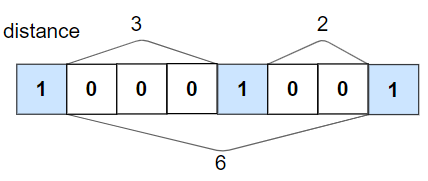
Input: nums = [1,0,0,0,1,0,0,1], k = 2
Output: true
Explanation: Each of the 1s are at least 2 places away from each other.
Example 2:
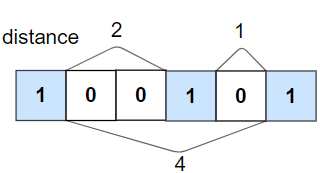
Input: nums = [1,0,0,1,0,1], k = 2
Output: false
Explanation: The second 1 and third 1 are only one apart from each other.
Constraints:
1 <= nums.length <= 1050 <= k <= nums.lengthnums[i]is0or1
Solutions
Solution 1: Simulation
We can iterate through the array \(\textit{nums}\) and use a variable \(j\) to record the index of the previous \(1\). When the element at the current position \(i\) is \(1\), we just need to check if \(i - j - 1\) is less than \(k\). If it is less than \(k\), it means there exists a pair of \(1\)s with fewer than \(k\) zeros between them, so we return \(\text{false}\). Otherwise, we update \(j\) to \(i\) and continue iterating through the array.
After the iteration is complete, we return \(\text{true}\).
The time complexity is \(O(n)\), where \(n\) is the length of the array \(\textit{nums}\). The space complexity is \(O(1)\).
1 2 3 4 5 6 7 8 9 | |
1 2 3 4 5 6 7 8 9 10 11 12 13 14 | |
1 2 3 4 5 6 7 8 9 10 11 12 13 14 15 | |
1 2 3 4 5 6 7 8 9 10 11 12 | |
1 2 3 4 5 6 7 8 9 10 11 12 | |
1 2 3 4 5 6 7 8 9 10 11 12 13 14 | |