Skip to content

1339. Maximum Product of Splitted Binary Tree

Description

Given the root of a binary tree, split the binary tree into two subtrees by removing one edge such that the product of the sums of the subtrees is maximized.

Return the maximum product of the sums of the two subtrees. Since the answer may be too large, return it modulo 109 + 7.

Note that you need to maximize the answer before taking the mod and not after taking it.

Β 

Example 1:

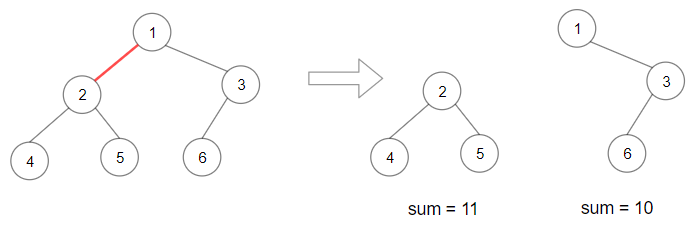
Input: root = [1,2,3,4,5,6]
Output: 110
Explanation: Remove the red edge and get 2 binary trees with sum 11 and 10. Their product is 110 (11*10)

Example 2:

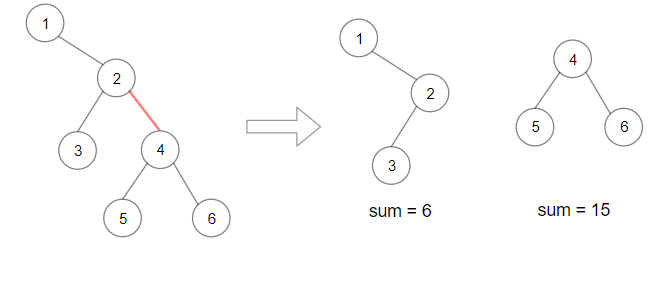
Input: root = [1,null,2,3,4,null,null,5,6]
Output: 90
Explanation: Remove the red edge and get 2 binary trees with sum 15 and 6.Their product is 90 (15*6)

Β 

Constraints:

  • The number of nodes in the tree is in the range [2, 5 * 104].
  • 1 <= Node.val <= 104

Solutions

Solution 1: Two DFS

We can solve this problem with two DFS traversals.

In the first traversal, we use a \(\text{sum}(\text{root})\) function to recursively calculate the sum of all nodes in the entire tree, denoted as \(s\).

In the second traversal, we use a \(\text{dfs}(\text{root})\) function to recursively traverse each node and calculate the sum of nodes in the subtree rooted at the current node, denoted as \(t\). After splitting at the current node and its parent, the sums of the two subtrees are \(t\) and \(s - t\) respectively, and their product is \(t \times (s - t)\). We traverse all nodes to find the maximum product, which is the answer.

The time complexity is \(O(n)\), and the space complexity is \(O(n)\), where \(n\) is the number of nodes in the binary tree.

 1
 2
 3
 4
 5
 6
 7
 8
 9
10
11
12
13
14
15
16
17
18
19
20
21
22
23
24
25
26
27
# Definition for a binary tree node.
# class TreeNode:
#     def __init__(self, val=0, left=None, right=None):
#         self.val = val
#         self.left = left
#         self.right = right
class Solution:
    def maxProduct(self, root: Optional[TreeNode]) -> int:
        def sum(root: Optional[TreeNode]) -> int:
            if root is None:
                return 0
            return root.val + sum(root.left) + sum(root.right)

        def dfs(root: Optional[TreeNode]) -> int:
            if root is None:
                return 0
            t = root.val + dfs(root.left) + dfs(root.right)
            nonlocal ans, s
            if t < s:
                ans = max(ans, t * (s - t))
            return t

        mod = 10**9 + 7
        s = sum(root)
        ans = 0
        dfs(root)
        return ans % mod
 1
 2
 3
 4
 5
 6
 7
 8
 9
10
11
12
13
14
15
16
17
18
19
20
21
22
23
24
25
26
27
28
29
30
31
32
33
34
35
36
37
38
39
40
41
42
43
44
/**
 * Definition for a binary tree node.
 * public class TreeNode {
 *     int val;
 *     TreeNode left;
 *     TreeNode right;
 *     TreeNode() {}
 *     TreeNode(int val) { this.val = val; }
 *     TreeNode(int val, TreeNode left, TreeNode right) {
 *         this.val = val;
 *         this.left = left;
 *         this.right = right;
 *     }
 * }
 */
class Solution {
    private long ans;
    private long s;

    public int maxProduct(TreeNode root) {
        final int mod = (int) 1e9 + 7;
        s = sum(root);
        dfs(root);
        return (int) (ans % mod);
    }

    private long dfs(TreeNode root) {
        if (root == null) {
            return 0;
        }
        long t = root.val + dfs(root.left) + dfs(root.right);
        if (t < s) {
            ans = Math.max(ans, t * (s - t));
        }
        return t;
    }

    private long sum(TreeNode root) {
        if (root == null) {
            return 0;
        }
        return root.val + sum(root.left) + sum(root.right);
    }
}
 1
 2
 3
 4
 5
 6
 7
 8
 9
10
11
12
13
14
15
16
17
18
19
20
21
22
23
24
25
26
27
28
29
30
31
32
33
34
35
36
37
38
39
40
41
42
/**
 * Definition for a binary tree node.
 * struct TreeNode {
 *     int val;
 *     TreeNode *left;
 *     TreeNode *right;
 *     TreeNode() : val(0), left(nullptr), right(nullptr) {}
 *     TreeNode(int x) : val(x), left(nullptr), right(nullptr) {}
 *     TreeNode(int x, TreeNode *left, TreeNode *right) : val(x), left(left), right(right) {}
 * };
 */
class Solution {
public:
    int maxProduct(TreeNode* root) {
        using ll = long long;
        ll ans = 0;
        const int mod = 1e9 + 7;

        auto sum = [&](this auto&& sum, TreeNode* root) -> ll {
            if (!root) {
                return 0;
            }
            return root->val + sum(root->left) + sum(root->right);
        };

        ll s = sum(root);

        auto dfs = [&](this auto&& dfs, TreeNode* root) -> ll {
            if (!root) {
                return 0;
            }
            ll t = root->val + dfs(root->left) + dfs(root->right);
            if (t < s) {
                ans = max(ans, t * (s - t));
            }
            return t;
        };

        dfs(root);
        return ans % mod;
    }
};
 1
 2
 3
 4
 5
 6
 7
 8
 9
10
11
12
13
14
15
16
17
18
19
20
21
22
23
24
25
26
27
28
29
30
31
32
33
/**
 * Definition for a binary tree node.
 * type TreeNode struct {
 *     Val int
 *     Left *TreeNode
 *     Right *TreeNode
 * }
 */
func maxProduct(root *TreeNode) (ans int) {
    const mod = 1e9 + 7
    var sum func(*TreeNode) int
    sum = func(root *TreeNode) int {
        if root == nil {
            return 0
        }
        return root.Val + sum(root.Left) + sum(root.Right)
    }
    s := sum(root)
    var dfs func(*TreeNode) int
    dfs = func(root *TreeNode) int {
        if root == nil {
            return 0
        }
        t := root.Val + dfs(root.Left) + dfs(root.Right)
        if t < s {
            ans = max(ans, t*(s-t))
        }
        return t
    }
    dfs(root)
    ans %= mod
    return
}
 1
 2
 3
 4
 5
 6
 7
 8
 9
10
11
12
13
14
15
16
17
18
19
20
21
22
23
24
25
26
27
28
29
30
31
32
33
34
35
36
37
/**
 * Definition for a binary tree node.
 * class TreeNode {
 *     val: number
 *     left: TreeNode | null
 *     right: TreeNode | null
 *     constructor(val?: number, left?: TreeNode | null, right?: TreeNode | null) {
 *         this.val = (val===undefined ? 0 : val)
 *         this.left = (left===undefined ? null : left)
 *         this.right = (right===undefined ? null : right)
 *     }
 * }
 */

function maxProduct(root: TreeNode | null): number {
    const sum = (root: TreeNode | null): number => {
        if (!root) {
            return 0;
        }
        return root.val + sum(root.left) + sum(root.right);
    };
    const s = sum(root);
    let ans = 0;
    const mod = 1e9 + 7;
    const dfs = (root: TreeNode | null): number => {
        if (!root) {
            return 0;
        }
        const t = root.val + dfs(root.left) + dfs(root.right);
        if (t < s) {
            ans = Math.max(ans, t * (s - t));
        }
        return t;
    };
    dfs(root);
    return ans % mod;
}
 1
 2
 3
 4
 5
 6
 7
 8
 9
10
11
12
13
14
15
16
17
18
19
20
21
22
23
24
25
26
27
28
29
30
31
32
33
34
35
36
37
38
39
40
41
42
43
44
45
46
47
48
49
50
51
52
// Definition for a binary tree node.
// #[derive(Debug, PartialEq, Eq)]
// pub struct TreeNode {
//   pub val: i32,
//   pub left: Option<Rc<RefCell<TreeNode>>>,
//   pub right: Option<Rc<RefCell<TreeNode>>>,
// }
//
// impl TreeNode {
//   #[inline]
//   pub fn new(val: i32) -> Self {
//     TreeNode {
//       val,
//       left: None,
//       right: None
//     }
//   }
// }
use std::rc::Rc;
use std::cell::RefCell;

impl Solution {
    pub fn max_product(root: Option<Rc<RefCell<TreeNode>>>) -> i32 {
        const MOD: i64 = 1_000_000_007;
        let mut ans: i64 = 0;
        let s = Self::sum(&root);
        Self::dfs(&root, s, &mut ans);
        (ans % MOD) as i32
    }

    fn dfs(root: &Option<Rc<RefCell<TreeNode>>>, s: i64, ans: &mut i64) -> i64 {
        if root.is_none() {
            return 0;
        }
        let node = root.as_ref().unwrap().borrow();
        let t = node.val as i64
            + Self::dfs(&node.left, s, ans)
            + Self::dfs(&node.right, s, ans);
        if t < s {
            *ans = (*ans).max(t * (s - t));
        }
        t
    }

    fn sum(root: &Option<Rc<RefCell<TreeNode>>>) -> i64 {
        if root.is_none() {
            return 0;
        }
        let node = root.as_ref().unwrap().borrow();
        node.val as i64 + Self::sum(&node.left) + Self::sum(&node.right)
    }
}

Comments