来源第 91 场双周赛 Q3难度中等分数2053
题目描述
一个 n 个节点的无向树,节点编号为 0 到 n - 1 ,树的根结点是 0 号节点。给你一个长度为 n - 1 的二维整数数组 edges ,其中 edges[i] = [ai, bi] ,表示节点 ai 和 bi 在树中有一条边。
在每一个节点 i 处有一扇门。同时给你一个都是偶数的数组 amount ,其中 amount[i] 表示:
- 如果
amount[i] 的值是负数,那么它表示打开节点 i 处门扣除的分数。 - 如果
amount[i] 的值是正数,那么它表示打开节点 i 处门加上的分数。
游戏按照如下规则进行:
- 一开始,Alice 在节点
0 处,Bob 在节点 bob 处。 - 每一秒钟,Alice 和 Bob 分别 移动到相邻的节点。Alice 朝着某个 叶子结点 移动,Bob 朝着节点
0 移动。 - 对于他们之间路径上的 每一个 节点,Alice 和 Bob 要么打开门并扣分,要么打开门并加分。注意:
- 如果门 已经打开 (被另一个人打开),不会有额外加分也不会扣分。
- 如果 Alice 和 Bob 同时 到达一个节点,他们会共享这个节点的加分或者扣分。换言之,如果打开这扇门扣
c 分,那么 Alice 和 Bob 分别扣 c / 2 分。如果这扇门的加分为 c ,那么他们分别加 c / 2 分。
- 如果 Alice 到达了一个叶子结点,她会停止移动。类似的,如果 Bob 到达了节点
0 ,他也会停止移动。注意这些事件互相 独立 ,不会影响另一方移动。
请你返回 Alice 朝最优叶子结点移动的 最大 净得分。
示例 1:
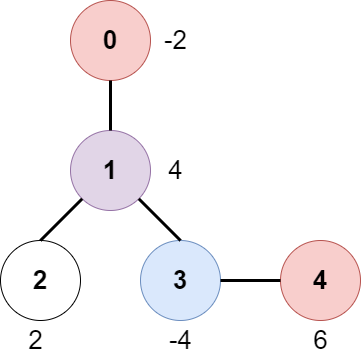
输入:edges = [[0,1],[1,2],[1,3],[3,4]], bob = 3, amount = [-2,4,2,-4,6]
输出:6
解释:
上图展示了输入给出的一棵树。游戏进行如下:
- Alice 一开始在节点 0 处,Bob 在节点 3 处。他们分别打开所在节点的门。
  Alice 得分为 -2 。
- Alice 和 Bob 都移动到节点 1 。
  因为他们同时到达这个节点,他们一起打开门并平分得分。
  Alice 的得分变为 -2 + (4 / 2) = 0 。
- Alice 移动到节点 3 。因为 Bob 已经打开了这扇门,Alice 得分不变。
  Bob 移动到节点 0 ,并停止移动。
- Alice 移动到节点 4 并打开这个节点的门,她得分变为 0 + 6 = 6 。
现在,Alice 和 Bob 都不能进行任何移动了,所以游戏结束。
Alice 无法得到更高分数。
示例 2:
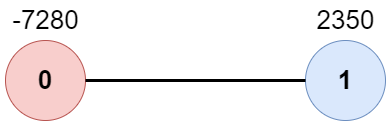
输入:edges = [[0,1]], bob = 1, amount = [-7280,2350]
输出:-7280
解释:
Alice 按照路径 0->1 移动,同时 Bob 按照路径 1->0 移动。
所以 Alice 只打开节点 0 处的门,她的得分为 -7280 。
提示:
2 <= n <= 105edges.length == n - 1edges[i].length == 20 <= ai, bi < nai != biedges 表示一棵有效的树。1 <= bob < namount.length == namount[i] 是范围 [-104, 104] 之间的一个 偶数 。
解法
方法一:两次 DFS
思考
Bob 的路线固定为 \(bob\to 0\),Alice 从 \(0\) 走向某一叶子。 \(n \le 10^5\),先 DFS 记下 Bob 到达各点的时间 \(ts\)。
再从 \(0\) 出发 DFS:到达时刻等于 \(ts[i]\) 则平分收益,更早则独得,更晚则门已空。在叶子更新最大得分。
根据题意,我们可以知道,Bob 的移动路径是固定的,即从节点 \(bob\) 出发,最终到达节点 \(0\)。因此,我们可以先跑一遍 DFS,求出 Bob 到达每个节点的时间,记在数组 \(ts\) 中。
然后我们再跑一遍 DFS,求出 Alice 每条移动路径的最大得分,我们记 Alice 到达节点 \(i\) 的时间为 \(t\),当前累计得分为 \(v\),那么 Alice 在经过节点 \(i\) 处后,累计的分数有三种情况:
- Alice 到达节点 \(i\) 的时间 \(t\) 与 Bob 到达节点 \(i\) 的时间 \(ts[i]\) 相同,那么 Alice 和 Bob 同时打开节点 \(i\) 处的门,Alice 获得的分数为 \(v + \frac{amount[i]}{2}\);
- Alice 到达节点 \(i\) 的时间 \(t\) 小于 Bob 到达节点 \(i\) 的时间 \(ts[i]\),那么 Alice 打开节点 \(i\) 处的门,Alice 获得的分数为 \(v + amount[i]\)。
- Alice 到达节点 \(i\) 的时间 \(t\) 大于 Bob 到达节点 \(i\) 的时间 \(ts[i]\),那么 Alice 不打开节点 \(i\) 处的门,Alice 获得的分数为 \(v\),即不变。
当 Alice 到达叶子节点时,更新最大得分。
时间复杂度 \(O(n)\),空间复杂度 \(O(n)\)。其中 \(n\) 为节点个数。
 1
 2
 3
 4
 5
 6
 7
 8
 9
10
11
12
13
14
15
16
17
18
19
20
21
22
23
24
25
26
27
28
29
30
31
32
33
34
35
36
37
38 | class Solution:
def mostProfitablePath(
self, edges: List[List[int]], bob: int, amount: List[int]
) -> int:
def dfs1(i, fa, t):
if i == 0:
ts[i] = min(ts[i], t)
return True
for j in g[i]:
if j != fa and dfs1(j, i, t + 1):
ts[j] = min(ts[j], t + 1)
return True
return False
def dfs2(i, fa, t, v):
if t == ts[i]:
v += amount[i] // 2
elif t < ts[i]:
v += amount[i]
nonlocal ans
if len(g[i]) == 1 and g[i][0] == fa:
ans = max(ans, v)
return
for j in g[i]:
if j != fa:
dfs2(j, i, t + 1, v)
n = len(edges) + 1
g = defaultdict(list)
ts = [n] * n
for a, b in edges:
g[a].append(b)
g[b].append(a)
dfs1(bob, -1, 0)
ts[bob] = 0
ans = -inf
dfs2(0, -1, 0, 0)
return ans
|
 1
 2
 3
 4
 5
 6
 7
 8
 9
10
11
12
13
14
15
16
17
18
19
20
21
22
23
24
25
26
27
28
29
30
31
32
33
34
35
36
37
38
39
40
41
42
43
44
45
46
47
48
49
50
51
52
53
54
55 | class Solution {
private List<Integer>[] g;
private int[] amount;
private int[] ts;
private int ans = Integer.MIN_VALUE;
public int mostProfitablePath(int[][] edges, int bob, int[] amount) {
int n = edges.length + 1;
g = new List[n];
ts = new int[n];
this.amount = amount;
Arrays.setAll(g, k -> new ArrayList<>());
Arrays.fill(ts, n);
for (var e : edges) {
int a = e[0], b = e[1];
g[a].add(b);
g[b].add(a);
}
dfs1(bob, -1, 0);
ts[bob] = 0;
dfs2(0, -1, 0, 0);
return ans;
}
private boolean dfs1(int i, int fa, int t) {
if (i == 0) {
ts[i] = Math.min(ts[i], t);
return true;
}
for (int j : g[i]) {
if (j != fa && dfs1(j, i, t + 1)) {
ts[j] = Math.min(ts[j], t + 1);
return true;
}
}
return false;
}
private void dfs2(int i, int fa, int t, int v) {
if (t == ts[i]) {
v += amount[i] >> 1;
} else if (t < ts[i]) {
v += amount[i];
}
if (g[i].size() == 1 && g[i].get(0) == fa) {
ans = Math.max(ans, v);
return;
}
for (int j : g[i]) {
if (j != fa) {
dfs2(j, i, t + 1, v);
}
}
}
}
|
 1
 2
 3
 4
 5
 6
 7
 8
 9
10
11
12
13
14
15
16
17
18
19
20
21
22
23
24
25
26
27
28
29
30
31
32
33
34
35
36
37
38
39
40
41
42
43 | class Solution {
public:
int mostProfitablePath(vector<vector<int>>& edges, int bob, vector<int>& amount) {
int n = edges.size() + 1;
vector<vector<int>> g(n);
for (auto& e : edges) {
int a = e[0], b = e[1];
g[a].emplace_back(b);
g[b].emplace_back(a);
}
vector<int> ts(n, n);
function<bool(int i, int fa, int t)> dfs1 = [&](int i, int fa, int t) -> bool {
if (i == 0) {
ts[i] = t;
return true;
}
for (int j : g[i]) {
if (j != fa && dfs1(j, i, t + 1)) {
ts[j] = min(ts[j], t + 1);
return true;
}
}
return false;
};
dfs1(bob, -1, 0);
ts[bob] = 0;
int ans = INT_MIN;
function<void(int i, int fa, int t, int v)> dfs2 = [&](int i, int fa, int t, int v) {
if (t == ts[i])
v += amount[i] >> 1;
else if (t < ts[i])
v += amount[i];
if (g[i].size() == 1 && g[i][0] == fa) {
ans = max(ans, v);
return;
}
for (int j : g[i])
if (j != fa) dfs2(j, i, t + 1, v);
};
dfs2(0, -1, 0, 0);
return ans;
}
};
|
 1
 2
 3
 4
 5
 6
 7
 8
 9
10
11
12
13
14
15
16
17
18
19
20
21
22
23
24
25
26
27
28
29
30
31
32
33
34
35
36
37
38
39
40
41
42
43
44
45
46
47
48
49 | func mostProfitablePath(edges [][]int, bob int, amount []int) int {
n := len(edges) + 1
g := make([][]int, n)
for _, e := range edges {
a, b := e[0], e[1]
g[a] = append(g[a], b)
g[b] = append(g[b], a)
}
ts := make([]int, n)
for i := range ts {
ts[i] = n
}
var dfs1 func(int, int, int) bool
dfs1 = func(i, fa, t int) bool {
if i == 0 {
ts[i] = min(ts[i], t)
return true
}
for _, j := range g[i] {
if j != fa && dfs1(j, i, t+1) {
ts[j] = min(ts[j], t+1)
return true
}
}
return false
}
dfs1(bob, -1, 0)
ts[bob] = 0
ans := -0x3f3f3f3f
var dfs2 func(int, int, int, int)
dfs2 = func(i, fa, t, v int) {
if t == ts[i] {
v += amount[i] >> 1
} else if t < ts[i] {
v += amount[i]
}
if len(g[i]) == 1 && g[i][0] == fa {
ans = max(ans, v)
return
}
for _, j := range g[i] {
if j != fa {
dfs2(j, i, t+1, v)
}
}
}
dfs2(0, -1, 0, 0)
return ans
}
|
方法二:两次显式栈
思考
Bob 的路线是树上从 \(bob\) 到根 \(0\) 的唯一路径,Alice 从 \(0\) 走向某个叶子,答案取她的最大净收入。\(n\le 10^5\),沿一条链递归时调用深度等于节点数,链长达到 \(1000\) 就会超出 Python 的递归上限。路径唯一,不必在搜索中层层返回:先用栈从 \(0\) 记下父亲,再顺着父亲把 Bob 的到达时间写入 \(ts\),其余节点保持哨兵 \(n\)。Alice 在节点 \(i\) 的得分只取决于她的时刻 \(t\) 与 \(ts[i]\) 的先后,第二遍用栈做前序。弹出时按同时、更早、更晚累加收益,仅当该点只与父亲相邻时才把它当作叶子并更新答案。
树上从 \(bob\) 到 \(0\) 只有一条路径。用显式栈从节点 \(0\) 遍历整棵树,记录每个节点的父亲。然后从 \(bob\) 沿着父亲走到 \(0\),第 \(t\) 步到达的节点把 \(ts\) 设为 \(t\)。没有走到的节点保持初值 \(n\),表示 Bob 不会经过。
接着用显式栈模拟 Alice 从 \(0\) 走向叶子。栈里存放节点、父亲、到达时刻 \(t\) 和进入该节点前的累计得分 \(v\)。弹出节点 \(i\) 后,累计得分有三种情况:
- Alice 到达节点 \(i\) 的时间 \(t\) 与 Bob 到达节点 \(i\) 的时间 \(ts[i]\) 相同,那么 Alice 和 Bob 同时打开节点 \(i\) 处的门,Alice 获得的分数为 \(v + \frac{amount[i]}{2}\);
- Alice 到达节点 \(i\) 的时间 \(t\) 小于 Bob 到达节点 \(i\) 的时间 \(ts[i]\),那么 Alice 打开节点 \(i\) 处的门,Alice 获得的分数为 \(v + amount[i]\)。
- Alice 到达节点 \(i\) 的时间 \(t\) 大于 Bob 到达节点 \(i\) 的时间 \(ts[i]\),那么 Alice 不打开节点 \(i\) 处的门,Alice 获得的分数为 \(v\),即不变。
若 \(i\) 只有一个邻居且该邻居是父亲,则 \(i\) 是叶子,用当前得分更新答案。
时间复杂度 \(O(n)\),空间复杂度 \(O(n)\)。其中 \(n\) 为节点个数。
 1
 2
 3
 4
 5
 6
 7
 8
 9
10
11
12
13
14
15
16
17
18
19
20
21
22
23
24
25
26
27
28
29
30
31
32
33
34
35
36
37
38
39
40
41 | class Solution:
def mostProfitablePath(
self, edges: List[List[int]], bob: int, amount: List[int]
) -> int:
n = len(edges) + 1
g = defaultdict(list)
for a, b in edges:
g[a].append(b)
g[b].append(a)
parent = [-1] * n
seen = [False] * n
seen[0] = True
stk = [0]
while stk:
i = stk.pop()
for j in g[i]:
if not seen[j]:
seen[j] = True
parent[j] = i
stk.append(j)
ts = [n] * n
x, t = bob, 0
while x != -1:
ts[x] = t
x = parent[x]
t += 1
ans = -inf
walk = [(0, -1, 0, 0)]
while walk:
i, fa, t, v = walk.pop()
if t == ts[i]:
v += amount[i] // 2
elif t < ts[i]:
v += amount[i]
if len(g[i]) == 1 and g[i][0] == fa:
ans = max(ans, v)
continue
for j in g[i]:
if j != fa:
walk.append((j, i, t + 1, v))
return ans
|
 1
 2
 3
 4
 5
 6
 7
 8
 9
10
11
12
13
14
15
16
17
18
19
20
21
22
23
24
25
26
27
28
29
30
31
32
33
34
35
36
37
38
39
40
41
42
43
44
45
46
47
48
49
50
51
52
53
54
55 | class Solution {
public int mostProfitablePath(int[][] edges, int bob, int[] amount) {
int n = edges.length + 1;
List<Integer>[] g = new List[n];
Arrays.setAll(g, k -> new ArrayList<>());
for (var e : edges) {
int a = e[0], b = e[1];
g[a].add(b);
g[b].add(a);
}
int[] parent = new int[n];
Arrays.fill(parent, -1);
boolean[] seen = new boolean[n];
seen[0] = true;
Deque<Integer> stk = new ArrayDeque<>();
stk.push(0);
while (!stk.isEmpty()) {
int i = stk.pop();
for (int j : g[i]) {
if (!seen[j]) {
seen[j] = true;
parent[j] = i;
stk.push(j);
}
}
}
int[] ts = new int[n];
Arrays.fill(ts, n);
for (int x = bob, t = 0; x != -1; x = parent[x], ++t) {
ts[x] = t;
}
int ans = Integer.MIN_VALUE;
Deque<int[]> walk = new ArrayDeque<>();
walk.push(new int[] {0, -1, 0, 0});
while (!walk.isEmpty()) {
int[] f = walk.pop();
int i = f[0], fa = f[1], t = f[2], v = f[3];
if (t == ts[i]) {
v += amount[i] >> 1;
} else if (t < ts[i]) {
v += amount[i];
}
if (g[i].size() == 1 && g[i].get(0) == fa) {
ans = Math.max(ans, v);
continue;
}
for (int j : g[i]) {
if (j != fa) {
walk.push(new int[] {j, i, t + 1, v});
}
}
}
return ans;
}
}
|
 1
 2
 3
 4
 5
 6
 7
 8
 9
10
11
12
13
14
15
16
17
18
19
20
21
22
23
24
25
26
27
28
29
30
31
32
33
34
35
36
37
38
39
40
41
42
43
44
45
46
47
48
49
50
51
52 | class Solution {
public:
int mostProfitablePath(vector<vector<int>>& edges, int bob, vector<int>& amount) {
int n = edges.size() + 1;
vector<vector<int>> g(n);
for (auto& e : edges) {
int a = e[0], b = e[1];
g[a].emplace_back(b);
g[b].emplace_back(a);
}
vector<int> parent(n, -1);
vector<char> seen(n);
seen[0] = 1;
vector<int> stk{0};
while (!stk.empty()) {
int i = stk.back();
stk.pop_back();
for (int j : g[i]) {
if (!seen[j]) {
seen[j] = 1;
parent[j] = i;
stk.push_back(j);
}
}
}
vector<int> ts(n, n);
for (int x = bob, t = 0; x != -1; x = parent[x], ++t) {
ts[x] = t;
}
int ans = INT_MIN;
vector<array<int, 4>> walk{{0, -1, 0, 0}};
while (!walk.empty()) {
auto [i, fa, t, v] = walk.back();
walk.pop_back();
if (t == ts[i]) {
v += amount[i] >> 1;
} else if (t < ts[i]) {
v += amount[i];
}
if (g[i].size() == 1 && g[i][0] == fa) {
ans = max(ans, v);
continue;
}
for (int j : g[i]) {
if (j != fa) {
walk.push_back({j, i, t + 1, v});
}
}
}
return ans;
}
};
|
 1
 2
 3
 4
 5
 6
 7
 8
 9
10
11
12
13
14
15
16
17
18
19
20
21
22
23
24
25
26
27
28
29
30
31
32
33
34
35
36
37
38
39
40
41
42
43
44
45
46
47
48
49
50
51
52
53
54
55
56
57 | func mostProfitablePath(edges [][]int, bob int, amount []int) int {
n := len(edges) + 1
g := make([][]int, n)
for _, e := range edges {
a, b := e[0], e[1]
g[a] = append(g[a], b)
g[b] = append(g[b], a)
}
parent := make([]int, n)
for i := range parent {
parent[i] = -1
}
seen := make([]bool, n)
seen[0] = true
stk := []int{0}
for len(stk) > 0 {
i := stk[len(stk)-1]
stk = stk[:len(stk)-1]
for _, j := range g[i] {
if !seen[j] {
seen[j] = true
parent[j] = i
stk = append(stk, j)
}
}
}
ts := make([]int, n)
for i := range ts {
ts[i] = n
}
for x, t := bob, 0; x != -1; x, t = parent[x], t+1 {
ts[x] = t
}
ans := -0x3f3f3f3f
type frame struct{ i, fa, t, v int }
walk := []frame{{0, -1, 0, 0}}
for len(walk) > 0 {
f := walk[len(walk)-1]
walk = walk[:len(walk)-1]
v := f.v
if f.t == ts[f.i] {
v += amount[f.i] >> 1
} else if f.t < ts[f.i] {
v += amount[f.i]
}
if len(g[f.i]) == 1 && g[f.i][0] == f.fa {
ans = max(ans, v)
continue
}
for _, j := range g[f.i] {
if j != f.fa {
walk = append(walk, frame{j, f.i, f.t + 1, v})
}
}
}
return ans
}
|