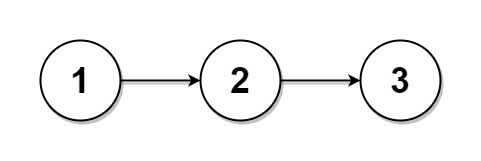
Given the head of a singly linked list and an integer k, split the linked list into k consecutive linked list parts.
The length of each part should be as equal as possible: no two parts should have a size differing by more than one. This may lead to some parts being null.
The parts should be in the order of occurrence in the input list, and parts occurring earlier should always have a size greater than or equal to parts occurring later.
Return an array of the k parts.
Example 1:
Input: head = [1,2,3], k = 5
Output: [[1],[2],[3],[],[]]
Explanation:
The first element output[0] has output[0].val = 1, output[0].next = null.
The last element output[4] is null, but its string representation as a ListNode is [].
Example 2:
Input: head = [1,2,3,4,5,6,7,8,9,10], k = 3
Output: [[1,2,3,4],[5,6,7],[8,9,10]]
Explanation:
The input has been split into consecutive parts with size difference at most 1, and earlier parts are a larger size than the later parts.
Constraints:
The number of nodes in the list is in the range [0, 1000].
0 <= Node.val <= 1000
1 <= k <= 50
Solutions
Solution 1: Simulation
Thinking
Split a list into \(k\) parts as evenly as possible, giving leftover nodes to the earlier parts. \(n\le 1000\), so count then cut.
Each part gets \(\lfloor n/k\rfloor\) nodes, and the first \(n\bmod k\) parts get one extra. Unused slots stay null.
A second walk advances the computed length, severs \(\textit{next}\), and records the next head. Two passes in all.
First, we traverse the linked list to obtain its length \(n\), and then we calculate the average length \(\textit{cnt} = \lfloor \frac{n}{k} \rfloor\) and the remainder \(\textit{mod} = n \bmod k\). For the first \(\textit{mod}\) parts, each part has a length of \(\textit{cnt} + 1\), while the lengths of the remaining parts are \(\textit{cnt}\).
Next, we just need to traverse the linked list and split it into \(k\) parts.
The time complexity is \(O(n)\), and the space complexity is \(O(k)\). Here, \(n\) is the length of the linked list.
/** * Definition for singly-linked list. * type ListNode struct { * Val int * Next *ListNode * } */funcsplitListToParts(head*ListNode,kint)[]*ListNode{n:=0forcur:=head;cur!=nil;cur=cur.Next{n++}cnt:=n/kmod:=n%kans:=make([]*ListNode,k)cur:=headfori:=0;i<k&&cur!=nil;i++{ans[i]=curm:=cntifi<mod{m++}forj:=1;j<m;j++{cur=cur.Next}next:=cur.Nextcur.Next=nilcur=next}returnans}