3071. Minimum Operations to Write the Letter Y on a Grid
SourceWeekly Contest 387 Q3DifficultyMediumRating1689
Description
You are given a 0-indexed n x n grid where n is odd, and grid[r][c] is 0, 1, or 2.
We say that a cell belongs to the Letter Y if it belongs to one of the following:
- The diagonal starting at the top-left cell and ending at the center cell of the grid.
- The diagonal starting at the top-right cell and ending at the center cell of the grid.
- The vertical line starting at the center cell and ending at the bottom border of the grid.
The Letter Y is written on the grid if and only if:
- All values at cells belonging to the Y are equal.
- All values at cells not belonging to the Y are equal.
- The values at cells belonging to the Y are different from the values at cells not belonging to the Y.
Return the minimum number of operations needed to write the letter Y on the grid given that in one operation you can change the value at any cell to 0, 1, or 2.
Example 1:
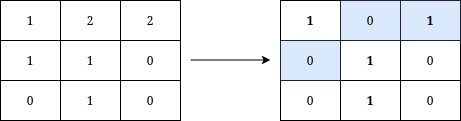
Input: grid = [[1,2,2],[1,1,0],[0,1,0]]
Output: 3
Explanation: We can write Y on the grid by applying the changes highlighted in blue in the image above. After the operations, all cells that belong to Y, denoted in bold, have the same value of 1 while those that do not belong to Y are equal to 0.
It can be shown that 3 is the minimum number of operations needed to write Y on the grid.
Example 2:
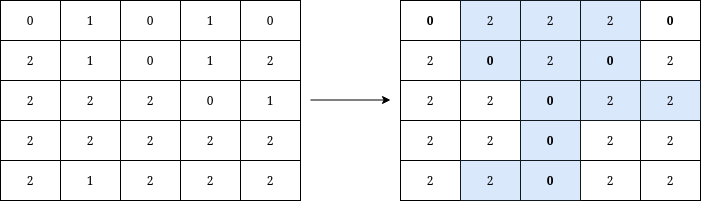
Input: grid = [[0,1,0,1,0],[2,1,0,1,2],[2,2,2,0,1],[2,2,2,2,2],[2,1,2,2,2]]
Output: 12
Explanation: We can write Y on the grid by applying the changes highlighted in blue in the image above. After the operations, all cells that belong to Y, denoted in bold, have the same value of 0 while those that do not belong to Y are equal to 2.
It can be shown that 12 is the minimum number of operations needed to write Y on the grid.
Constraints:
3 <= n <= 49n == grid.length == grid[i].length0 <= grid[i][j] <= 2nis odd.
Solutions
Solution 1: Counting
Thinking
Cells on the Y must share a value \(a\) and the rest share \(b \ne a\). \(n \le 49\) is odd, so the Y’s shape is fixed.
Once we know each color’s count on and off the Y, there are only \(3 \times 2\) pairs \((a,b)\), and the edits are \(n^2\) minus the two kept counts.
One pass splits Y versus non-Y; we then minimize \(n^2-\textit{cnt}_1[i]-\textit{cnt}_2[j]\) over \(i \ne j\).
We use two arrays of length 3, cnt1 and cnt2, to record the counts of cell values that belong to Y and do not belong to Y, respectively. Then we enumerate i and j, which represent the values of cells that belong to Y and do not belong to Y, respectively, to calculate the minimum number of operations.
The time complexity is \(O(n^2)\), where \(n\) is the size of the matrix. The space complexity is \(O(1)\).
1 2 3 4 5 6 7 8 9 10 11 12 13 14 15 16 17 | |
1 2 3 4 5 6 7 8 9 10 11 12 13 14 15 16 17 18 19 20 21 22 23 24 25 26 27 28 | |
1 2 3 4 5 6 7 8 9 10 11 12 13 14 15 16 17 18 19 20 21 22 23 24 25 26 27 28 29 | |
1 2 3 4 5 6 7 8 9 10 11 12 13 14 15 16 17 18 19 20 21 22 23 24 25 26 | |
1 2 3 4 5 6 7 8 9 10 11 12 13 14 15 16 17 18 19 20 21 22 23 24 25 26 | |