2467. Most Profitable Path in a Tree
SourceBiweekly Contest 91 Q3DifficultyMediumRating2053
Description
There is an undirected tree with n nodes labeled from 0 to n - 1, rooted at node 0. You are given a 2D integer array edges of length n - 1 where edges[i] = [ai, bi] indicates that there is an edge between nodes ai and bi in the tree.
At every node i, there is a gate. You are also given an array of even integers amount, where amount[i] represents:
- the price needed to open the gate at node
i, ifamount[i]is negative, or, - the cash reward obtained on opening the gate at node
i, otherwise.
The game goes on as follows:
- Initially, Alice is at node
0and Bob is at nodebob. - At every second, Alice and Bob each move to an adjacent node. Alice moves towards some leaf node, while Bob moves towards node
0. - For every node along their path, Alice and Bob either spend money to open the gate at that node, or accept the reward. Note that:
- If the gate is already open, no price will be required, nor will there be any cash reward.
- If Alice and Bob reach the node simultaneously, they share the price/reward for opening the gate there. In other words, if the price to open the gate is
c, then both Alice and Bob payc / 2each. Similarly, if the reward at the gate isc, both of them receivec / 2each.
- If Alice reaches a leaf node, she stops moving. Similarly, if Bob reaches node
0, he stops moving. Note that these events are independent of each other.
Return the maximum net income Alice can have if she travels towards the optimal leaf node.
Example 1:
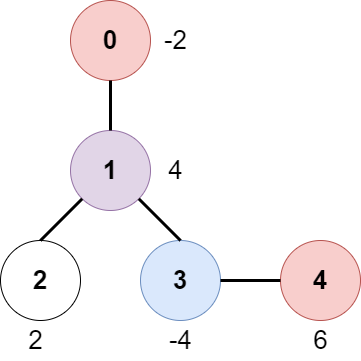
Input: edges = [[0,1],[1,2],[1,3],[3,4]], bob = 3, amount = [-2,4,2,-4,6]
Output: 6
Explanation:
The above diagram represents the given tree. The game goes as follows:
- Alice is initially on node 0, Bob on node 3. They open the gates of their respective nodes.
  Alice's net income is now -2.
- Both Alice and Bob move to node 1.
  Since they reach here simultaneously, they open the gate together and share the reward.
  Alice's net income becomes -2 + (4 / 2) = 0.
- Alice moves on to node 3. Since Bob already opened its gate, Alice's income remains unchanged.
  Bob moves on to node 0, and stops moving.
- Alice moves on to node 4 and opens the gate there. Her net income becomes 0 + 6 = 6.
Now, neither Alice nor Bob can make any further moves, and the game ends.
It is not possible for Alice to get a higher net income.
Example 2:
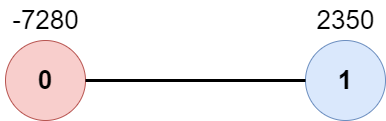
Input: edges = [[0,1]], bob = 1, amount = [-7280,2350]
Output: -7280
Explanation:
Alice follows the path 0->1 whereas Bob follows the path 1->0.
Thus, Alice opens the gate at node 0 only. Hence, her net income is -7280.
Constraints:
2 <= n <= 105edges.length == n - 1edges[i].length == 20 <= ai, bi < nai != biedgesrepresents a valid tree.1 <= bob < namount.length == namount[i]is an even integer in the range[-104, 104].
Solutions
Solution 1: Two DFS Traversals
Thinking
Bob's path is the unique \(bob\to 0\) route; Alice walks from \(0\) to a leaf. At \(n\le 10^5\), a first DFS stores Bob's arrival time \(ts\) on that path.
A second DFS from \(0\) scores a node as half if times tie, full if Alice is earlier, and zero if later. Update the answer at leaves.
According to the problem, we know that Bob's moving path is fixed, that is, starting from node \(bob\) and finally reaching node \(0\). Therefore, we can first run a DFS to find out the time it takes for Bob to reach each node, which we record in the array \(ts\).
Then we run another DFS to find the maximum score for each of Alice's moving paths. We denote the time for Alice to reach node \(i\) as \(t\), and the current cumulative score as \(v\). After Alice passes node \(i\), the cumulative score has three cases:
- The time \(t\) for Alice to reach node \(i\) is the same as the time \(ts[i]\) for Bob to reach node \(i\). In this case, Alice and Bob open the door at node \(i\) at the same time, and the score Alice gets is \(v + \frac{amount[i]}{2}\).
- The time \(t\) for Alice to reach node \(i\) is less than the time \(ts[i]\) for Bob to reach node \(i\). In this case, Alice opens the door at node \(i\), and the score Alice gets is \(v + amount[i]\).
- The time \(t\) for Alice to reach node \(i\) is greater than the time \(ts[i]\) for Bob to reach node \(i\). In this case, Alice does not open the door at node \(i\), and the score Alice gets is \(v\), which remains unchanged.
When Alice reaches a leaf node, update the maximum score.
The time complexity is \(O(n)\), and the space complexity is \(O(n)\). Here, \(n\) is the number of nodes.
1 2 3 4 5 6 7 8 9 10 11 12 13 14 15 16 17 18 19 20 21 22 23 24 25 26 27 28 29 30 31 32 33 34 35 36 37 38 | |
1 2 3 4 5 6 7 8 9 10 11 12 13 14 15 16 17 18 19 20 21 22 23 24 25 26 27 28 29 30 31 32 33 34 35 36 37 38 39 40 41 42 43 44 45 46 47 48 49 50 51 52 53 54 55 | |
1 2 3 4 5 6 7 8 9 10 11 12 13 14 15 16 17 18 19 20 21 22 23 24 25 26 27 28 29 30 31 32 33 34 35 36 37 38 39 40 41 42 43 | |
1 2 3 4 5 6 7 8 9 10 11 12 13 14 15 16 17 18 19 20 21 22 23 24 25 26 27 28 29 30 31 32 33 34 35 36 37 38 39 40 41 42 43 44 45 46 47 48 49 | |
Solution 2: Two Explicit Stacks
Thinking
Bob follows the unique path from \(bob\) to the root \(0\), and Alice walks from \(0\) to a leaf. The answer is her maximum net income. With \(n\le 10^5\), recursion along a chain uses a call depth equal to the node count and overflows Python once the chain reaches length \(1000\). The path is unique, so the search does not need to return through every frame. A stack rooted at \(0\) records each parent, and walking those parents writes Bob's arrival time into \(ts\). Every other node keeps the sentinel \(n\). Alice's score at node \(i\) depends only on her time \(t\) and \(ts[i]\), so the second walk is a pre-order stack. A popped node adds half the gate, the whole gate, or nothing. A node whose only neighbor is its parent is a leaf, and that score updates the answer.
The tree has one path from \(bob\) to \(0\). An explicit stack walks the tree from node \(0\) and records each node's parent. Walking from \(bob\) along those parents then sets \(ts\) to the step \(t\) at which Bob arrives. Nodes that are not on this path keep the initial value \(n\), meaning Bob never opens them.
A second explicit stack moves Alice from \(0\) toward a leaf. Each frame stores a node, its parent, the arrival time \(t\), and the income \(v\) collected before entering the node. After node \(i\) is popped, the income has three cases:
- The time \(t\) for Alice to reach node \(i\) is the same as the time \(ts[i]\) for Bob to reach node \(i\). In this case, Alice and Bob open the door at node \(i\) at the same time, and the score Alice gets is \(v + \frac{amount[i]}{2}\).
- The time \(t\) for Alice to reach node \(i\) is less than the time \(ts[i]\) for Bob to reach node \(i\). In this case, Alice opens the door at node \(i\), and the score Alice gets is \(v + amount[i]\).
- The time \(t\) for Alice to reach node \(i\) is greater than the time \(ts[i]\) for Bob to reach node \(i\). In this case, Alice does not open the door at node \(i\), and the score Alice gets is \(v\), which remains unchanged.
If \(i\) has only one neighbor and that neighbor is its parent, then \(i\) is a leaf and the current score updates the answer.
The time complexity is \(O(n)\), and the space complexity is \(O(n)\). Here, \(n\) is the number of nodes.
1 2 3 4 5 6 7 8 9 10 11 12 13 14 15 16 17 18 19 20 21 22 23 24 25 26 27 28 29 30 31 32 33 34 35 36 37 38 39 40 41 | |
1 2 3 4 5 6 7 8 9 10 11 12 13 14 15 16 17 18 19 20 21 22 23 24 25 26 27 28 29 30 31 32 33 34 35 36 37 38 39 40 41 42 43 44 45 46 47 48 49 50 51 52 53 54 55 | |
1 2 3 4 5 6 7 8 9 10 11 12 13 14 15 16 17 18 19 20 21 22 23 24 25 26 27 28 29 30 31 32 33 34 35 36 37 38 39 40 41 42 43 44 45 46 47 48 49 50 51 52 | |
1 2 3 4 5 6 7 8 9 10 11 12 13 14 15 16 17 18 19 20 21 22 23 24 25 26 27 28 29 30 31 32 33 34 35 36 37 38 39 40 41 42 43 44 45 46 47 48 49 50 51 52 53 54 55 56 57 | |