You are given a 0-indexed binary matrix grid. In one operation, you can flip any 1 in grid to be 0.
A binary matrix is well-isolated if there is no 1 in the matrix that is 4-directionally connected (i.e., horizontal and vertical) to another 1.
Return the minimum number of operations to make gridwell-isolated.
Example 1:
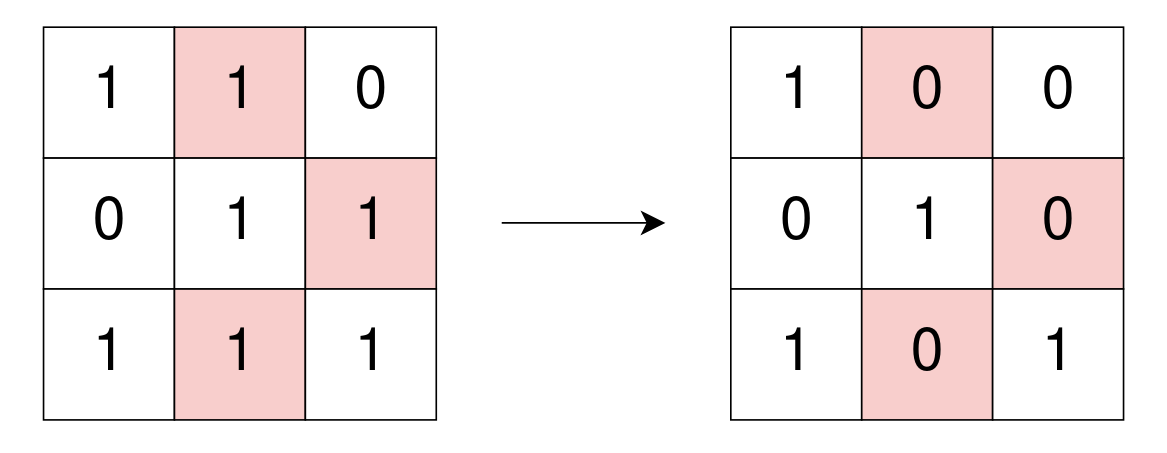
Input: grid = [[1,1,0],[0,1,1],[1,1,1]]
Output: 3
Explanation: Use 3 operations to change grid[0][1], grid[1][2], and grid[2][1] to 0.
After, no more 1's are 4-directionally connected and grid is well-isolated.
Example 2:
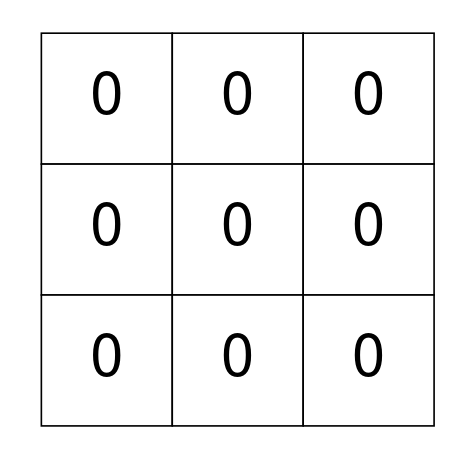
Input: grid = [[0,0,0],[0,0,0],[0,0,0]]
Output: 0
Explanation: There are no 1's in grid and it is well-isolated.
No operations were done so return 0.
Example 3:
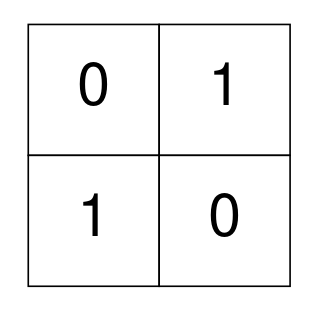
Input: grid = [[0,1],[1,0]]
Output: 0
Explanation: None of the 1's are 4-directionally connected and grid is well-isolated.
No operations were done so return 0.
Constraints:
m == grid.length
n == grid[i].length
1 <= m, n <= 300
grid[i][j] is either 0 or 1.
Solutions
Solution 1: Hungarian Algorithm
Thinking
Each operation removes one \(1\), and we must eliminate every adjacent pair of \(1\)s — a minimum vertex cover of those edges. The grid is bipartite by the parity of \(i+j\).
On a bipartite graph the minimum cover equals the maximum matching, which the Hungarian algorithm can compute for this grid size.
Connect each odd-cell \(1\) to neighboring \(1\)s and search augmenting paths; the matching size is the minimum number of operations.
We observe that if two \(1\)s in the matrix are adjacent, they must belong to different groups. Therefore, we can treat all \(1\)s in the matrix as vertices, and connect an edge between two adjacent \(1\)s to construct a bipartite graph.
Then, the problem can be transformed into finding the minimum vertex cover of a bipartite graph, which means selecting the minimum number of vertices to cover all edges. Since the minimum vertex cover of a bipartite graph equals the maximum matching, we can use the Hungarian algorithm to find the maximum matching of the bipartite graph.
The core idea of the Hungarian algorithm is to continuously search for augmenting paths starting from unmatched vertices until no augmenting path exists, which yields the maximum matching.
The time complexity is \(O(m \times n)\), where \(n\) and \(m\) are the number of \(1\)s in the matrix and the number of edges, respectively.