There is a tree (i.e., a connected, undirected graph that has no cycles) consisting of n nodes numbered from 0 to n - 1 and exactly n - 1 edges. Each node has a value associated with it, and the root of the tree is node 0.
To represent this tree, you are given an integer array nums and a 2D array edges. Each nums[i] represents the ith node's value, and each edges[j] = [uj, vj] represents an edge between nodes uj and vj in the tree.
Two values x and y are coprime if gcd(x, y) == 1 where gcd(x, y) is the greatest common divisor of x and y.
An ancestor of a node i is any other node on the shortest path from node i to the root. A node is not considered an ancestor of itself.
Return an array ans of size n, where ans[i] is the closest ancestor to node i such that nums[i]and nums[ans[i]] are coprime, or -1 if there is no such ancestor.
Example 1:
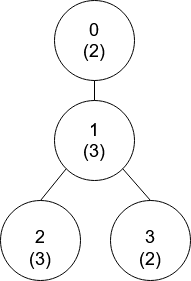
Input: nums = [2,3,3,2], edges = [[0,1],[1,2],[1,3]]
Output: [-1,0,0,1]
Explanation: In the above figure, each node's value is in parentheses.
- Node 0 has no coprime ancestors.
- Node 1 has only one ancestor, node 0. Their values are coprime (gcd(2,3) == 1).
- Node 2 has two ancestors, nodes 1 and 0. Node 1's value is not coprime (gcd(3,3) == 3), but node 0's
  value is (gcd(2,3) == 1), so node 0 is the closest valid ancestor.
- Node 3 has two ancestors, nodes 1 and 0. It is coprime with node 1 (gcd(3,2) == 1), so node 1 is its
  closest valid ancestor.
For each node we want the closest ancestor whose value is coprime with it. \(n\le 10^5\) but values lie in \([1,50]\), so one stack per value is enough.
Precompute coprime pairs in \(1..50\). During DFS, look at the stack top of every value coprime to \(nums[i]\) and take the deepest.
Push \((i,\textit{depth})\) onto the stack of \(nums[i]\) before recursing and pop afterward, so the top is always the nearest ancestor.
Since the range of \(nums[i]\) in the problem is \([1, 50]\), we can preprocess all the coprime numbers for each number and record them in the array \(f\), where \(f[i]\) represents all the coprime numbers of \(i\).
Next, we can use a backtracking method to traverse the entire tree from the root node. For each node \(i\), we can get all the coprime numbers of \(nums[i]\) through the array \(f\). Then we enumerate all the coprime numbers of \(nums[i]\), find the ancestor node \(t\) that has appeared and has the maximum depth, which is the nearest coprime ancestor node of \(i\). Here we can use a stack array \(stks\) of length \(51\) to get each appeared value \(v\) and its depth. The top element of each stack \(stks[v]\) is the nearest ancestor node with the maximum depth.
The time complexity is \(O(n \times M)\), and the space complexity is \(O(M^2 + n)\). Where \(n\) is the number of nodes, and \(M\) is the maximum value of \(nums[i]\), in this problem \(M = 50\).
For each node we want the closest ancestor whose value is coprime with it. With \(n\le 10^5\) and values in \([1,50]\), one ancestor stack per value is enough. Recursing into each child from the root is too deep: a chain makes the call depth \(n\).
Precompute coprime pairs in \(1..50\). On a visit, look at the stack top of every value coprime to \(nums[i]\) and take the deepest.
The explicit stack stores \((node, parent, depth, next child)\). Before walking to a child we push \((i,\textit{depth})\) onto the stack of \(nums[i]\) and pop it after that child is finished, so the top stays the nearest ancestor.
Since the range of \(nums[i]\) in the problem is \([1, 50]\), we can preprocess all the coprime numbers for each number and record them in the array \(f\), where \(f[i]\) represents all the coprime numbers of \(i\).
Next, an explicit stack walks the tree in preorder from the root. For each node \(i\), enumerate the values coprime to \(nums[i]\) and take the ancestor \(t\) of maximum depth among those stack tops; that is the nearest coprime ancestor. The stack array \(stks\) has length \(51\), and \(stks[v]\) records nodes of value \(v\) on the current root path together with their depths. Before walking to a child, push \((i,\textit{depth})\) onto \(stks[nums[i]]\), and pop it after that child is finished.
The time complexity is \(O(n \times M)\), and the space complexity is \(O(M^2 + n)\). Where \(n\) is the number of nodes, and \(M\) is the maximum value of \(nums[i]\), in this problem \(M = 50\).