Skip to content

1765. Map of Highest Peak

SourceBiweekly Contest 46 Q3DifficultyMediumRating1782

Description

You are given an integer matrix isWater of size m x n that represents a map of land and water cells.

  • If isWater[i][j] == 0, cell (i, j) is a land cell.
  • If isWater[i][j] == 1, cell (i, j) is a water cell.

You must assign each cell a height in a way that follows these rules:

  • The height of each cell must be non-negative.
  • If the cell is a water cell, its height must be 0.
  • Any two adjacent cells must have an absolute height difference of at most 1. A cell is adjacent to another cell if the former is directly north, east, south, or west of the latter (i.e., their sides are touching).

Find an assignment of heights such that the maximum height in the matrix is maximized.

Return an integer matrix height of size m x n where height[i][j] is cell (i, j)'s height. If there are multiple solutions, return any of them.


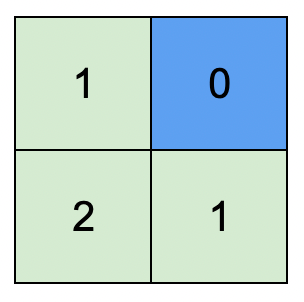
Example 1:

Input: isWater = [[0,1],[0,0]]
Output: [[1,0],[2,1]]
Explanation: The image shows the assigned heights of each cell.
The blue cell is the water cell, and the green cells are the land cells.

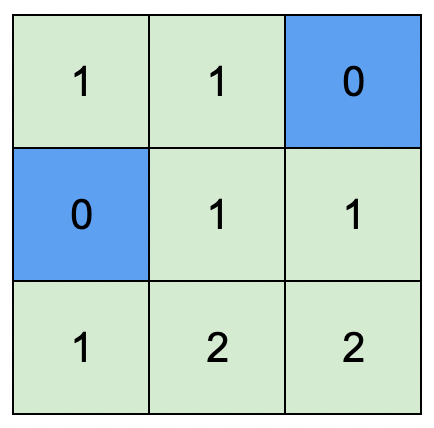
Example 2:

Input: isWater = [[0,0,1],[1,0,0],[0,0,0]]
Output: [[1,1,0],[0,1,1],[1,2,2]]
Explanation: A height of 2 is the maximum possible height of any assignment.
Any height assignment that has a maximum height of 2 while still meeting the rules will also be accepted.


Constraints:

  • m == isWater.length
  • n == isWater[i].length
  • 1 <= m, n <= 1000
  • isWater[i][j] is 0 or 1.
  • There is at least one water cell.


Note: This question is the same as 542: https://leetcode.com/problems/01-matrix/

Solutions

Solution 1

Thinking

Water cells must be height \(0\), adjacent heights differ by at most \(1\), and land should be as high as possible. The height is the distance to the nearest water.

Multi-source BFS: enqueue every water cell at \(0\), and set each unseen neighbour to the current height plus one. The distance field is the height map.

 1
 2
 3
 4
 5
 6
 7
 8
 9
10
11
12
13
14
15
16
17
18
class Solution:
    def highestPeak(self, isWater: List[List[int]]) -> List[List[int]]:
        m, n = len(isWater), len(isWater[0])
        ans = [[-1] * n for _ in range(m)]
        q = deque()
        for i, row in enumerate(isWater):
            for j, v in enumerate(row):
                if v:
                    q.append((i, j))
                    ans[i][j] = 0
        while q:
            i, j = q.popleft()
            for a, b in pairwise((-1, 0, 1, 0, -1)):
                x, y = i + a, j + b
                if 0 <= x < m and 0 <= y < n and ans[x][y] == -1:
                    ans[x][y] = ans[i][j] + 1
                    q.append((x, y))
        return ans
 1
 2
 3
 4
 5
 6
 7
 8
 9
10
11
12
13
14
15
16
17
18
19
20
21
22
23
24
25
26
27
28
class Solution {
    public int[][] highestPeak(int[][] isWater) {
        int m = isWater.length, n = isWater[0].length;
        int[][] ans = new int[m][n];
        Deque<int[]> q = new ArrayDeque<>();
        for (int i = 0; i < m; ++i) {
            for (int j = 0; j < n; ++j) {
                ans[i][j] = isWater[i][j] - 1;
                if (ans[i][j] == 0) {
                    q.offer(new int[] {i, j});
                }
            }
        }
        int[] dirs = {-1, 0, 1, 0, -1};
        while (!q.isEmpty()) {
            var p = q.poll();
            int i = p[0], j = p[1];
            for (int k = 0; k < 4; ++k) {
                int x = i + dirs[k], y = j + dirs[k + 1];
                if (x >= 0 && x < m && y >= 0 && y < n && ans[x][y] == -1) {
                    ans[x][y] = ans[i][j] + 1;
                    q.offer(new int[] {x, y});
                }
            }
        }
        return ans;
    }
}
 1
 2
 3
 4
 5
 6
 7
 8
 9
10
11
12
13
14
15
16
17
18
19
20
21
22
23
24
25
26
27
28
29
30
class Solution {
public:
    const int dirs[5] = {-1, 0, 1, 0, -1};

    vector<vector<int>> highestPeak(vector<vector<int>>& isWater) {
        int m = isWater.size(), n = isWater[0].size();
        vector<vector<int>> ans(m, vector<int>(n));
        queue<pair<int, int>> q;
        for (int i = 0; i < m; ++i) {
            for (int j = 0; j < n; ++j) {
                ans[i][j] = isWater[i][j] - 1;
                if (ans[i][j] == 0) {
                    q.emplace(i, j);
                }
            }
        }
        while (!q.empty()) {
            auto [i, j] = q.front();
            q.pop();
            for (int k = 0; k < 4; ++k) {
                int x = i + dirs[k], y = j + dirs[k + 1];
                if (x >= 0 && x < m && y >= 0 && y < n && ans[x][y] == -1) {
                    ans[x][y] = ans[i][j] + 1;
                    q.emplace(x, y);
                }
            }
        }
        return ans;
    }
};
 1
 2
 3
 4
 5
 6
 7
 8
 9
10
11
12
13
14
15
16
17
18
19
20
21
22
23
24
25
26
27
28
29
func highestPeak(isWater [][]int) [][]int {
    m, n := len(isWater), len(isWater[0])
    ans := make([][]int, m)
    type pair struct{ i, j int }
    q := []pair{}
    for i, row := range isWater {
        ans[i] = make([]int, n)
        for j, v := range row {
            ans[i][j] = v - 1
            if v == 1 {
                q = append(q, pair{i, j})
            }
        }
    }
    dirs := []int{-1, 0, 1, 0, -1}
    for len(q) > 0 {
        p := q[0]
        q = q[1:]
        i, j := p.i, p.j
        for k := 0; k < 4; k++ {
            x, y := i+dirs[k], j+dirs[k+1]
            if x >= 0 && x < m && y >= 0 && y < n && ans[x][y] == -1 {
                ans[x][y] = ans[i][j] + 1
                q = append(q, pair{x, y})
            }
        }
    }
    return ans
}
 1
 2
 3
 4
 5
 6
 7
 8
 9
10
11
12
13
14
15
16
17
18
19
20
21
22
23
24
25
26
27
28
29
30
function highestPeak(isWater: number[][]): number[][] {
    const m = isWater.length;
    const n = isWater[0].length;
    let ans: number[][] = [];
    let q: number[][] = [];
    for (let i = 0; i < m; ++i) {
        ans.push(new Array(n).fill(-1));
        for (let j = 0; j < n; ++j) {
            if (isWater[i][j]) {
                q.push([i, j]);
                ans[i][j] = 0;
            }
        }
    }
    const dirs = [-1, 0, 1, 0, -1];
    while (q.length) {
        let tq: number[][] = [];
        for (const [i, j] of q) {
            for (let k = 0; k < 4; k++) {
                const [x, y] = [i + dirs[k], j + dirs[k + 1]];
                if (x >= 0 && x < m && y >= 0 && y < n && ans[x][y] == -1) {
                    tq.push([x, y]);
                    ans[x][y] = ans[i][j] + 1;
                }
            }
        }
        q = tq;
    }
    return ans;
}
 1
 2
 3
 4
 5
 6
 7
 8
 9
10
11
12
13
14
15
16
17
18
19
20
21
22
23
24
25
26
27
28
29
30
31
32
33
34
35
36
37
38
39
40
41
42
43
44
45
46
47
48
49
use std::collections::VecDeque;

impl Solution {
    #[allow(dead_code)]
    pub fn highest_peak(is_water: Vec<Vec<i32>>) -> Vec<Vec<i32>> {
        let n = is_water.len();
        let m = is_water[0].len();
        let mut ret_vec = vec![vec![-1; m]; n];
        let mut q: VecDeque<(usize, usize)> = VecDeque::new();
        let vis_pair: Vec<(i32, i32)> = vec![(-1, 0), (1, 0), (0, -1), (0, 1)];

        // Initialize the return vector
        for i in 0..n {
            for j in 0..m {
                if is_water[i][j] == 1 {
                    // This cell is water, the height of which must be 0
                    ret_vec[i][j] = 0;
                    q.push_back((i, j));
                }
            }
        }

        while !q.is_empty() {
            // Get the front X-Y Coordinates
            let (x, y) = q.front().unwrap().clone();
            q.pop_front();
            // Traverse through the vis pair
            for d in &vis_pair {
                let (dx, dy) = *d;
                if Self::check_bounds((x as i32) + dx, (y as i32) + dy, n as i32, m as i32) {
                    if ret_vec[((x as i32) + dx) as usize][((y as i32) + dy) as usize] == -1 {
                        // This cell hasn't been visited, update its height
                        ret_vec[((x as i32) + dx) as usize][((y as i32) + dy) as usize] =
                            ret_vec[x][y] + 1;
                        // Enqueue the current cell
                        q.push_back((((x as i32) + dx) as usize, ((y as i32) + dy) as usize));
                    }
                }
            }
        }

        ret_vec
    }

    #[allow(dead_code)]
    fn check_bounds(i: i32, j: i32, n: i32, m: i32) -> bool {
        i >= 0 && i < n && j >= 0 && j < m
    }
}

Solution 2

Thinking

Solution 2 is the same multi-source BFS, popping an explicit layer size. The algorithm and complexity are unchanged.
 1
 2
 3
 4
 5
 6
 7
 8
 9
10
11
12
13
14
15
16
17
18
19
class Solution:
    def highestPeak(self, isWater: List[List[int]]) -> List[List[int]]:
        m, n = len(isWater), len(isWater[0])
        ans = [[-1] * n for _ in range(m)]
        q = deque()
        for i, row in enumerate(isWater):
            for j, v in enumerate(row):
                if v:
                    q.append((i, j))
                    ans[i][j] = 0
        while q:
            for _ in range(len(q)):
                i, j = q.popleft()
                for a, b in pairwise((-1, 0, 1, 0, -1)):
                    x, y = i + a, j + b
                    if 0 <= x < m and 0 <= y < n and ans[x][y] == -1:
                        ans[x][y] = ans[i][j] + 1
                        q.append((x, y))
        return ans
 1
 2
 3
 4
 5
 6
 7
 8
 9
10
11
12
13
14
15
16
17
18
19
20
21
22
23
24
25
26
27
28
29
30
class Solution {
    public int[][] highestPeak(int[][] isWater) {
        int m = isWater.length, n = isWater[0].length;
        int[][] ans = new int[m][n];
        Deque<int[]> q = new ArrayDeque<>();
        for (int i = 0; i < m; ++i) {
            for (int j = 0; j < n; ++j) {
                ans[i][j] = isWater[i][j] - 1;
                if (ans[i][j] == 0) {
                    q.offer(new int[] {i, j});
                }
            }
        }
        int[] dirs = {-1, 0, 1, 0, -1};
        while (!q.isEmpty()) {
            for (int t = q.size(); t > 0; --t) {
                var p = q.poll();
                int i = p[0], j = p[1];
                for (int k = 0; k < 4; ++k) {
                    int x = i + dirs[k], y = j + dirs[k + 1];
                    if (x >= 0 && x < m && y >= 0 && y < n && ans[x][y] == -1) {
                        ans[x][y] = ans[i][j] + 1;
                        q.offer(new int[] {x, y});
                    }
                }
            }
        }
        return ans;
    }
}
 1
 2
 3
 4
 5
 6
 7
 8
 9
10
11
12
13
14
15
16
17
18
19
20
21
22
23
24
25
26
27
28
29
30
31
32
class Solution {
public:
    const int dirs[5] = {-1, 0, 1, 0, -1};

    vector<vector<int>> highestPeak(vector<vector<int>>& isWater) {
        int m = isWater.size(), n = isWater[0].size();
        vector<vector<int>> ans(m, vector<int>(n));
        queue<pair<int, int>> q;
        for (int i = 0; i < m; ++i) {
            for (int j = 0; j < n; ++j) {
                ans[i][j] = isWater[i][j] - 1;
                if (ans[i][j] == 0) {
                    q.emplace(i, j);
                }
            }
        }
        while (!q.empty()) {
            for (int t = q.size(); t; --t) {
                auto [i, j] = q.front();
                q.pop();
                for (int k = 0; k < 4; ++k) {
                    int x = i + dirs[k], y = j + dirs[k + 1];
                    if (x >= 0 && x < m && y >= 0 && y < n && ans[x][y] == -1) {
                        ans[x][y] = ans[i][j] + 1;
                        q.emplace(x, y);
                    }
                }
            }
        }
        return ans;
    }
};
 1
 2
 3
 4
 5
 6
 7
 8
 9
10
11
12
13
14
15
16
17
18
19
20
21
22
23
24
25
26
27
28
29
30
31
func highestPeak(isWater [][]int) [][]int {
    m, n := len(isWater), len(isWater[0])
    ans := make([][]int, m)
    type pair struct{ i, j int }
    q := []pair{}
    for i, row := range isWater {
        ans[i] = make([]int, n)
        for j, v := range row {
            ans[i][j] = v - 1
            if v == 1 {
                q = append(q, pair{i, j})
            }
        }
    }
    dirs := []int{-1, 0, 1, 0, -1}
    for len(q) > 0 {
        for t := len(q); t > 0; t-- {
            p := q[0]
            q = q[1:]
            i, j := p.i, p.j
            for k := 0; k < 4; k++ {
                x, y := i+dirs[k], j+dirs[k+1]
                if x >= 0 && x < m && y >= 0 && y < n && ans[x][y] == -1 {
                    ans[x][y] = ans[i][j] + 1
                    q = append(q, pair{x, y})
                }
            }
        }
    }
    return ans
}

Comments