You are given an array pairs, where pairs[i] = [xi, yi], and:
There are no duplicates.
xi < yi
Let ways be the number of rooted trees that satisfy the following conditions:
The tree consists of nodes whose values appeared in pairs.
A pair [xi, yi] exists in pairsif and only ifxi is an ancestor of yi or yi is an ancestor of xi.
Note: the tree does not have to be a binary tree.
Two ways are considered to be different if there is at least one node that has different parents in both ways.
Return:
0 if ways == 0
1 if ways == 1
2 if ways > 1
A rooted tree is a tree that has a single root node, and all edges are oriented to be outgoing from the root.
An ancestor of a node is any node on the path from the root to that node (excluding the node itself). The root has no ancestors.
Example 1:
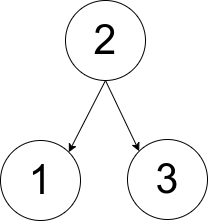
Input: pairs = [[1,2],[2,3]]
Output: 1
Explanation: There is exactly one valid rooted tree, which is shown in the above figure.
Example 2:
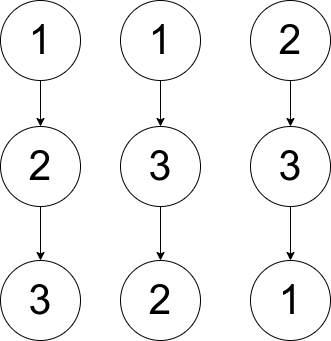
Input: pairs = [[1,2],[2,3],[1,3]]
Output: 2
Explanation: There are multiple valid rooted trees. Three of them are shown in the above figures.
Example 3:
Input: pairs = [[1,2],[2,3],[2,4],[1,5]]
Output: 0
Explanation: There are no valid rooted trees.
Constraints:
1 <= pairs.length <= 105
1 <= xi < yi <= 500
The elements in pairs are unique.
Solutions
Solution 1
Thinking
Pairs encode ancestry: an edge exists iff one node is an ancestor of the other. We must report whether \(0\), \(1\), or more than one rooted tree fits.
Larger pair-degree means closer to the root. Sort nodes by degree; a node's parent candidate is a neighbour of no-smaller degree.
The candidate must be adjacent to every neighbour of the node. More than one node without a parent is impossible. Equal degrees on a parent-child pair yield multiple trees; otherwise exactly one.