1518. Water Bottles
SourceWeekly Contest 198 Q1DifficultyEasyRating1245
Description
There are numBottles water bottles that are initially full of water. You can exchange numExchange empty water bottles from the market with one full water bottle.
The operation of drinking a full water bottle turns it into an empty bottle.
Given the two integers numBottles and numExchange, return the maximum number of water bottles you can drink.
Example 1:
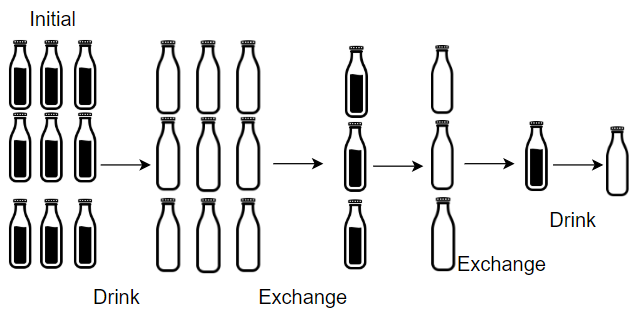
Input: numBottles = 9, numExchange = 3
Output: 13
Explanation: You can exchange 3 empty bottles to get 1 full water bottle.
Number of water bottles you can drink: 9 + 3 + 1 = 13.
Example 2:
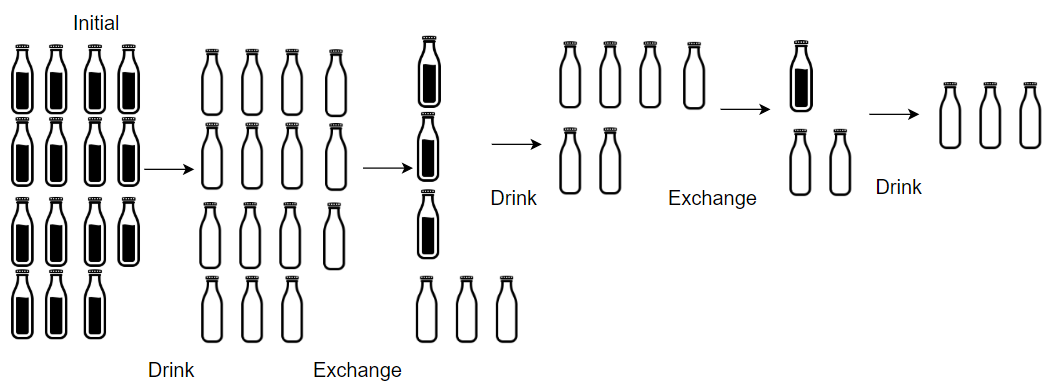
Input: numBottles = 15, numExchange = 4
Output: 19
Explanation: You can exchange 4 empty bottles to get 1 full water bottle.
Number of water bottles you can drink: 15 + 3 + 1 = 19.
Constraints:
1 <= numBottles <= 1002 <= numExchange <= 100
Solutions
Solution 1
Thinking
Empty bottles exchange for a full one every \(numExchange\) empties; we want the total number drunk. The values are small enough to simulate each exchange rather than seek a closed form.
Drink the initial \(numBottles\) first. Whenever the empty count is at least the rate, spend \(numExchange\) empties for one full bottle; after drinking it, the empty count falls by \(numExchange-1\) and the answer grows by one. Stop when a further exchange is impossible.
1 2 3 4 5 6 7 | |
1 2 3 4 5 6 7 8 9 | |
1 2 3 4 5 6 7 8 9 10 | |
1 2 3 4 5 6 7 | |
1 2 3 4 5 6 7 | |
1 2 3 4 5 6 7 8 9 10 11 12 | |
1 2 3 4 5 6 7 8 9 10 11 12 13 14 15 | |